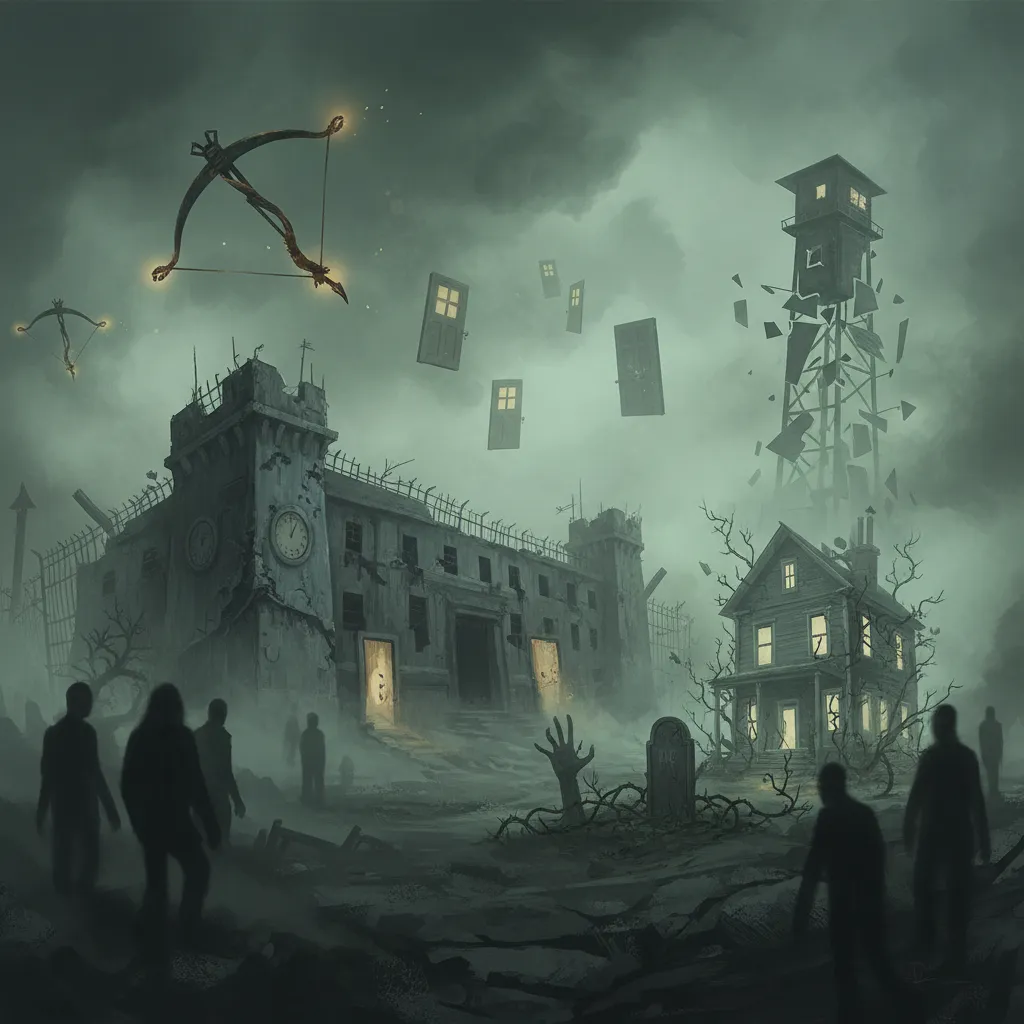
The exhaustion we feel toward the zombie is not a saturation of content, but the terror of the conceptual displacement—the slow, inevitable realization that the schizo-flow of pure annihilation has been systematically re-coded back into a marketable, controllable spectacle.
The debate over the "authenticity" of the zombie—whether it shuffles in the tradition of Romero or sprints with the vitality of the infected—is merely a superficial argument about the velocity of the deterritorialization. The core problem, so exquisitely highlighted in S3E10 "Home," is the obstinate refusal of the survivor’s psyche to embrace the Body-without-Organs (BwO) that the apocalypse promises. Rick Grimes and his desperate clinging to the Prison’s concrete geometry are the perfect cinematic demonstration of the neurotic’s last stand against the molecular chaos of the outside, a final, self-destructive attempt to force the universe’s limitless flux back into the suffocating cage of bourgeois stratification (Deleuze & Guattari, 1983).
The Suburban Machine vs. The Urban Flow: A Pathology of Values
The question of Rick's leadership failure is fundamentally a geographical one: the tragedy of the suburban desiring-machine. The suburbs were never built to produce survival; they were engineered to produce repressed contentment and the rigid, artificial safety of the Oedipal family unit. The suburban terrain is a smooth space overlaid with the densest possible molar stratification—rules about lawn height, neighborhood watch, and the absolute denial of the "eat or be eaten" truth that pulsates beneath the asphalt.
The hypothetical "Urban Rick," exposed to the ruthless flow of survival intrinsic to the city's perpetual, high-velocity exchange—where the libidinal energy of the crowd is already geared toward immediate struggle and the constant, violent negotiation of territory—would have been spiritually prepared for the apocalypse. His Character Armor (Reich, 1972) would be thinner, his ethical machine already calibrated to the schizo-logic of becoming-animal.
But the Rick we see is the Suburban Administrator who survived the trauma only to attempt a massive re-territorialization of the nuclear family ideal within the Prison's walls. His descent into psychosis, marked by the persistent, unanswerable voice of Lori—the Symbolic Signifier of the failed domestic debt—is the final, desperate effort of the Repressive Code to maintain its grip. The ghost is not grief; it is the Law itself, ringing on a dead line, consuming all of Rick’s available desire-flow and paralyzing his capacity for effective political action (Žižek, 2008). He is the Suicide King, not by choice, but by the psychic necessity of his own repressed suburban neurosis. He cannot detach from the archaic Oedipal debt because the suburban landscape never taught him how to live in the flux of absolute risk.
The Zombie: From Pure Deterritorialization to Capitalist Re-coding
The critique of zombie displacement—the slippage from the Romero shuffling archetype to the hyper-sexualized, romantic, or sprinting iteration—is a perfect schizoanalytic observation of the capitalist machine’s genius for re-coding.
The Romero zombie, the slow, mindless flow of decay, is the purest cinematic realization of the BwO's terrifying potential. It is an undifferentiated dead-flow that lacks all utility, lacking memory, purpose, or speed. It is a slow, relentless deterritorialization of all social meaning. It does not chase money, power, or even revenge; it simply is the molecular decay of flesh and the irreversible dissolution of the subject into the collective, consuming swarm. This is the truth the genre machine fears.
The contemporary, "Twilighted" zombie—the one that runs, loves, or exhibits residual cognitive function—is a necessary re-territorialization. It restores the subject to the flow of exchange. A running zombie reintroduces the Action-Image (Deleuze, 1989), allowing for traditional cinematic narrative based on speed, chase, and counter-action. A loving zombie re-inscribes the Oedipal romance, making the monster palatable, available for libidinal investment, and thus, marketable. The market cannot tolerate the pure, non-productive BwO; it must always find a way to make it useful—even if that utility is just the production of disposable spectacle.
The Walking Dead operates in a treacherous interstitial space. It retains the aesthetic of the slow, classic flow of the BwO (the shuffling mass) but immediately caps and re-codes its dramatic flow onto human neurotic conflict. The plot is driven not by the zombies’ overwhelming flow, but by Rick's trauma, Lori's betrayal, or the Governor's territorial rage. The walkers are relegated to being mere environmental noise, the raw material of the schizo-landscape used only to externalize human neurosis. The show uses the aesthetics of deterritorialization (the crumbling world) to justify the persistence of stratification (the endless debate over who is moral, who is leader, who deserves to be in the family).
The Prison: A Body Under Attack
The Prison is the ultimate machinic assemblage of the survivors' repressed desire for stability. It is the hard shell, the Character Armor made external, designed to seal off the molar assemblage (the group) from the schizo-flow of the outside world.
The Governor's retaliatory attack in "Home" is not merely a military invasion; it is the calculated deployment of a nomadic war-machine designed to shatter this stratification. The assault—swift, brutal, and targeted at the perimeter—is an attempt to force the Prison's occupants into their own lines of flight. The destruction of the watchtowers and the bus crashing through the fence are literal manifestations of the flow of chaos invading the carefully structured territorial body. The fortress-BwO has been breached.
Crucially, the attack is designed to activate Rick's psychic collapse. By bringing the violence right up to the boundary, it forces him to choose between the internal, paralyzing voice of the Oedipal Signifier (Lori) and the external, immediate, material threat to the territorial body. This is the moment of evental pressure (Badiou, 2005): the external truth demands a Subjective response, but the Subject (Rick) is still consumed by the internal lie.
His withdrawal, his inability to command or even perceive the threat until it is already inside, is the abdication of the administrator. Rick is allowing the Psychic Stratum to override the Political Stratum. He is, in this moment, a failed desiring-machine, incapable of connecting the sensory input (the gunfire) to the productive output (the defense). This paralysis is a form of suicide of the Code—he would rather see the territory destroyed than surrender the comfort of his internalized grief-machine.
The Crisis of the Missing Flow: Daryl's Return and the New Assemblage
The departure and subsequent return of Daryl Dixon is the episode's crucial moment of re-coding. Daryl, the pure nomadic element, the becoming-wolf who exists through affective intensity and utility rather than ethical code, had briefly followed Merle, the Arch-Territorial kin-figure, back to the archaic familial flow.
His return to the Prison is a conscious rejection of that re-territorialization. It is the affirmation of a new, emerging molecular assemblage—the group—over the molar, biological debt of blood. Daryl comes back not because he has been convinced of Rick’s moral superiority, but because the flow of loyalty and shared struggle with the new group has proven to be a stronger desiring-production than the destructive, regressive flow of kinship with Merle.
This influx of Daryl's productive schizo-energy—his uninhibited connection to the war-machine—is what finally forces Rick out of his paralysis. Rick is forced to witness the necessary deterritorialization of his own authority. He has failed, and the group must operate without him, or else die.
The episode ends with the group huddled together, not in victory, but in a forced re-calibration. They are building a new, minoritarian machine out of the shattered pieces of the old one. This machine is defined not by the bourgeois values of the suburban past (the Lori-ghost), but by the necessity of the present: the pure will-to-power (Nietzsche, 1968) channeled into collective defense and the immediate, brutal logic of survival. The zombie flow continues, but the group has learned, painfully, that the only true protection is the constant, fluid deterritorialization of their own fixed concepts of self and society. They must become what they fight: a relentless, uncoded force of the outside that refuses to be stratified by the ghosts of the past. The suburbs are dead; the prison is shattered; the only remaining truth is the flow.
References
Badiou, A. (2005). Being and event. (O. Feltham, Trans.). Continuum.
Deleuze, G. (1989). Cinema 2: The time-image. (H. Tomlinson & R. Galeta, Trans.). University of Minnesota Press.
Deleuze, G., & Guattari, F. (1983). Anti-Oedipus: Capitalism and schizophrenia. (R. Hurley, M. Seem, & H. R. Lane, Trans.). University of Minnesota Press.
Nietzsche, F. (1968). The will to power. (W. Kaufmann, Ed., & W. Kaufmann & R. J. Hollingdale, Trans.). Vintage Books.
Reich, W. (1972). Character analysis. (V. R. Carfagno, Trans.). Farrar, Straus and Giroux.
Žižek, S. (2008). The sublime object of ideology. Verso.
Comments
Post a Comment