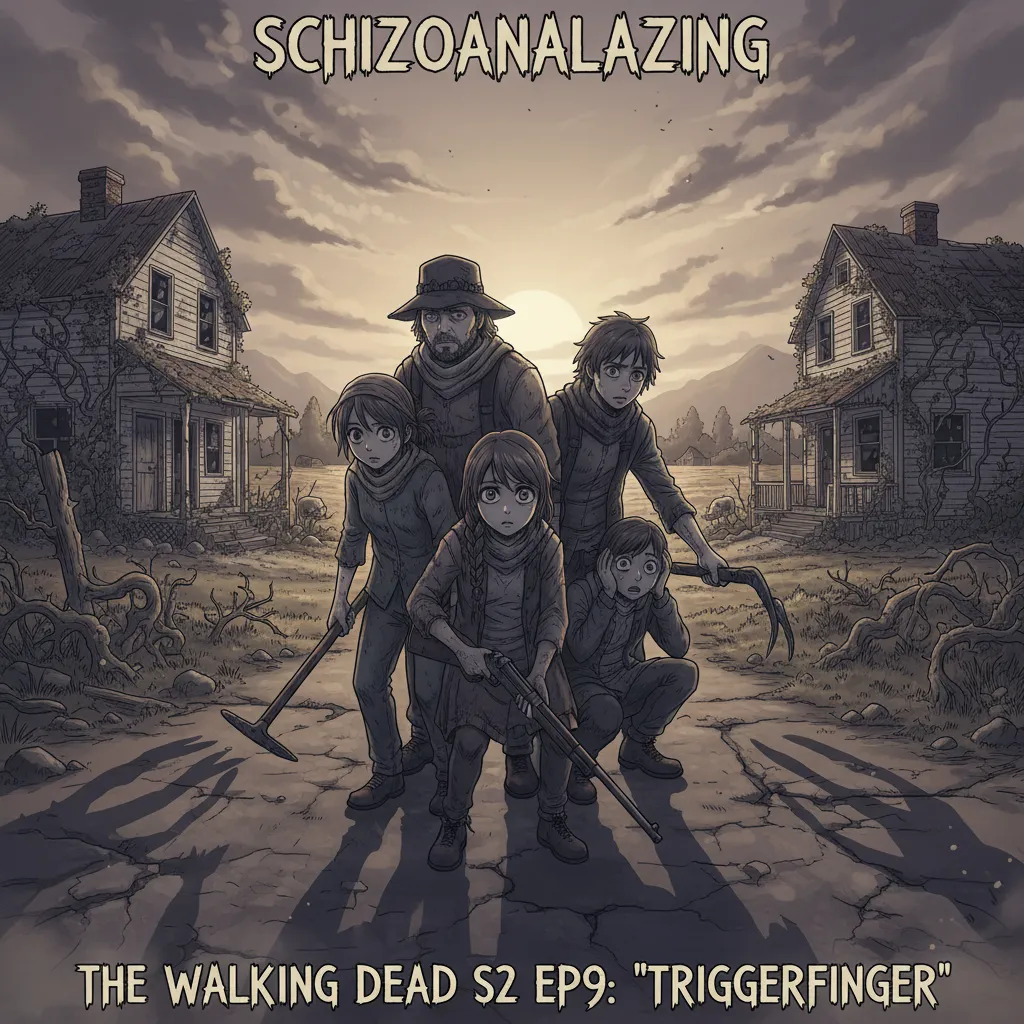
Welcome to our journey into the guts of The Walking Dead. What kind of journey? A philosophical, psychoanalytical, and political kind. What I would like to do over the next couple months is dig thought the Walking Dead episode by episode to see what it can teach us. Thank you for following me on this journey. I look forward to reading your comments. Be forewarned: There are spoilers everywhere. Don’t forget to check out my previous article in the Philosophizing TWD series: Schizoanalyzing TWD S2E8 "Nebraska"
The insult, a blunt instrument wielded in the name of civility, echoes across the pre-apocalyptic world and into the shattered remnants of civilization: "I agree with your point, but I don't like how you say it." Here, Shane, perpetually on the knife-edge of pragmatic brutality, and by extension, our own radical critiques pushing for molecular political change, become similarly targeted. This targeting is enacted by the cowardly altruists, those figures who, terrified of conflict, have internalized the mistaken notion that social change, or indeed, any decisive action, must be performed in a way that meticulously protects everyone's feelings. To be fair, this position is not altruism in its entirety; it's its shadow, its necrotic tail—a form of political cowardice that actively impedes the necessary flows of desire for survival and transformation. Let’s put this on an Aristotelian spectrum, as you suggest, and get sawing, slicing through the ideological strata of this moral impasse.
The concept of altruism, in its varied definitions, can stretch from radical selflessness to a generalized concern for the well-being of others. However, for our schizoanalytic mapping, we define altruism as the ideology where an individual or group desires to push for the simultaneous positive gains of everyone at once. This ideal, while possessing a superficial sheen of universal benevolence, becomes a dangerous, even malignant, desiring-machine when confronted with the raw, deterritorialized flows of the zombie apocalypse. We oppose this ideal to two other, deeply problematic forms of its deployment: "us vs. them" altruism, and "naive altruism." These aren't just ethical positions; they are territorializations of desire, attempting to impose rigid codes onto the molecular chaos of existence.
"Us vs. them" altruism is a personalized, highly stratified flow, based on an unstated premise within the ideology itself. It defines existence through a rigid binary of in-groups and out-groups. Compassion, resources, and even the very concept of "humanity" are confined to the designated "us," while "them" fall outside this protective circuit. Essentially, it's altruism for us and not for them. A chilling example from our recent history is George Bush II’s declaration of the "War on Terror." The unspoken presupposition here was clear: this was a fight for the sake of the United States, a reterritorialization of global conflict onto a nationalistic Body-without-Organs (BwO) of self-interest. The same critical mirror would not be held up to our own country, nor would it pursue "white terrorists" with the same fervor, or apply its lens to complex conflicts like Israel and Palestine. The war on terror was focused on benefiting "us" over "them," and crucially, on negating the humanhood of "them." When the US military fails to count civilian casualties from drone strikes, they are not simply failing to report; they are actively deterritorializing the victims' humanity, negating their right to be recognized as human and included in the "us." This negation is a profound act of molecular violence, a severing of potential connections and flows, ensuring that the desiring-machine of national security can operate unhindered by empathy. This mirrors Freud's concept of the "narcissism of minor differences" (Freud, Group Psychology and the Analysis of the Ego, 1922), but amplified to a global, geopolitical scale, creating vast zones of non-being for those outside the designated "us."
On the far left of this spectrum, we find "naive altruism." This ideology attempts to sweep all humanity into one vast, undifferentiated basket, seeking to promote all human good at once. The obvious problem, a glaring break in its theoretical flow, is its presupposition of a class- and color-blind universe, one that views the world as if it has magically become post-racial and post-class. Justifying, by thought alone, that all of humanity deserves and should achieve positive gain simultaneously, is a beautiful idea, but one fundamentally unmoored from reality. It is the ideology of "do-gooders" who operate under the paralyzing belief that it is possible to always and necessarily act in a way that causes no one even the slightest bit of negative harm, down to simply hurting feelings. This stance becomes a form of political paralysis, a refusal to engage with the raw flows of desire that are inherently contradictory and often violent. Andrea’s argument to Shane is the perfect articulation of this "do-gooder" ethos:
Andrea: "Have you ever considered a lighter touch? ...abandoning the search for Sophia... taking out the walkers in the barn... lying to Lori today... Those were all the right calls, it's your presentation that leaves something to be desired." (The Walking Dead (TV Series 2010–) IMDb, 2014).
Andrea's words are a revelation of political cowardice disguised as ethical concern. She concedes that Shane's actions were "the right calls"—pragmatically necessary for survival—but condemns his "presentation." This is a terrifying inversion of priorities. It reveals a profound terror of the raw, deterritorializing force of necessary action, preferring the appearance of benevolence over its often difficult, visceral execution. Andrea embodies a neurotic fixation on social decorum, even as the very fabric of society has been torn apart, replaced by the relentless desiring-machines of zombie hunger. This isn't altruism; it's a crippling anxiety, a psychological paralysis that masquerades as moral superiority. It actively obstructs any true line of flight towards radical survival. As Zizek (2001) might contend, this "lighter touch" ideology functions as a fetish, allowing Andrea to avoid the "unbearable truth" of necessary brutality by clinging to the "lie" of polite conduct.
Who, then, navigates this treacherous ethical terrain? Rick and Daryl. Both characters, though flawed and often brutal, maintain a precarious, yet vital, balance between these two extremes. For example, in "Triggerfinger," Rick throws himself and others into danger to save a punk who was just shooting at him. Rick here is balancing the "Us-as-everyone" (the lingering aspiration of the idealized cop, a pre-apocalyptic desiring-machine of public service, a ghost of the Body-without-Organs (BwO) of a functioning society) and the "us-as-them-vs-us" (the pure self-interest of the group, recognizing the strategic value of a hostage to potentially avoid future danger). This is not pure, naive altruism, nor is it brutal indifference. It is a strategic, molecular altruism, an understanding of the interconnectedness of potential threats and resources, even when those resources are initially hostile. It is an improvisation, a new kind of ethical assemblage, constantly reconfigured in the heat of immediate threat. This dynamic interplay between universalist ideals and pragmatic self-preservation reflects Nietzsche's (1886) concept of the "will to power" in its most nuanced form: not simply brute force, but the constant striving and re-evaluation of values to affirm life in the face of chaos.
The question I raised in my post about "Nebraska" was what kind of culture is most appropriate for the end of the world? This is also a question of leadership, of how the desiring-machines of social organization are to be assembled. What kind of leadership is most appropriate for the end of the world? Is it the ruthless clarity of the "them vs. us" approach that takes decisive action to protect a group? Or the fluffy flower-child leader who wants to hug all the zombies to alleviate their suffering, thereby disavowing the very essence of the zombie's destructive flow? Or, is it the self-interest altruist, like Rick, who seeks a pragmatic balance, understanding that survival, and therefore any ethical action, requires a constant negotiation of these conflicting flows? Wilhelm Reich (1972) might suggest that authentic social change, or survival in this context, demands a dismantling of ideological "character armor" that prevents genuine engagement with reality, whether that armor is naive altruism or pure self-interest. Rick and Daryl, in their often-brutal pragmatism, are closer to this unarmored engagement with the raw flows of life and death, constantly building new desiring-machines of survival, even if they appear messy, violent, and devoid of "lighter touches." The true political courage, it seems, lies not in pleasing everyone, but in daring to make the "right call," even when its presentation leaves something to be desired by those still clinging to a dead world's politeness. The revolutionary becoming in the apocalypse is not found in polite discourse, but in the brutal, yet necessary, acts that safeguard the possibility of future desire.
References
Badiou, A. (2001). Ethics: An Essay on the Understanding of Evil. Verso.
Deleuze, G., & Guattari, F. (1983). Anti-Oedipus: Capitalism and Schizophrenia. University of Minnesota Press.
Freud, S. (1922). Group Psychology and the Analysis of the Ego. The Standard Edition of the Complete Psychological Works of Sigmund Freud, Volume XVIII. (Various editions).
Nietzsche, F. (1886). Beyond Good and Evil: Prelude to a Philosophy of the Future. (Various editions).
Reich, W. (1972). Character Analysis (3rd ed.). Farrar, Straus and Giroux.
The Walking Dead (TV Series 2010–) IMDb. (2014). Retrieved 15 May 2014, from http://www.imdb.com/title/tt1520211/
Zizek, S. (2001). The Fetish. Cabinet Magazine, 2. Retrieved from http://www.cabinetmagazine.org/issues/2/western
Comments
Post a Comment