Welcome to our journey into the guts of The Walking Dead. What kind of journey? A philosophical, psychoanalytical, and political kind. What I would like to do over the next couple months is dig thought the Walking Dead episode by episode to see what it can teach us. Thank you for following me on this journey. I look forward to reading your comments. Be forewarned: There are spoilers everywhere. Don’t forget to check out my previous article in the Philosophizing TWD series: Philosophizing The Walking Dead S2E7 Pretty Much Dead Already and Post-Apocalyptic Group Therapy
The world, already a screaming Desiring-Machine of flesh, blood, and deterritorialized violence, finds pockets of resistance in the form of hyper-structured Territories. Hershel’s farm is precisely such a Territory, attempting to impose a domestic, agrarian code onto the raw, molecular chaos of the zombie event. Yet, this code is not built on survival; it is built on a monumental fetish. A fetish, that strange, delicate knot woven by the psyche, designed to hold the unbearable at bay. It's a conceptual hinge, a point where psychic flow is violently reterritorialized onto a specific object or idea to sustain a protective delusion. For Hershel, the barn is the ultimate Organ of denial, a literal container for the unbearable truth: his family members are dead, consumed by the zombified machine ([Deleuze & Guattari, Anti-Oedipus, p. 19]).
The very fabric of the farm's reality, its social and psychological strata, is predicated on the maintenance of this fetish. By clinging to the fiction that his relatives are merely "sick" and treatable, Hershel enacts a profound act of transubstantiation. He converts the chaotic, necrotic flow of the zombie plague—the ultimate deterritorialization of the human body—into a manageable, pastoral flow of care, a domestic ritual of feeding chickens and locking barn doors. This conversion is not just a coping mechanism; it is the entire engine of his sanity, and, by extension, the tenuous peace on the farm. Zizek (2001) argues compellingly that the fetish is the necessary Lie—a crucial tool for the “thorough realist” to manage the full impact of an unbearable truth. Hershel’s realism is only possible because he clings to the barn and its inhabitants as the embodiment of this disavowal. The barn is not a symptom disturbing the surface; it is, strikingly, the symptom's inverse, the very structure that sustains the false appearance, successfully blocking the repressed Other Scene of trauma. This is where the ideological knot tightens, binding the collective: the delusion becomes the unspoken price of group cohesion and psychological survival on the farm. The living family members, seeing the zombified ones contained and fed, can successfully postpone the immense work of mourning and the inevitable dissolution of their familiar, pre-apocalyptic familial structures. They invest in the fiction, not because they are inherently deluded, but because the alternative is a psychological void, a terrifying Body-without-Organs (BwO) of raw, unmediated grief.
What, then, is this trauma that the fetish so desperately guards? Hershel's denial is a refusal to accept the molecular breakdown of the human form and the irrevocable loss of social connection that the zombies represent. It is a refusal of the world's new, horrific code. Freud, in his early work on fetishism, identified it as a means of disavowing a traumatic perception, a way to maintain contradictory beliefs simultaneously (Freud, 1927). Here, the trauma is not just the death of loved ones, but the death of an entire world's meaning. The farm, with its barn, becomes a miniature, highly organized Oedipal machine, attempting to re-establish a familial order (father, mother, children—even if dead) against the chaotic, non-Oedipal flows of the zombie apocalypse. It's a desperate attempt to re-stratify the molecular flows of death back into legible, mourn-able categories. Wilhelm Reich (1972) might see this as a form of character armor, but instead of protecting an individual ego, it protects a collective, familial ego, shielding it from the "psychic plague" of total disintegration.
The barn is not merely a physical structure; it is a desiring-production unit. It produces "not-dead" family members, emotional stability, and a narrative of hope, however false. This production requires a constant input of repression, a perpetual reterritorialization of truth into comforting lie. The problem, as it always is with such precarious ideological constructions, is that the external reality, the outside of the fetish, is a relentless force of deterritorialization. No matter how fervently Hershel's sentimentality envelops his zombified family, it cannot alter the fundamental truth: they will eat his face if given the chance. This is the truth that Nietzsche (1886) might identify as the raw, unfiltered "will to power" of the zombified being—a primal, unmediated drive for consumption that mocks all human codes of sentiment and family.
The mass shooting at the barn, therefore, precipitates not just a tragedy, but a sudden, violent deterritorialization of Hershel’s entire psychic apparatus. The zombies, the Organized Body of his delusion, are ripped apart, collapsing the fetishistic structure that had so carefully housed his trauma. This is the schizophrenic break that the Oedipal machine of the farm had so desperately sought to prevent.
When the objects of denial are literally perforated by bullets, Hershel's world doesn't just crumble; it psychologically disassembles. The trauma—the original inability to mourn, the fundamental rupture with the world's previous meaning—erupts simultaneously with the re-traumatization of seeing those bodies finally destroyed. The sudden, forced destruction of the fetish pushes Hershel onto a direct Line of Flight towards the Body-without-Organs (BwO)—the raw, unstratified, intensity-driven body stripped of all organization and sense. Alain Badiou (2001) might view this moment as an Event, a rupture that fundamentally reconfigures the existing situation, demanding a new fidelity to a truth that was previously obscured.
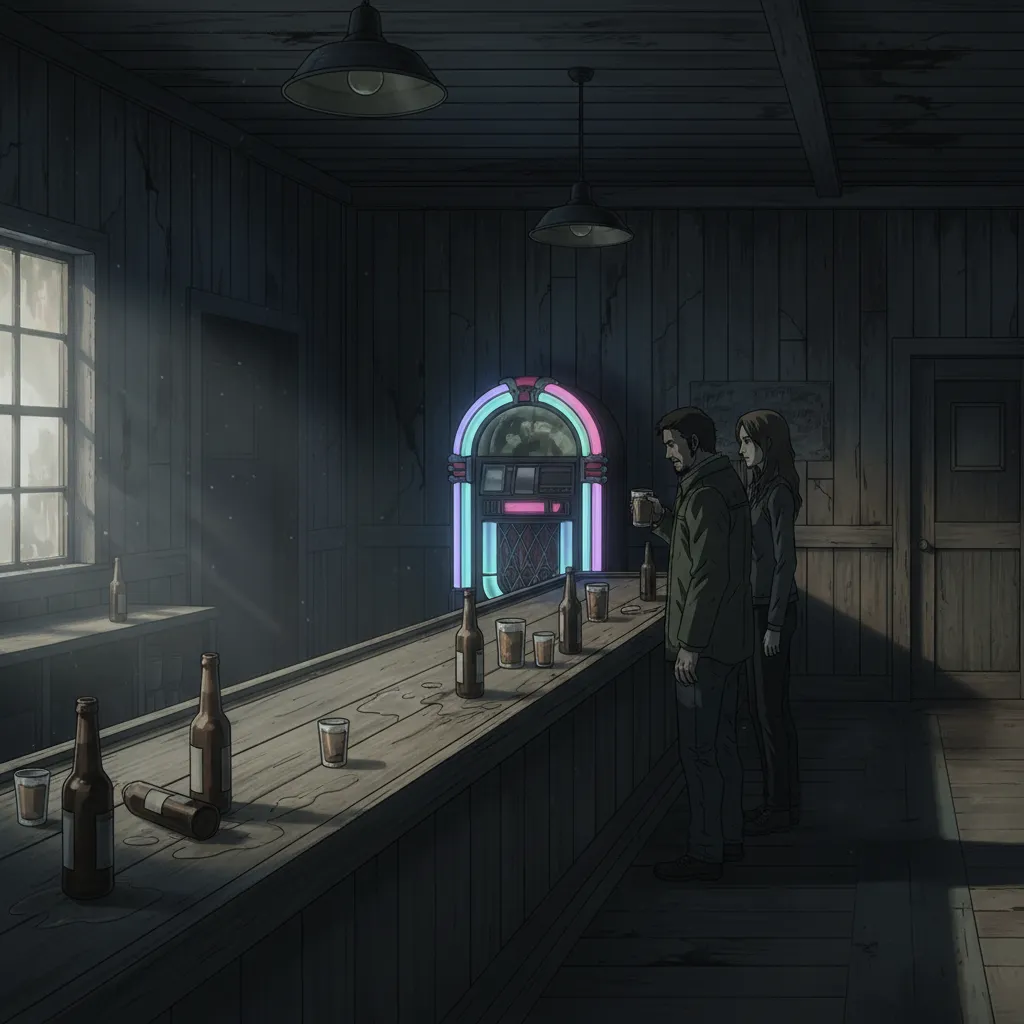
Hershel's subsequent flight into the bar in "Nebraska" is his frantic attempt to disassemble the idea that structured his reality. He moves from the highly structured, agrarian territory of the farm (the Organized Body ruled by his delusion) to a purely intensive space—the bar—where alcohol offers a chemical, temporary form of the BwO: a fluid, unstructured state of refusal and dissolution. He is refusing the new code of survival, refusing the necessary grief, and refusing the world's new organizational logic. He is, in effect, trying to become-fluid, to flow away from the unbearable solidity of his shattered belief system.
The violence of Rick's action at the barn, while pragmatic and seemingly driven by a "realistic" assessment of the threat, functions schizoanalytically as an act of becoming-revolutionary—a necessary, brutal intervention to smash the prevailing code (the Hershel Family Code) that was preventing any true engagement with the new reality. This explosion clears the land, but leaves Hershel floating, unmoored from the social body, forced to confront the pure, un-coded flow of death that he had so desperately tried to contain within four wooden walls. His trauma, now freed from the repository of the barn, rushes into the present, forcing an agonizing and necessary confrontation with the raw facts of the zombie machine. This forced deterritorialization is not gentle; it is a violent liberation into a chaotic truth, where the only path forward is to build new machines of desire, or succumb to the pure, unorganized flows of despair.
References
Badiou, A. (2001). Ethics: An Essay on the Understanding of Evil. Verso.
Deleuze, G., & Guattari, F. (1983). Anti-Oedipus: Capitalism and Schizophrenia. University of Minnesota Press.
Freud, S. (1927). Fetishism. The Standard Edition of the Complete Psychological Works of Sigmund Freud, Volume XXI (1927-1931): The Future of an Illusion, Civilization and Its Discontents, and Other Works, 147-157.
Nietzsche, F. (1886). Beyond Good and Evil: Prelude to a Philosophy of the Future. (Various editions).
Reich, W. (1972). Character Analysis (3rd ed.). Farrar, Straus and Giroux.
Zizek, S. (2001). The Fetish. Cabinet Magazine, 2. Retrieved from http://www.cabinetmagazine.org/issues/2/western
Comments
Post a Comment