The moment of creative blockage is never purely psychological; it is the sound of the State Apparatus of thought arresting a deterritorialized flow, insisting that consciousness be coded and contained.
The Nausea of Choice: Writing Block as Oedipal Paralysis
The subjective experience of being "stuck"—the self-consciousness, the feeling of not reading enough, the nausea before the Netflix menu—is the neurosis manufactured by the Oedipal machine of late capital. Your struggle to write is the exact, molecular diagram of the group’s struggle to lead in the apocalypse: a conflict between the will to flow and the paralyzing demand for Stratification.
The internal fight is not a lack of content, but a failure of desiring-production. Your mind, as Nietzsche observed, is a political arena (Nietzsche, 1887, p. 78), but the inclination that takes power is rarely the pure Will to Power. Instead, it is the voice of the Super-Ego (Freud, 1961, p. 13), the internalized father-figure of academic expectation, insisting that your output must be authorized by sufficient reading and coherent structure.
The paralysis induced by the endless choice menu—the "gnawing sensation" that there are no surprises left—is the ultimate proof of ontological insecurity (Laing, 1960, p. 39). When the self lacks a substantial sense of its own reality, it cannot risk choosing, for the choice itself might reveal the hollowness beneath. The subject becomes consumed by the Divided Self, where the "observing self" constantly critiques the "acting self," preventing the initiation of the necessary line of flight (Deleuze & Guattari, 1983, p. 203) into pure creation. The failure to choose is the Oedipal apparatus sealing the borders, preventing the flow of content from escaping the neurotic territory of the writer’s guilt.
The repeated cycle of "I start, I stop, and I start again" is the sound of your internal desiring-machine attempting to short-circuit the Oedipal code, only to be dragged back by the gravitational pull of Character Armor (Reich, 1972, p. 182). Your body—the physical action of checking the phone, the difficulty making the time—is literally enacting a muscular armor against the potential rupture of creation. To write the deterritorialized critique, you must first deterritorialize your own writing process.
The Farm as the Oedipal Apparatus: Hershel's Failed Stratification
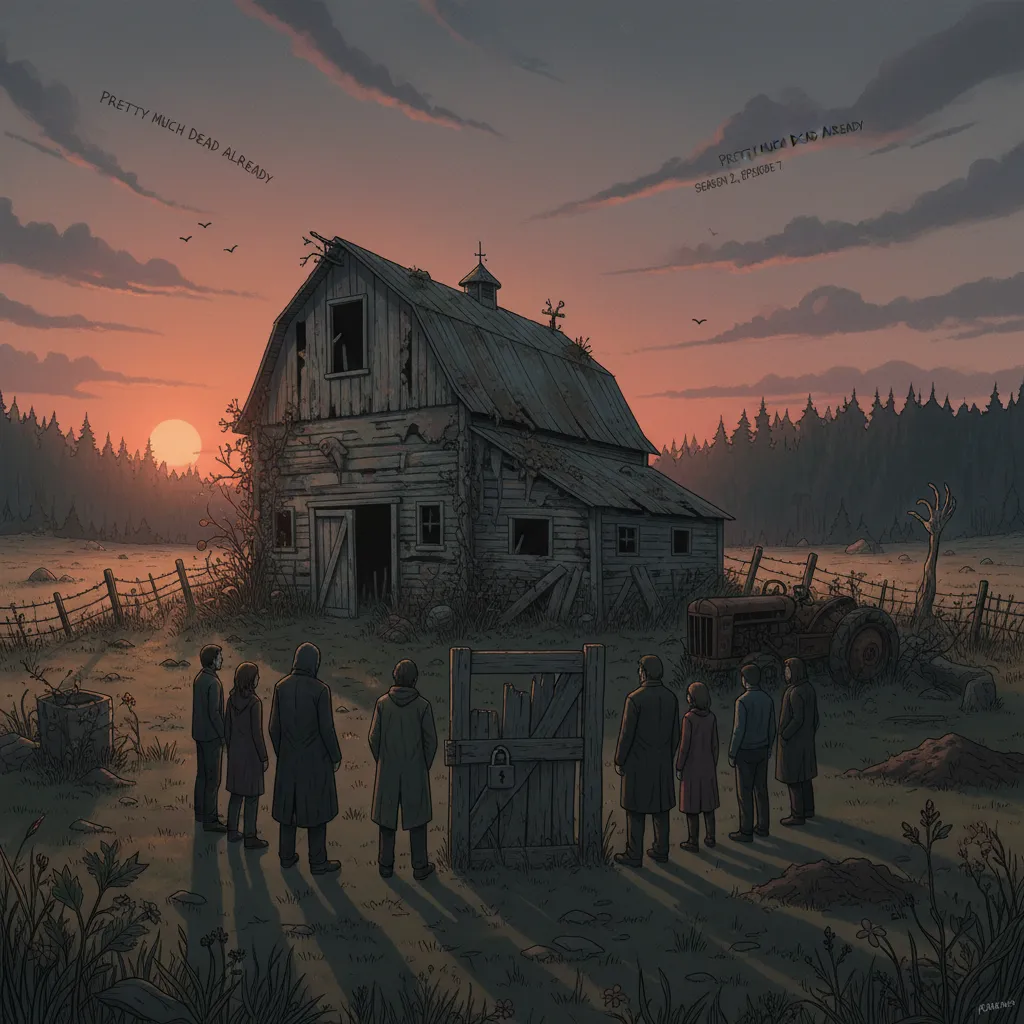
The narrative of "Pretty Much Dead Already" is generated by the collision of two fundamentally opposed desiring-machines: the Nomadic War-Machine of Rick and Shane, and the State Apparatus embodied by Hershel’s farm.
Hershel’s farm is not merely a safe haven; it is a profound act of reterritorialization onto a defunct, pre-apocalyptic coding. It is a nostalgic Oedipal structure where the dead (zombies) are treated as unruly, sick children to be contained, rather than as the molecular flow of chaos they actually represent. This refusal to acknowledge the death of the old world (the "everything turns out OK" ideology) is the ultimate maladaptive collective ideology you identified.
Stratified Code (Hershel) | Deterritorialized Flow (Zombies) | Oedipal Function |
|---|---|---|
The Barn | The captured, moaning dead. | The Container (The Family Cell) that attempts to privatize the flow of death, treating the apocalypse as a temporary fever. |
Hope/Normality | The uncodable, viral principle of the walkers. | The Suture (Deleuze & Guattari, 1983, p. 237) that attempts to sew the political reality of chaos back into the domestic fabric of a farm. |
Hershel's Authority | Shane’s impatience/Rick’s pragmatic violence. | The State Apparatus of thought, suppressing the line of flight that demands the annihilation of the old scripts. |
Hershel’s attempt to "cattle drive zombies" into a barn is the most potent schizoanalytic diagram in the episode. It is the political economy of the farm attempting to code the uncodable. The zombies, as pure flow, should be annihilated or utilized in a nomadic strategy (as you noted, for camouflage). Instead, Hershel attempts to domesticate death, forcing the chaotic flow of the walkers to submit to the stratification of the farm’s architecture. This is the neurotic mechanism of society writ large: taking the pure, terrifying energy of desire (the schizoid flow) and forcing it into the manageable, symbolic territory of the Oedipal family. Hershel is attempting to impose a collective character armor (Reich) onto the entire group, protecting them not from the walkers, but from the brutal truth of their own liberation.
The Will to Power and the Collision of Desiring-Machines
The conflict between Rick and Shane is the central engine of the group’s desiring-machine, where Nietzsche’s internal political arena is externalized into open conflict.
Shane, operating from a position of ontological hyper-insecurity (Laing), exhibits a frantic, muscular Character Armor (Reich) that manifests as aggression and impatience. His internal fight is a direct, short-circuiting impulse: immediate survival at any cost. This is the line of flight expressed as pure, cynical pragmatism. He attempts to exert his Will to Power not through reasoned argument, but through affective intensity—instilling distrust to deterritorialize Rick's existing authority and replace it with his own. He is the war-machine struggling against the State-form that Rick, however reluctantly, represents.
Rick, conversely, operates with a reactive Will to Power. His actions are initially dictated by the demands of the social body (protecting the group, ensuring their stay on the farm). His decision to side with Hershel against his own better judgment ("Collecting zombies like Pokémon isn't a safe thing to do") is not weakness; it is a complex political move: a temporary reterritorialization designed to achieve a higher political objective (stability). Rick is engaging in a miniature Hegelian Dialectic (Hegel, 1807, p. 115): he submits to the Thesis (Hershel's authority) only to secure the Antithesis (the safety of his family), aiming for a Synthesis (a new, viable social structure). This grants him the "larger leeway" you observed, allowing him to code his actions as serving the group, even when they appear strategically flawed.
The group, in its own ontological insecurity, grants authority to the leader who best addresses their need for a sublime object of ideology (Žižek, 1989, p. 53). Hershel provides hope; Rick provides pragmatic protection; Shane provides violent, cathartic decisiveness.
Sophia's Eruption: The Schizophrenic Intervention
The moment Sophia shambles out of the barn is the Great Deterritorialization of Season 2. It is the moment the Oedipal Machine explodes.
The Collapse of Signification: The group "freezes in indecision." This is the collective reaching a state of Body-without-Organs (BwO)—a temporary zero-point where the Oedipal coding of language, morality, and social role completely fails. They are no longer subjects who act; they are simply bodies witnessing an uncodable event. The previous narratives—search, hope, find—all collapse into the singular, horrifying image of the child-walker.
The Evental Rupture: Sophia is the living proof that the barn's stratification failed. She is the snake escaping the bag, the flow demanding liberation. Her presence is the evental rupture (Badiou, 2005, p. 43) that demands the group choose between the old, repressive scripts (hope) and the new, terrible reality (death).
The Anti-Therapeutic Act: Rick shooting Sophia is the schizophrenic intervention. It is a violent, singular decision that acts not as a therapy to heal the group’s delusion, but as a shock to shatter it. You are absolutely correct: this action short-circuited a maladaptive collective ideology. It destroys the collective character armor by forcing them to look at the sublime object of their own repressed truth. This act is the terrifying moment of critical consciousness (Freire, 1970, p. 35) being achieved through violence—the oppressed confronting the ultimate reality of their oppression by the viral flow of death. The bullet is the line of flight that irrevocably separates the survivors from the "old notions and norms."
5. The Schizoid Exodus: Beyond the Therapeutic Lie
The opening critique of therapy—the priest seeking God in the gaps, the shrink seeking biology—is precisely the Oedipal apparatus at work. Both seek to reterritorialize the chaotic flow of human suffering into a manageable code: sin (theological code) or maladaptive neural pathways (scientific code). Neither path affirms the schizophrenic truth: that the woman's self-deprecating thoughts might be a completely valid, even rational, machine-production generated by her repressive social environment.
The therapist's intervention seeks to short-circuit the pathways to reach a "less troublesome state of being." But the schizoanalyst does not seek a "less troublesome state." The schizoanalyst seeks becoming-revolutionary—a state where the flow is liberated, not managed.
The Walking Dead demands this same Schizoid Exodus. The moment of Sophia's death is the end of group therapy. It is the refusal to submit to the Oedipal promise of order. The most valuable insight—that the "giant pile of zombies in a barn is a good deterrent"—is an understanding achieved only after the ideological stratification of the barn is destroyed. It is a nomadic truth that can only be generated on the smooth space outside the farm's failed State-form.
Your creative blockage, the group’s indecision, and Hershel’s farm are all the same problem: the desire to be contained. The path forward—for the writer, for Rick's group, and for the critique—is to affirm the nomadic existence (Nietzsche, 1887), to treat the struggle as productive, and to let the flows of concept and cinematic image run wild until the plastic membrane of sense finally tears.
References (APA Style)
Badiou, A. (2005). Ethics: An Essay on the Understanding of Evil. (P. Hallward, Trans.). Verso.
Deleuze, G. (1989). Cinema 2: The Time-Image. (H. Tomlinson & R. Galeta, Trans.). University of Minnesota Press.
Deleuze, G., & Guattari, F. (1983). Anti-Oedipus: Capitalism and Schizophrenia. (R. Hurley, M. Seem, & H. R. Lane, Trans.). University of Minnesota Press.
Freire, P. (1970). Pedagogy of the Oppressed. (M. B. Ramos, Trans.). Herder and Herder.
Freud, S. (1961). Civilization and Its Discontents. (J. Strachey, Ed. and Trans.). W. W. Norton & Company.
Hegel, G. W. F. (1807). Phenomenology of Spirit. (A. V. Miller, Trans., 1977). Oxford University Press.
Laing, R. D. (1960). The Divided Self: An Existential Study in Sanity and Madness. Pantheon Books.
Nietzsche, F. (1887). On the Genealogy of Morality. (W. Kaufmann, Trans.). Random House.
Reich, W. (1972). Character Analysis. (V. R. Carfagno, Trans.). Farrar, Straus and Giroux.
Žižek, S. (1989). The Sublime Object of Ideology. Verso.
Comments
Post a Comment