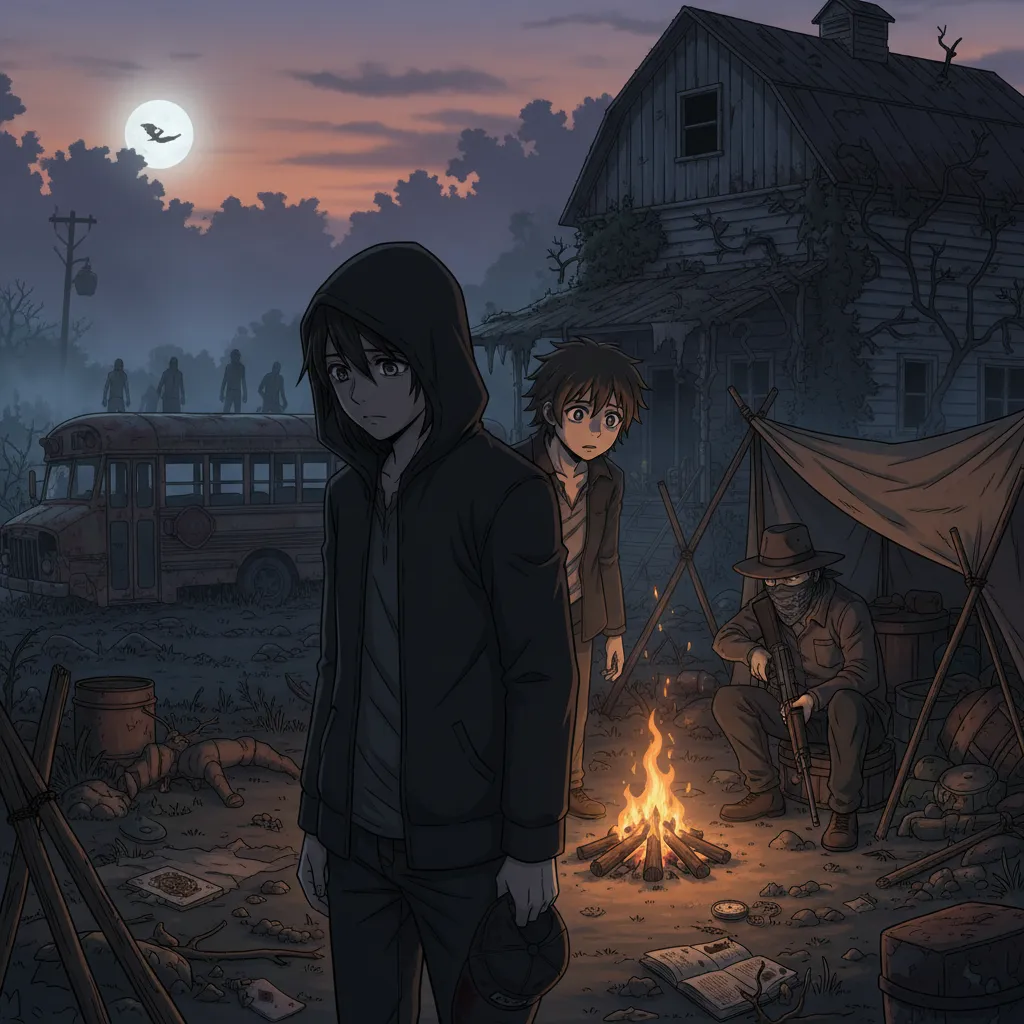
The social machine, even in the apocalypse, cannot cease to function; it merely changes the currency it trades in. The old currency was dollars; the new currency is secrets and lies, the compressed, unstable energy packets that create the illusion of social cohesion. We must follow this flow of deception as it deterritorializes the human face and stratifies the body into a surface of hidden intentions.
The world has become a vast, schizo-economic landscape where reality is not an objective constant but a fragile equilibrium maintained by mutually beneficial fictions. The question is not, "What is the right truth?" but rather, "Which lie produces the most necessary flow of collective desire?"
I. The Lie as Desiring-Production: Lori, Shane, and the Flow of Power
Lori Grimes is the ultimate, non-heroic subject of this political economy of desire. Her actions are not guided by morality but by the pure calculus of self-preservation—a terrifying, molecular rationality. The text observes: she is otherwise inept at surviving, thus she must move a man in her life to protect her. This is not simply a feminine trope; it is the instantaneous creation of a desiring-machine based on the scarcity of safety. She must wrap her legs around the closest alpha male (Shane) to secure her safety, establishing a circuit of libidinal-protection.
This transactional coupling is instantly complicated by Shane’s lie about Rick’s death. Shane’s lie is the prime mover in this episode’s machinic assembly. It is a calculated reterritorialization of Lori’s desire onto his own body, which functions as a truth effect. Shane’s deception doesn't merely convey false information; it creates a space where Lori’s feelings for him could develop, validating his aggressive, uncompromising selfhood.
Lori and Shane are caught in a subtle dialectic where Lori is the medium of exchange (conceptual synthesis of Deleuze & Guattari, 1983). Shane, the Id-Machine (Freud, 1961) whose actions are governed by raw instinct, uses the lie to channel Lori's libidinal flow towards himself. His lie functions as a Despotic Signifier that encodes her choice, allowing her to cling to the man who “doesn't need her approval, or reassurance to bolster his self-esteem.” This appeals to Lori because she is exhausted by the neurotic demands of Rick’s fractured ego (as analyzed in previous episodes). Shane's Character Armor (Reich, 1949), forged in violence, offers the illusion of impenetrable stability.
Lori’s subsequent lie to Rick about the affair is equally machinic. It is not shame but a survivalist algorithm: avoid the conflict that would put both men into a fight to the death. This move, "a smart move that avoided conflict which may have left her with one man to protect her instead of two," is the pure function of the socius attempting to maintain its population density and labor pool. The lie is the lubricant that prevents the desiring-machines (Rick’s leadership and Shane’s brute force) from locking up in a mutually destructive embrace.
II. Hershel's Barn: The Stagnant Flow and the Political Axiom of Exclusion
Parallel to Lori’s domestic deception, Hershel maintains his lie by omission concerning the walkers in the barn. This secret is an entirely different order of deception: it is a Molar lie designed to preserve an axiomatic truth—the fiction that the old world's codes of sanctity and life can still be applied to the new reality.
Hershel believes the walkers are merely the sick, awaiting cure, or the peacefully departed. The barn is his reterritorialization of the hospital, the church, and the family mausoleum. He attempts to halt the chaotic, destructive flow of the zombie virus by containing it within a physical, symbolic structure. “The socius is precisely what blocks the flow, what prevents the coupling of desiring-machines in the open field, by recording and repressing them within specific codes” (Deleuze & Guattari, 1983, p. 30). Hershel’s lie is the code; the barn is the recording surface. He is repressing the truth of the world’s fundamental molecular fragmentation to maintain the stability of his own ontological security (Laing, 1960).
The conflict between Hershel's stagnant Molar-Machine (the barn as a symbol of denial) and the molecular flow of the survivors’ pragmatic desire (to eliminate threat) is inevitable.
III. The Unraveling: Lies as the Event and the Subject’s Rupture
The unraveling of the lies is not a moment of moral catharsis; it is a deterritorializing event—a moment where the foundational fictions that structured the group’s reality are violently snapped.
Maggie’s Confrontation (Glenn’s Subjection): Lori forces Glenn, the most molecular and least armored subject, to procure abortion pills. This is a cruel stratification of Glenn's desire, turning his newfound agency (from the well-walker event) into an unwilling instrument of Lori’s neurosis. When Maggie confronts Lori, the flow of complicity is revealed.
The Barn Truth (Dale’s Neurosis): Glenn, unable to bear the weight of Hershel’s secret, becomes a conduit, relaying the knowledge to Dale. Dale, the group’s resident Super-Ego (Freud, 1961) and guardian of the old morality, confronts Hershel. The pressure of the secreted flow becomes too great, and the Axiom of Exclusion must break.
Rick’s Discovery (The Ego’s Collapse): Rick finds the morning-after pills. The lie is no longer a verbal statement but a material object—a pharmaceutical signifier of betrayal. When Lori confronts Rick about Shane, and finds out he already knew, the Oedipal fantasy that Rick has clung to—Rick the loving husband of a faithful wife, spiting oblivion—disintegrates.
This collapse aligns perfectly with Alain Badiou’s concept of the Truth-Event. The Event is the coming to light of an indiscernible of the times (Badiou, 2005, p. 17). The infidelity and the abortion pills were always part of the set of the survivors, but they were indiscernible, un-named multiples. When the lies unravel, they become manifest; they become the Truth of the collective’s being.
Rick’s identity is founded on a fiction—the fiction of his perfect leadership and domestic unity. “Truth, the kind of truth that matters, is not when we are able to identify reality from fiction, but when the difference between reality and fiction does not matter because we are fully invested into the fiction that structures reality.” Rick uses Lori as the object to justify his self-confidence, making her the neurotic medium of his self-esteem. When the tie that binds his self-sense to the world is snapped, he enters a state of profound fragmentation—a new line of flight of pure anxiety.
The episode leaves the survivors on a fragmented plane of possibility, where the Character Armor of the old world (Rick’s moral superiority, Hershel’s sanctity) has been irrevocably shattered by the molecular flow of lies. The truth is that there is no truth outside of the fictions we create to survive the absurdity (Camus, 1991). The revolution must begin here: on the shattered surface of the lie, where the subject must be re-produced not by the code of others, but by the relentless, self-affirming production of their own desires and their own meaning.
Comments
Post a Comment