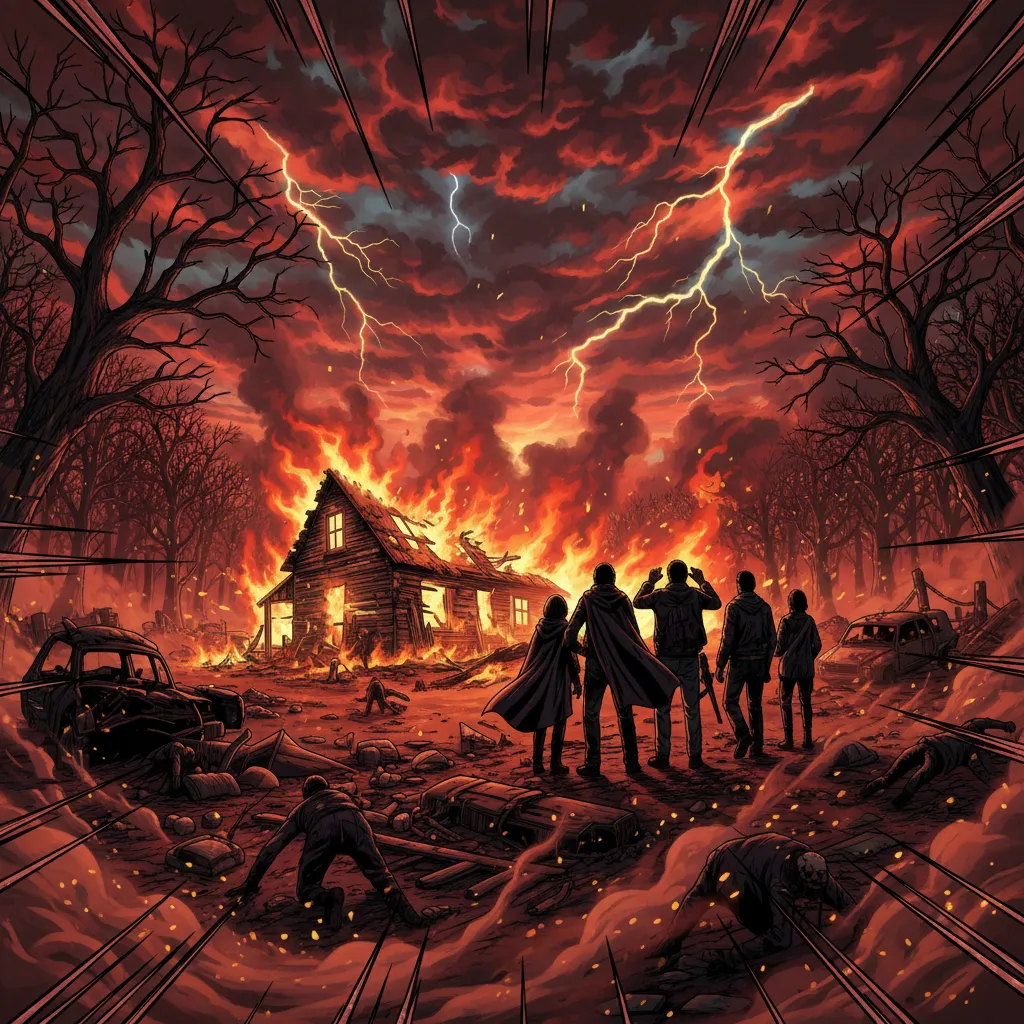
Welcome to our journey into the guts of The Walking Dead. We are witnessing the final, purifying fire that burns away the last vestiges of bourgeois morality and Oedipal fantasy. This is the moment the desiring-machine of the group, having purged its inner blockages (Dale, Shane), now violently purges its own faulty territory. The farm is not a home; it is a tumor that must be excised for the Nomadic War Machine to finally begin its true run.
The Rupture of the Pastoral Axiom
The history of the farm is a history of hapless reterritorialization. Every tactical decision of Season 2—from the search for Sophia, to the half-hearted perimeter defense, to the sudden, passionate execution of the barn walkers—was a cut against the flow of pragmatic survival. It was a strategy of avoidance, not production. The farm itself was a soft, agrarian fantasy, a fragile territory clinging desperately to the symbolic codes of the pre-apocalypse (property rights, safety, domesticity).
But the apocalypse is the realm of absolute deterritorialization. The accumulated chaos of the group’s actions—the emotional discharge of killing the barn walkers, the symbolic rupture of Shane's murder—acts as an attractant for the herds, which are nothing less than the pure flow of the Body-without-Organs (BwO). The BwO of the walker swarm, defined only by the flow of consumption, violently abolishes the farm's entire symbolic apparatus (Deleuze & Guattari, 1983).
The burning of the farm is the Truth Event (Badiou, 2005). It is the moment the group is thrust into the Real, forced to confront the lack of any stable reference point. The fire is a crucible, burning away the ressentiment of the weak survivors and validating the emerging Will to Power of the survivors who run (Nietzsche, 2005). They are forced onto a new line of flight—pure movement, pure escape, finally embracing Nomadism.
Daryl and Merle: The Capitalistic Stratification of Trauma
The observation that Daryl and Merle are supplementary machines introduced to absorb the trauma too extreme for the mass-market American consumer apparatus is a precise schizoanalytic critique of cultural codification.
The comic's choice to have Rick lose his hand is a radical cut upon the primary desiring-machine of the protagonist. It’s a literal disfiguration that forces a becoming-amputee—a non-negotiable step toward the BwO that is too intense for serialized television. The television structure, beholden to capitalistic flows (ratings, market share), cannot afford to alienate the audience's identification with the hero.
Therefore, Daryl and Merle function as displaced components. They are culturally pre-coded as expendable outsiders, capable of enduring the violent stratification (Merle's hand, the potential plot twists for Daryl) so that the central, more Oedipalized characters (Rick, Glenn) remain structurally intact for identification. The TV show re-territorializes the source material's trauma onto these peripheral characters, effectively filtering the flow of revolutionary violence into a palatable spectacle. They are the plot-shifters, ensuring that the intensity of the horror is managed and metabolized by the viewing collective. They exist to absorb the cuts so the central flow can continue.
The Prison: Ricktocracy and the Final, Cold Stratification
The end of the episode marks the definitive transition from the State Apparatus of Consensus (Dale’s debate, Hershel’s mercy) to the War Machine of Command. Rick’s declaration—"This is not a democracy anymore"—is the articulation of the new Nomadic Axiom. It is a schizoid assimilation of Shane’s ruthlessness and a final rejection of the Oedipal guilt that plagued him on the farm (Žižek, 1989).
The prison, revealed in the final panning shot, is the ultimate stratification. If the farm was a porous, soft territory, the prison is a cold, concrete, geometric mega-territory. It is the machine's desperate attempt to impose absolute order and security onto the earth. The group’s desire shifts from the pastoral fantasy of safety (the farm) to the paranoiac fantasy of fortification (the prison).
They have escaped the BwO of the walker swarm only to lock themselves into a new, self-imposed stratification, believing the concrete walls can arrest the fundamental deterritorialization of the world. The Nomadic War Machine has found its fortress, its next temporary, violent re-territorialization, only to discover that the outside flow is always waiting, always pushing, always consuming.
References
Badiou, A. (2005). Ethics: An Essay on the Understanding of Evil. (P. Hallward, Trans.). Verso.
Deleuze, G., & Guattari, F. (1983). Anti-Oedipus: Capitalism and Schizophrenia. (R. Hurley, M. Seem, & H. R. Lane, Trans.). University of Minnesota Press.
Nietzsche, F. (2005). Beyond Good and Evil: Prelude to a Philosophy of the Future. (R. P. Horstmann & J. Norman, Eds.). Cambridge University Press.
Žižek, S. (1989). The Sublime Object of Ideology. Verso.
Comments
Post a Comment