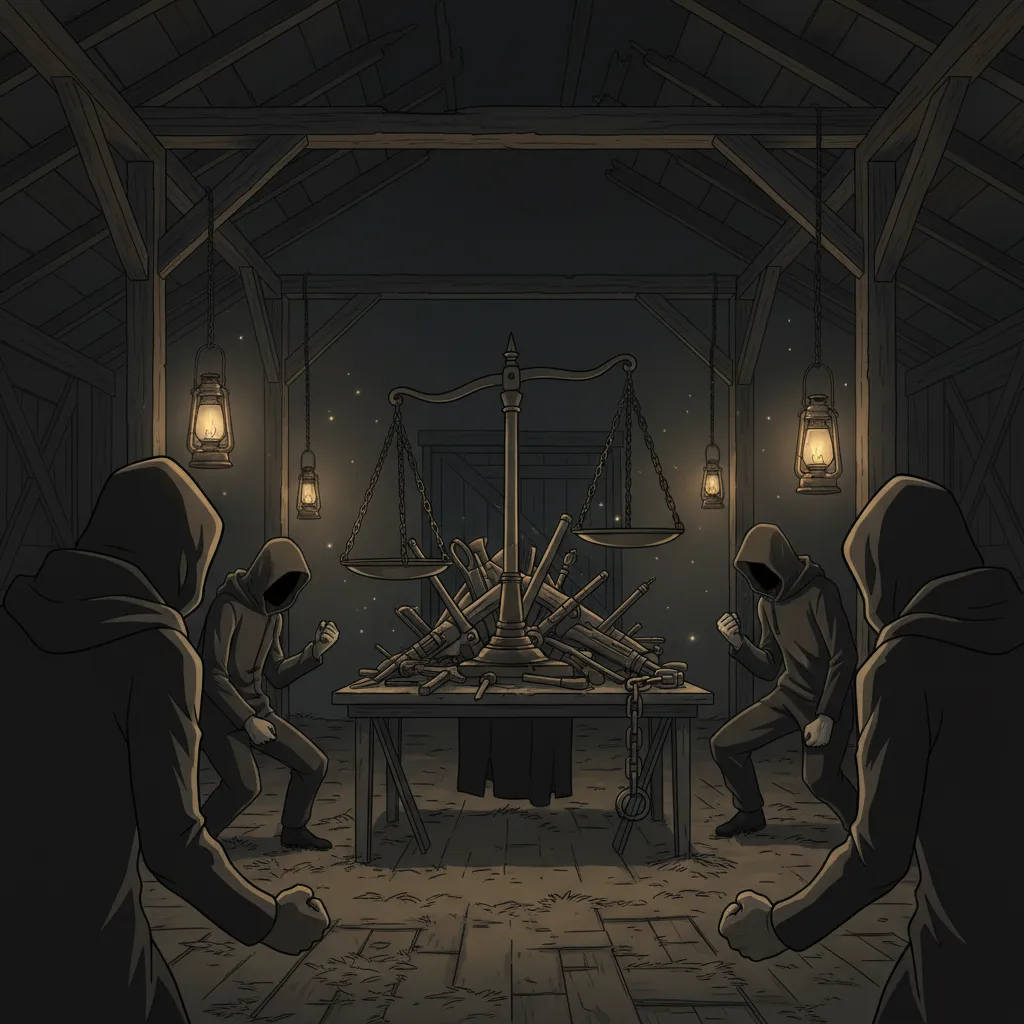
The farm is a flawed Body-without-Organs (BwO), a temporary, desperate re-territorialization onto the old, comforting codes of agrarian safety. This fragile structure is consumed by a perpetual internal oscillation, a failure to decide which machine—the democratic or the despotic—will preside over the flow of survival. The episode's true horror is the spectacle of moral paralysis, where all the energy of debate collapses into a moment of pure, decisive, molecular violence.
The Futility of the Moral Flow: Dale's Archaic Signifiers
Dale’s final campaign is the final, frantic pump of the dying social machine (Deleuze & Guattari, 1983, p. 37). His attempt to secure a fair trial for the captive is a futile effort to re-code the post-apocalyptic reality using the broken signifiers of the world before: law, justice, consensus. This is the schizophrenia of the archaic code—an attempt to apply the moral structure of a functional, integrated State apparatus to a reality that is pure, unbound flow.
Dale’s flow of language meets the concrete blockage of the group’s collective terror. This terror is already channeled into a lethal pragmatism, an emergent axiomatic of survival championed by Shane. The captive is not a human subject requiring judgment, but merely an object of exchange in a larger contest for the symbolic master signifier (Žižek, 1989): Who gets to decide who lives and who dies?
The debate is not ethical, but political economy: a struggle over which desiring-machine will monopolize the flow of life and death. The democratic desire for deliberation proves to be an anti-production—it uses up valuable time and energy without generating a necessary survival outcome. Dale's failure confirms that the territorial machine of the past has been liquidated by the apocalypse's brutal, indifferent axioms.
Rick's Oedipal Paralysis: The Failure to Form the BwO
Rick, the nominal leader, exists as a split subject ($S\diamond D$), a figure of neurotic stasis. His leadership is not a commitment to the Body-without-Organs—the zero degree intensity of a body ready for anything—but a perpetual internal loop. He oscillates between the need for Oedipal approval (Lori's gaze, Dale's moral sanction) and the necessity of schizoid production (the cold logic of violence). His inability to execute the hostage is the clearest manifestation of his character armor (Reich, 1972)—the rigid, psychological defense mechanism that prevents him from embracing the radical deterritorialization required for command.
Rick is the site where the opposing flows block each other. He attempts to embody the old Law of the Father (Freud, 1930/1961)—the judicial, temperate authority—but the new reality demands the primal, desiring-machine of the War Machine. When Carl, the wandering child and agent of the future’s raw intensity, urges him to shoot, Rick retreats. He confuses the child's pure desire for action (a positive line of flight) with a moral condemnation, thus perpetuating his paralysis and failing to complete the Event (Badiou, 2007) of definitive rule. His leadership is not a becoming-leader but a being-in-doubt.
The Molecular Chaos and the Decisive Line of Flight
Carl's earlier, seemingly trivial action—tossing rocks at the walker caught in the mud—is the decisive molecular event that punctures the farm's entire system of security. This is an act of pure, unmediated deterritorialization (Deleuze & Guattari, 1983, p. 41), where childish play inadvertently liberates the primal, external flow of unreason. The walker, now freed, is the anti-production that forces the group to make a real choice, superseding all symbolic deliberation.
The walker’s disembowelment of Dale is the ultimate, definitive rupture. The entire debate over the hostage is instantly rendered irrelevant by the gutting of the debater. The chaos Dale so desperately sought to keep outside of the symbolic order literally breaches his personal territory (his body) and liquidates him.
In this context, Rick's final hesitation over Dale's dying body is his last flicker of the Oedipal code. Daryl's execution shot is the act of the Nomad, the definitive choice of the new machine. Euthanasia, presented as a final act of humaneness, is revealed as the only possible execution in this world: the necessary, pragmatic liquidation of the organ (Dale's life) that can no longer contribute to the collective BwO. Daryl is not performing a moral act; he is performing a becoming-revolutionary act, cutting the flow of unnecessary suffering and stabilizing the group's desire onto the single, immediate necessity of survival.
References
Badiou, A. (2007). Being and Event (O. Feltham, Trans.). Continuum.
Deleuze, G., & Guattari, F. (1983). Anti-Oedipus: Capitalism and Schizophrenia (R. Hurley, M. Seem, & H. R. Lane, Trans.). University of Minnesota Press.
Freud, S. (1961). Civilization and its discontents (J. Strachey, Ed. & Trans.). W. W. Norton & Company. (Original work published 1930).
Nietzsche, F. (1989). On the genealogy of morality (W. Kaufmann & R. J. Hollingdale, Trans.). Vintage Books. (Original work published 1887).
Reich, W. (1972). Character Analysis (V. R. Carfagno, Trans.). Farrar, Straus and Giroux.
The Walking Dead S2E11. (2012). Directed by B. T. Kirk. AMC.
Žižek, S. (1989). The sublime object of ideology. Verso.
Comments
Post a Comment