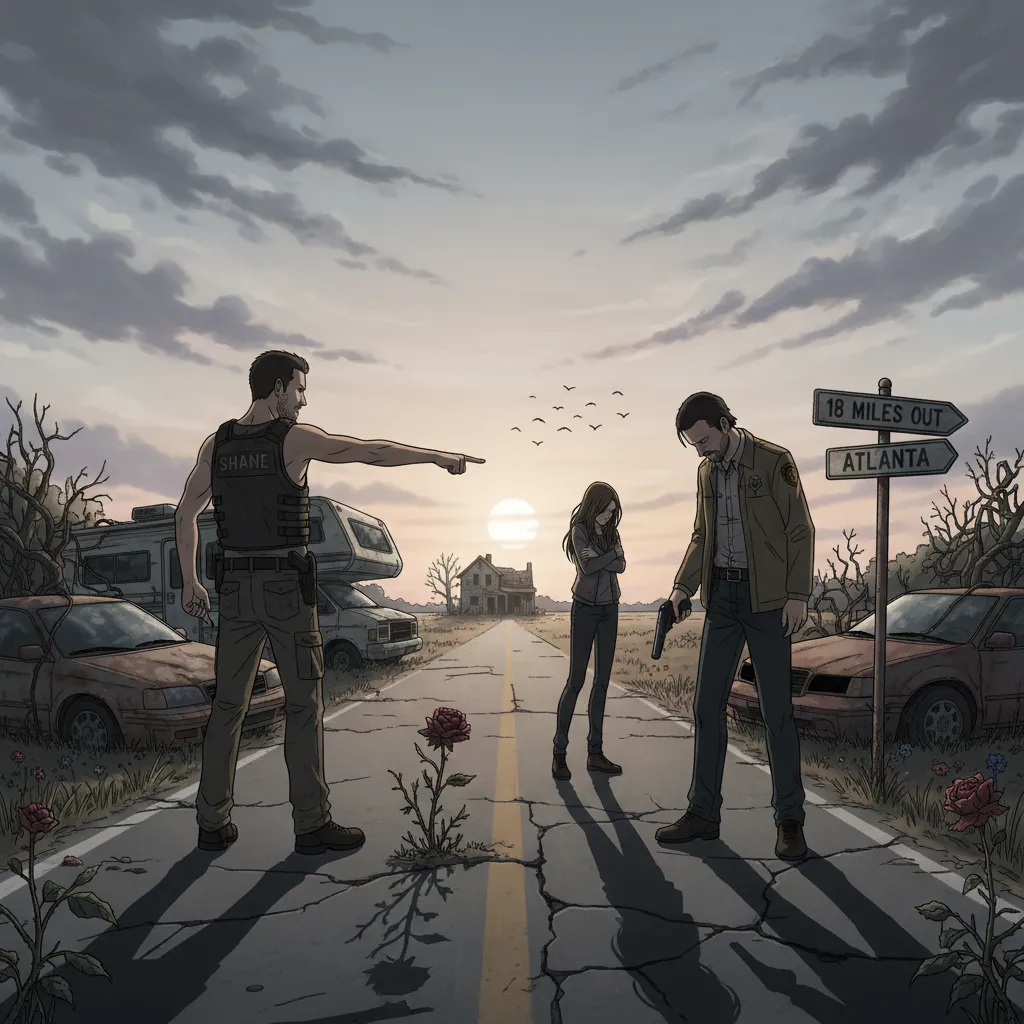
Welcome to our journey into the guts of The Walking Dead. What kind of journey? A philosophical, psychoanalytical, and political kind. What I would like to do over the next couple months is dig thought the Walking Dead episode by episode to see what it can teach us. Thank you for following me on this journey. I look forward to reading your comments. Be forewarned: There are spoilers everywhere. Don’t forget to check out my previous article in the Philosophizing TWD series: Schizoanalyzing TWD S2E9 "Triggerfinger"
Let’s get sawing. The "bromance" between Rick and Shane, ostensibly a bond forged in loyalty and shared trauma, is perhaps one of the most fraught, most revealing relationships ever depicted on film, particularly within the brutal, deterritorialized landscape of The Walking Dead. Rick, the noble, post-comatose hero, clings to the vestiges of pre-apocalyptic morality. Shane, his assumed best friend and partner, is a far rougher cut, a raw force that would find a natural home amongst those cops macing protesters during the Occupy Wall Street movements—an embodiment of power exerted, rather than negotiated. Both are cops. This shared profession is not incidental; it reveals a profound pre-conditioning, a deeply embedded social visioning process that colors their every action, every decision, and every attempt to build a new code amidst the molecular chaos.
The function of a cop, even in a pre-apocalyptic world, is not merely to enforce laws, but to produce and reproduce a certain social order. When a cop pulls over a "punk" for speeding, an immediate, forceful declaration of presence is required. No "wiggle room" for argument can be allowed, for any such allowance risks the cop losing the upper hand, the symbolic control necessary to maintain order. This immediate territorialization of space and power, the swift interpellation of the "perp" into a subordinate subject position, is the very desiring-machine of law enforcement in action. It’s a mechanism that forces the molecular flows of individual will into the stratified channels of state authority.
Cops, however, are never isolated microcosms of power. They are firmly integrated within a vast, complex juridical and discursive apparatus that conditions their relationships—to each other, to authority, and crucially, to civilians. This is the chain of command, an embedded set of social relationships that perpetually reproduce themselves, inscribing roles and expectations onto the very Body-without-Organs (BwO) of society. This entire apparatus functions through processes of interpellation, as Althusser (1971) famously argued. When a policeman "hails" a pedestrian—"Hey, you!"—and that pedestrian turns, they are not merely reacting to a sound; they are subjectifying themselves into the symbolic network of the policeman, into the ideological state apparatus of the law. The initial "hail," the disturbing call, is fragmentary, a moment of raw, un-coded intensity. It is only when we project our self into the other's symbolic network, recognizing the authority, the uniform, the role, that we can make sense of this initial trauma, thereby reducing its troubling, deterritorializing impact. We become a subject of the law, and in doing so, regain a sense of narrative coherence.
Sometimes, however, this subjectification does not "chill" the residue; it exacerbates it. Consider the anecdote of the ruthless street parking policy in a holiday town. The "no overnight parking" policy, especially in winter, became a frustrating reterritorialization of public space, imposing arbitrary limits on individuals. My personal experience, receiving a parking ticket despite the widening of the street for plows, revealed a disjunction. The initial trauma of the ticket, the disturbing call of authority, was fragmentary. Yet, as I subjectivized myself into the township's symbolic network—the municipal codes, the laws of the street—I found this subjective placement unjustified and narrative-defying. The logic of the ticketing, in conjunction with the history of the street and its signs (put up when the street was paved with stones, predating the modern pavement), simply did not support the policy. This allowed for a cognitive mapping that produced a line of flight from the assumed authority. While recognizing the immediate state of the situation, I could imagine a very real alternative to the symbolic relativity that was pushed upon me. This is the moment when the desiring-machine of individual rationality clashes with the stratified codes of an illogical state apparatus, revealing the arbitrary nature of power.
Shane and Rick, fundamentally, differ in their capacity to adapt their cognitive mapping to the terrifyingly new end-of-the-world narratives. Shane's ruthless pursuit of self-interest and survival, while undeniably effective for immediate pragmatic gains, is a vision stubbornly rooted in pre-apocalyptic values. His desire is still primarily channeled through the old juridical apparatus of control and dominance, albeit stripped of its formal legitimacy. He seeks to impose a new, personal, authoritarian code onto the chaos, becoming a self-appointed legislator of the new territory. His actions, though brutal, are still attempts to re-stratify the world according to a familiar, albeit hardened, logic of power.
Rick, on the other hand, is engaged in a more complex, molecular project. He is attempting to integrate pre- and post-apocalyptic values into a new cultural grounding for himself and the group of survivors. He is, to borrow from Deleuze and Guattari, trying to build a new assemblage—a heterogeneous mix of old ethics and new necessities—to navigate the flows of desire and survival. Rick is able to do this because, unlike Shane, he respects the opinions of the people. He can get others to buy into his vision and, crucially, like him at the same time. This is the difference between a leader who merely imposes a code and one who fosters a new collective desiring-production.
The stark difference here can be analogized to Stalin and Lenin. When Lenin was on his deathbed, Stalin famously manipulated information, delivering falsified news articles to politically isolate Lenin from political reality. This isolation was a deliberate strategy Stalin used to consolidate his own power, to block Lenin from impeding his rise. Is this not a chillingly similar scheme to Shane lying to Lori about Rick's death? Shane's deception, a deliberate manipulation of the informational flow, allowed him to move Lori out of harm's way (a seemingly altruistic act that served his desire) and, more importantly, to buy his way into her heart and pants. This act of dis-information reterritorialized Lori's emotional landscape, shaping her desires and attachments to serve Shane's own territorial ambitions. Shane attempted to Oedipalize the situation, replacing the "father" (Rick) with himself, constructing a new familial desiring-machine based on deceit and a violent imposition of his will. His drive is a testament to the despotic machine of unchecked power, a stark contrast to Rick's more democratic, fluid approach to leadership, which attempts to channel collective desire rather than brutally dictate it. The tension in "18 Miles Out" is the clash of these two distinct desiring-machines: Shane's rigid, pre-apocalyptic authoritarianism versus Rick's emergent, adaptable, and collective-oriented post-apocalyptic ethic. The fate of the group, indeed, the very possibility of a new form of human becoming, hinges on which machine will ultimately prevail.
References
Althusser, L. (1971). Lenin and philosophy and other essays. Monthly Review Press.
Badiou, A. (2001). Ethics: An essay on the understanding of evil. Verso.
Deleuze, G., & Guattari, F. (1983). Anti-Oedipus: Capitalism and Schizophrenia. University of Minnesota Press.
Freud, S. (1955). Group psychology and the analysis of the ego. In J. Strachey (Ed. & Trans.), The standard edition of the complete psychological works of Sigmund Freud, Volume XVIII (1920-1922) (pp. 67–143). Hogarth Press.
Nietzsche, F. (2002). Beyond good and evil: Prelude to a philosophy of the future (R. P. Hollingdale, Trans.). Cambridge University Press. (Original work published 1886).
Reich, W. (1972). Character analysis (3rd ed.). Farrar, Straus and Giroux.
The Walking Dead (TV Series 2010–) IMDb. (2014). Retrieved 15 May 2014, from http://www.imdb.com/title/tt1520211/
Zizek, S. (2001). The fetish. Cabinet Magazine, 2. Retrieved from http://www.cabinetmagazine.org/issues/2/western
Comments
Post a Comment