The antenna of the walkie-talkie is a lonely finger pointing at a heaven that has already been liquidated.
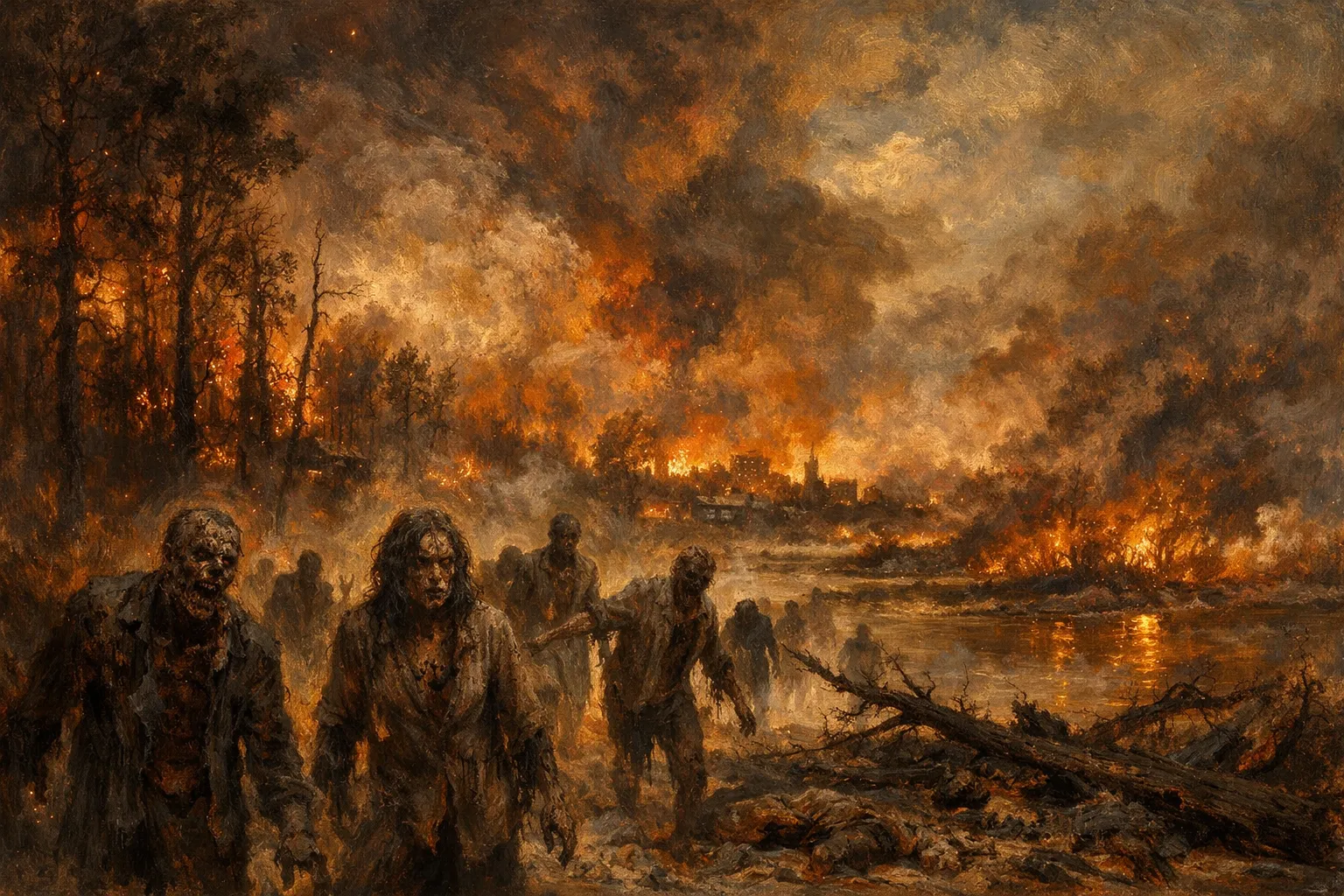
The morning air in the wake of the camp massacre does not smell of grief; it smells of carbonized memory and the metallic tang of an overstimulated nervous system. To speak of the survivors is to speak of a broken circuit, a collective of desiring-machines suddenly unplugged from the molar grid of the city and forced into a molecular state of pure, unmediated survival. Rick Grimes stands at the edge of the quarry, lobbing prayers through a plastic radio to a Morgan Jones who has become a disembodied ghost, a virtual node in a network that no longer carries data. This is the supplication of the faith-shaken man giving a dead God one last chance to calibrate the compass. The radio is not a communication device here; it is an affective prosthetic, an attempt to re-territorialize the silence through the rhythmic emission of words that have lost their referent. Atlanta is not a city anymore; it is a black hole where the promise of safety has been ground into the dust of the dead.
Burial Rites as Molar Respiration
The act of burying the dead while burning the monsters is the group’s first desperate attempt to re-stratify the chaos. Daryl Dixon represents the position of extreme, clinical pitilessness, the nomad who sees only sacks of disease where others see Amy or Ed. He operates on a logic of pure anti-production: the dead are waste, and waste must be incinerated to prevent the contagion from re-entering the circuit. Glenn stops him, insisting on a dignified burial, a re-assertion of the symbolic order that privileges the human corpse as a site of meaning. This is the friction between the movement-image and the time-image (Deleuze, 1989). The movement-image demands the immediate clearing of the board so the chase can continue; the time-image lingers on the cataract eyes of a zombifying sibling, forcing the living to look death in the eye and get their hands dirty with the literal dirt of the grave.
Andrea’s vigil over Amy is the quintessential manifestation of a subject caught in the suspension of duration. She stays with the body, whispering apologies for time not spent, for the "latency" of her sisterly affection. When Amy’s hand begins to twitch, we witness the transition from the organism to the Body-without-Organs. The zombie is the ultimate modern myth because it literalizes the internalization of anti-production in capitalism (Deleuze & Guattari, 1983). The re-animating Amy is a desiring-machine that has been hacked by a virus of pure, mindless consumption. Andrea’s bullet to the head is not a murder but a "mercy-cut," a final stratification that closes the circuit of Amy’s individual narrative before the undifferentiated flow of the wildfire epidemic can fully claim her.
The Character Armor of the Woods
As the camp is packed, the tensions between Rick and Shane escalate from a difference in leadership to a full-scale somatic conflict. Rick suggests the CDC, an appeal to the institutional ruins of biopower, while Shane argues for Fort Benning, a flight toward the military-industrial complex. This is the struggle over which apparatus of capture the group will submit to next. Shane’s resentment of Rick’s re-emergence—the disruption of the Oedipal triangle he had briefly inhabited with Lori and Carl—begins to rupture his character armor. Wilhelm Reich (1972) identified character armor as the sum total of typical attitudes developed to block emotional excitations, resulting in a physical and psychological rigidity. Shane’s armor is cracking under the heat of a "secondary drive" of pure, destructive hostility.
In the woods, the "Evil Elmer Fudd" moment occurs. Shane aims his rifle at Rick’s back, his finger tensing on the trigger of a desiring-machine aimed at the heart of the Symbolic Law. He is on the verge of performing an absolute deterritorialization, an act of sovereign violence that would liquidate his rival and re-secure his territory. It is only the intervention of Dale’s gaze—the "wise and learned" surveillance of the elder—that forces Shane to backpedal. This encounter illustrates the Foucaultian panopticon in reverse: Shane is not controlled by the tower, but by the unexpected witness in the bushes. The shame he feels is a form of re-territorialization, a temporary freezing of his homicidal flow that redirects him back toward the collective mission to the CDC.
Jim and the Right to Die on the Road
Jim’s bite is the molecular event that forces the group to confront the "Wildfire" within their own ranks. The reveal of the wound triggers a hysterical discharge among the already delirious survivors. Rick insists that "we don't kill the living," a molar axiom that he attempts to enforce even as Daryl points out the blatant hypocrisy of Rick pointing a gun at his own people to maintain the peace. Rick’s definition of "the living" is a sliding scale, a political category that includes his friends but excludes the "Others" he was prepared to shoot in the city. Biopower, as the power to make live and let die, finds its most acute expression in the group's handling of Jim (Foucault, 1978).
Jim’s condition deteriorates as they travel in Dale’s RV—a nomadic transport machine that is itself on the verge of collapse. His request to be left behind is an act of radical self-determination, a refusal to be a "burden" on the group's limited metabolic economy. He asks to be left under a tree, to "be with his family," a spiritualized release that Rick, the agnostic administrator, finds nonsensical. Jim is choosing to shed his character armor entirely, accepting the transition from the organism to the non-organic state of the BwO. He sits under the tree, rejecting the gun Rick offers, opting to let the wildfire take its course. He is the first to truly "walk" among the dead as a matter of choice, a line of flight that exits the human strata and enters the undifferentiated forest flow.
The CDC: The Sterile Body-without-Organs
While the survivors crawl along the highway, the narrative shifts to the subterranean enclosure of the CDC, where Dr. Edwin Jenner records his video diaries. Jenner is the lone component of a dead institution, a desiring-machine idling in a bunker. His samples—the TS-19 tissue—are the last virtual memories of the species’ biological continuity. The CDC is a paranoiac machine designed for totalized control, divided into sectors of quadrillage, rigorous monitoring, and automated decontamination protocols (Foucault, 1977).
The accident in the lab—the spilled chemicals triggering the fire and the destruction of the samples—is the final collapse of the scientific episteme. Jenner’s "butter fingers" are the somatic symptom of a subject who has lost all faith in the productivity of his labor. With the loss of the samples, he reaches a state of absolute melancholia, where the "experience of death" becomes the only reality he can contemplate (Deleuze & Guattari, 1983). He sits in the dark, drinking, a catatonic BwO waiting for the air to run out. To him, the spreading infection is not a disease to be cured, but a "Wildfire" that has already consumed the world, leaving him as the only un-burnt scrap.
The Surveillance Gaze and the Threshold
The arrival of the survivors at the CDC gates is the collision of two distinct failures. Rick’s group arrives as a desperate, fly-swarmed herd, screaming at a camera that they do not know is being watched. Rick’s lash-out at the lens is a demand for recognition from the Big Other. He needs the institution to be "right" about its promise of havens and cures because the alternative is an unmappable void. He is the supplicant again, begging for the "God" of science to open the door and provide theAIR conditioning, the hot showers, and the Airplay of the old world.
Jenner, watching the monitors, sees the group as a sudden, unpredictable rupture in his suicidal inertia. They are a "wild card," a reason to live for one more day, or perhaps merely more fuel for the fire. When he triggers the external doors, the survivors are flooded with a blinding white light—the light of the "Absolute Survey." They are let into the fortress of biopower just as the biopower itself has ceased to function. The doors seal behind them, a re-territorialization that promises safety but actually leads to a deeper, more explosive entrapment. The "safest place on earth" is revealed to be the site of the species' final, sterile recording.
Conclusion: The Coda of the Human Strata
"Wildfire" serves as the indication from the narrative machine that no character, no matter their popularity or functionality, is safe from the deterritorializing force of the apocalypse. The group has moved past the farce of the farm-camp and into the tragedy of the institution. They have traded the unpredictability of the woods for the rigid, suicidal certainty of the lab. The "human" they are trying to protect is a category that is rapidly dissolving, replaced by "viral subjectivity" (Dunn, 2018).
As they enter the CDC, they are not being rescued; they are being indexed. The "coda" of their lives is being written in the electronic logs of a dead man. The only thing that remains is the "will to power," the egoistic self-sufficiency that some will embrace and others will fear. The episode ends in a whimper of artificial light, a temporary stay of execution that only heightens the stakes for the inevitable explosion to come. They have taken the wrong turn at Albuquerque, and death is what's up, Doc. Death.
References
Badiou, A. (2005). Ethics: An Essay on the Understanding of Evil. (P. Hallward, Trans.). Verso.
Deleuze, G. (1989). Cinema 2: The Time-Image. (H. Tomlinson & R. Galeta, Trans.). University of Minnesota Press.
Deleuze, G., & Guattari, F. (1983). Anti-Oedipus: Capitalism and Schizophrenia. (R. Hurley, M. Seem, & H. R. Lane, Trans.). University of Minnesota Press.
Deleuze, G., & Guattari, F. (1987). A Thousand Plateaus: Capitalism and Schizophrenia. (B. Massumi, Trans.). University of Minnesota Press.
Dunn, J. (2018). The Zombie Apocalypse Has Already Happened: Queering Subjectivity in Zombie Film (Doctoral dissertation, Duquesne University). Duquesne University Digital Repository.
Foucault, M. (1977). Discipline and Punish: The Birth of the Prison. (A. Sheridan, Trans.). Vintage Books.
Foucault, M. (1978). The History of Sexuality: Volume 1: An Introduction. (R. Hurley, Trans.). Pantheon Books.
Freud, S. (1961). Civilization and Its Discontents. (J. Strachey, Ed. & Trans.). W. W. Norton & Company. (Original work published 1930).
Lowen, A. (1976). Bioenergetics. Penguin Books.
Nietzsche, F. (1967). On the Genealogy of Morals. (W. Kaufmann & R. J. Hollingdale, Trans.). Vintage Books. (Original work published 1887).
Reich, W. (1972). Character Analysis. (V. R. Carfagno, Trans.). Farrar, Straus and Giroux. (Original work published 1933).
Sloterdijk, P. (2014). Rage and Time: A Political Investigation. (M. Wenning, Trans.). Columbia University Press.
Žižek, S. (1989). The Sublime Object of Ideology. Verso.
Comments
Post a Comment