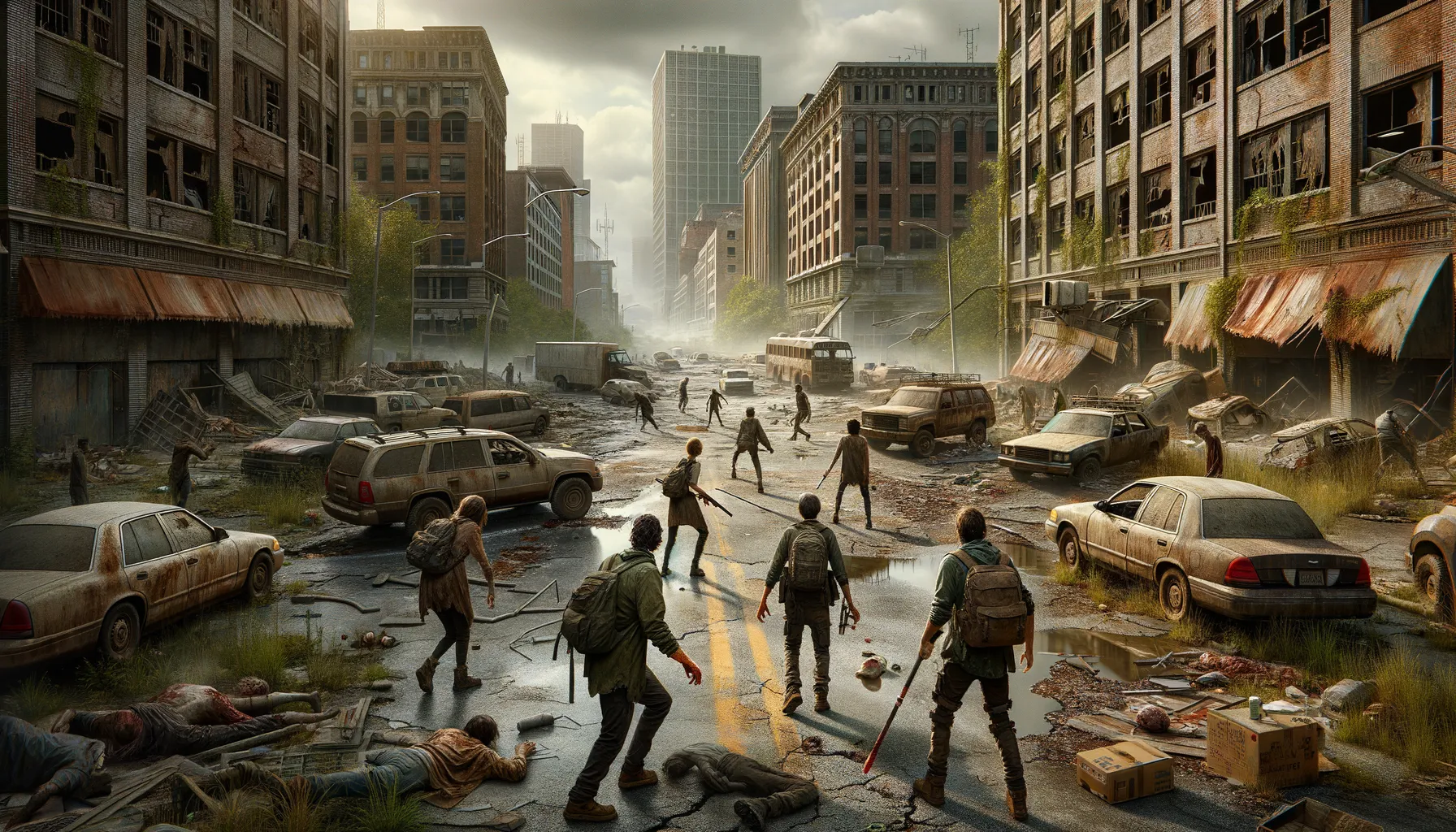
Years ago, I remember sitting, popcorn in hand, watching The Walking Dead’s second-ever episode and hoping it was ‘just another zombie show’. Little did I know I’d be swept up in a heady debate on racism, survival ethics, and the ever-present tug-of-war between authority and chaos. If you’re like me, you may have shouted at the screen during the Merle-on-the-rooftop fiasco, or laughed (nervously) at Rick’s ‘meat valve’ heart lesson. But lurking beneath the chaos of swinging axes and nervous sarcasm is a surprisingly profound meditation on what happens to our deepest social structures when everything else falls away. In this post, we’ll look at S1E2 ("Guts") not as just another gorefest—but as a wild schizoanalytic playground where humanity’s ugliest truths and oddest hopes get turned inside out.
The Rooftop Rumble: Where Racism and Apocalypse Collide
The rooftop confrontation between Rick Grimes and Merle Dixon in The Walking Dead S1E2 “Guts” is more than a fight for survival—it’s a collision of deep-rooted social issues and the raw chaos of the apocalypse. According to the 2014 analysis, “Schizoanalysing The Walking Dead: S1E2 Guts,” this moment exposes how racism and authority don’t simply vanish when society crumbles. Instead, they mutate, adapt, and sometimes become even more visible under extreme stress.
From the start, the rooftop scene sets the stage for the episode’s larger questions: What happens to prejudice when the world ends? Can authority survive in chaos, or does it reveal its own fragility? The analysis uses schizoanalytic concepts like Necro-Universalism, Racist-Axiom, and Character-Armor to unpack these questions, showing how the “zombie-flow” of the apocalypse both disrupts and exposes the old social order.
Merle Dixon, with his aggressive posturing and racist language, embodies the Racist-Axiom. He clings to the social privilege of whiteness, using slurs and violence to reassert his status. When T-Dog challenges him, Merle’s reaction isn’t just about his intelligence being questioned—it’s about his authority and identity being threatened. The analysis draws on Reich’s idea of Character Armor: Merle’s sense of self is protected by a tough exterior, both physically and ideologically. But in the chaos of the apocalypse, this armor is exposed as weak and brittle.
The rooftop becomes a battleground for authority. Rick’s attempt to unite the group—“There is us and the dead. We survive this by pulling together, not apart”—introduces a new kind of unity, what the analysis calls Necro-Universalism. This is a universalism based on survival, where old differences like race should, in theory, fall away. Yet, as the analysis notes, this unity is fragile. It’s built by creating a new “outside”—the dead—recoding difference into a new binary that still excludes.
Personal experience echoes this dynamic. During a citywide blackout, I once witnessed a heated argument between neighbors. With the lights out and uncertainty in the air, people’s fears and prejudices surfaced quickly. No zombies were needed—chaos alone stripped everyone down to their rawest instincts. The same thing happens on the rooftop: the apocalypse doesn’t erase old wounds; it exposes and sometimes deepens them.
- Racism persists and mutates: Even when civilization collapses, social stratifications don’t disappear—they adapt to new circumstances.
- Authority is fragile: The struggle for leadership is constant, and even the strongest “character armor” can crack under pressure.
- Survival is complex: Escaping walkers is only part of the challenge; navigating the old wounds and prejudices that refuse to die is just as important.
The rooftop rumble in “Guts” is a microcosm of the series’ larger themes. It shows that when order breaks down, people don’t automatically become equals. Instead, they often fall back on familiar hierarchies, even as those structures are revealed to be hollow. The apocalypse, as the analysis suggests, is both a chance to break free from old patterns and a dangerous opportunity for them to reassert themselves in new forms.
Necro-Universalism: Dead Bodies, Dead Metaphors, Dead Certainties
In The Walking Dead S1E2 "Guts," Rick Grimes’ urgent call for unity—“us and them”—is more than a survival tactic. According to the 2014 schizoanalytic study, this mantra is rooted in Necro-Universalism: a worldview where only the living matter, and all other differences are rendered meaningless in the face of death. The zombie apocalypse, as depicted in this episode, acts as a radical equalizer. Social metaphors that once defined identity—race, authority, even love—are stripped away, leaving behind a raw, unsettling universality. In this new order, everyone is reduced to potential prey, and the only meaningful distinction is between the living and the dead.
This erasure of difference is not simply liberating. Drawing on St. Paul’s message in Galatians 3:28—“you are all one”—and Žižek’s critique of universalism, the analysis questions whether such unity is genuine or just a new form of exclusion. When Rick tells Merle, “Only dark meat and white meat. There is us and the dead,” he is not abolishing boundaries but redrawing them. The living, united by their shared vulnerability, now define themselves against the ultimate Other: the dead. In this way, the apocalypse’s promise of unity is double-edged. It offers a sense of togetherness, but only by creating a new outside—a new enemy.
The episode’s infamous “meat valve” scene, where Rick awkwardly describes the heart as “just a fleshy meat valve,” further exposes the emptiness of old metaphors. In a world where romance is reduced to biology and love to muscle and blood, even Valentine’s Day could become a grotesque ritual—imagine gifting preserved organs instead of chocolates. This moment is more than comic relief; it is a schizoanalytic metaphor for the collapse of meaning. The heart, once a symbol of love and unity, is revealed as nothing more than tissue. Underneath every feud, every alliance, lies only flesh and chaos—the Body-without-Organs (BwO) that the zombie genre so vividly displays.
- Rick’s ‘us and them’ mantra: Necro-Universalism reduces all meaning to survival; only the living count.
- Zombie universality: Social metaphors (race, authority, love) are erased; everyone is equally at risk.
- St. Paul and Žižek’s critique: Is unity real, or just a new way to create outsiders?
- ‘Meat valve’ metaphor: Beneath all social constructs lies only flesh—awkward, gross, and telling.
- Wild card: In this world, Valentine’s Day might mean gifting preserved organs, not chocolates.
- Universalism’s double edge: The apocalypse’s unity is built on exclusion, not true equality.
This necro-universal logic is not without danger. The study warns that even as the apocalypse “robs racism of its social support,” it does not guarantee liberation from prejudice. The group’s unity is fragile, always at risk of re-stratification. As survivors cling to old habits—like Rick’s use of handcuffs, a symbol of state power—they reveal how easily new certainties can become as oppressive as the old. In the world of The Walking Dead, dead bodies, dead metaphors, and dead certainties haunt every attempt at building a new order.
Merle Dixon and the Anatomy of Character Armor
In the schizoanalytic reading of The Walking Dead S1E2 "Guts," Merle Dixon stands out as less a man than a fortress. His entire presence is defined by what the 2014 analysis calls Character Armor—a set of defensive routines built from racism, violence, and bluster. For Merle, these are not just habits but survival strategies. They are the walls he builds around himself, both muscular and ideological, to keep the world at bay. In the pre-apocalyptic world, these routines might have kept him afloat. But in the chaos of the zombie apocalypse, the analysis argues, the soft underbelly of this armor is exposed.
Merle’s behavior on the rooftop is a textbook example of what Wilhelm Reich described as character armor. Reich, a psychoanalyst, argued that what looks like ego or confidence is often just fear in disguise. Merle’s racism and aggression are not signs of strength, but of deep-seated insecurity. When T-Dog challenges him, Merle doesn’t just push back—he explodes. Slurs become his weapons, and his demand for leadership is less about guiding the group and more about barricading himself behind authority. The analysis notes that Merle’s sense of self is tightly bound to the social privilege of whiteness; even when civilization collapses, this privilege lingers as a psychological shelter.
The rooftop confrontation reveals how Merle’s identity is a fragile construction. The apocalypse, described as a Deterritorialization Event, strips away the usual supports for racism and social hierarchy. Suddenly, Merle’s fortress is surrounded by chaos. The group is no longer held together by the old rules, and Merle’s authority is threatened. The analysis draws on R.D. Laing’s idea of ontological insecurity—the terror of losing one’s sense of self. Merle’s violent outbursts are desperate attempts to reassert control, to rebuild his character armor in a world that no longer recognizes it.
This pattern is familiar. As one might recall from personal experience, there are always those who pick fights at parties, not because they are fearless, but because they are terrified of being ignored. Merle would approve. His aggression is a mask for his fear of irrelevance, a last-ditch effort to matter in a world that is rapidly moving on without him.
Even as the world falls apart, the psychological shelter of whiteness remains. The analysis points out that Merle’s character armor is not just physical—his muscles and bravado—but also ideological. He clings to the remnants of social privilege, using them as a shield against the uncertainty of the new world. When Rick tries to introduce a new kind of unity—what the analysis calls Necro-Universalism—Merle resists. He cannot let go of the old barricades, even when they no longer serve him.
In this way, Merle Dixon embodies the ongoing danger of re-stratification. His character armor, built from racism and violence, is both his defense and his prison. The apocalypse may have stripped away the structures that supported his identity, but the psychological routines remain, shaping his every move in the new, chaotic world.
Deterritorialization and Re-Territorialization: New Lines, Old Patterns
The second episode of The Walking Dead, “Guts,” throws its characters—and viewers—into a world where the old rules have been violently swept aside. According to the 2014 analysis, this is a textbook case of deterritorialization: the zombie apocalypse acts as a massive reset, dissolving the social boundaries and hierarchies that once organized daily life. As the city fills with the undead, the familiar structures of race, authority, and identity seem to lose their grip. The world is suddenly up for grabs, the “door barricaded” against the old order.
Yet, as the analysis points out, this chaos does not last long. Humans, faced with uncertainty, quickly scramble to build new hierarchies. The rooftop confrontation between Rick and Merle is a clear example. Merle, stripped of the social support that once upheld his racism and authority, desperately tries to reassert control. He shouts, threatens, and demands leadership, embodying what the study calls the Racist-Axiom and Character-Armor. His sense of self is tied to the old world’s privileges, and he seeks to “re-territorialize” by recreating those patterns, even in a world where the living are outnumbered by the dead.
This dynamic is not unique to apocalyptic fiction. Even in everyday life, when familiar systems break down—say, on a camping trip where the GPS dies—someone inevitably steps up to take charge. The group may accept this new “leader,” not because of any formal authority, but because order, even temporary, feels safer than chaos. The study draws a parallel: in the face of the zombie threat, the survivors are tempted to accept a dictator if it promises safety, even if that means repeating old mistakes.
Rick’s decision to handcuff Merle is a pivotal moment. On one hand, it represents a victory for what the analysis calls Nomadic Law: a new, flexible order based on survival and group unity. Rick’s authority is not inherited from the old world, but earned through action and necessity. On the other hand, the use of handcuffs—a tool of the pre-apocalypse—signals a retreat into the comfort of control. The group, faced with overwhelming uncertainty, falls back on familiar instruments of power. This is the paradox of re-territorialization: even as the apocalypse offers liberation from old structures, it also invites the same games to begin anew.
The analysis uses the metaphor of the Body-without-Organs (BwO) to describe this process. In the zombie apocalypse, all social metaphors—race, authority, even the idea of “the heart”—are stripped away, leaving only the raw material of survival. But this shared vulnerability does not guarantee freedom from prejudice or hierarchy. Instead, the group must constantly balance the chaos of deterritorialization with the need for mini-order, even if that means falling back on patterns that echo the world they lost.
- Zombie apocalypse triggers massive deterritorialization: Old rules are thrown out, but new lines are quickly drawn.
- People scramble to build new hierarchies: Sometimes, the group chooses a dictator if it promises safety.
- Handcuffing Merle: A win for survival unity, but also a retreat into the comfort of control.
- Apocalypses as liberation: They invite people to start the same games over, even in new forms.
- Anecdote: Even on a camping trip, sudden leaders arise when order breaks down.
- Group survival: Depends on balancing chaos with mini-order, even if it repeats old mistakes.
Sisyphus-Flow and the Futility of Order
In the schizoanalytic reading of The Walking Dead S1E2 "Guts," Rick Grimes emerges as a modern Sisyphus, endlessly pushing the boulder of order up a hill of chaos, only to watch it tumble down again. The 2014 analysis frames this as the "Sisyphus-Flow," a cycle where attempts to restore meaning and structure are always provisional, always on the verge of collapse. In the world of the zombie apocalypse, where the only constant is unpredictability, Rick’s struggle to organize, protect, and reunite his group is both heroic and, ultimately, doomed.
This Sisyphus-Flow is not just a metaphor for Rick’s actions, but a deeper commentary on the human compulsion to seek order in the face of overwhelming disorder. The episode’s events—Rick’s desperate plans, his attempts to negotiate with Merle, and his efforts to save his family—are all acts of re-stratification. Each is a push against the tide of the Body-without-Organs (BwO), the schizoanalytic term for the raw, unstructured chaos that the zombie apocalypse represents. Yet, as the analysis notes, every attempt at order is temporary, always slipping through the survivors’ fingers.
At the heart of Rick’s struggle is an Oedipal desire: the belief that, even after the collapse of civilization, family and social order can be restored. This is not just a personal longing, but a drive that shapes the group’s dynamics. Rick’s quest is powered by the hope that meaning can be rebuilt, that the old world’s values—protection, leadership, unity—can be salvaged from the ruins. The analysis likens this to the myth of Sisyphus, but with a distinctly existential twist: if life is absurd, then the only response is to fight for what you love, even if the fight is unwinnable.
There is a certain existential humor in this struggle. As the analysis suggests, Rick’s efforts are reminiscent of anyone who has ever tried to impose order on chaos, only to be thwarted by forces beyond their control. I once spent a week color-coding files at a temp job that folded before payday; Rick’s effort feels familiar. The futility is not just tragic, but also darkly comic—a reminder that the search for meaning is itself a kind of absurd heroism.
Yet, the analysis warns, the collapse of meaning does not automatically bring liberation. In fact, "meaninglessness" can be its own form of stratification, a terrifying void that survivors rush to fill with new hierarchies and authorities. The episode shows how quickly the group risks re-creating old structures, even after the apocalypse has wiped the slate clean. The handcuffing of Merle, for example, is both a rejection of his racist authority and a retreat to traditional instruments of control. In this sense, the Sisyphus-Flow is not just about the futility of order, but about the persistent, often unconscious, drive to rebuild it—even when logic and history suggest it will never last.
- Rick’s journey is Sisyphus-esque: pushing stones uphill even when chaos is the only constant.
- Order is always provisional: always doomed to slip through fingers—yet we try.
- Oedipal desire: belief that family and order can be restored, even if the world has ended.
- Existentialist humor: if life’s absurd, at least fight for what you love.
- Meaninglessness isn’t liberation: it can be the most terrifying stratification of all.
When the Heart Is Just a Meat Valve: The Death of Social Metaphors
In The Walking Dead S1E2 "Guts," the collapse of civilization is not just about the end of government or the rise of zombies—it is the death of social metaphors themselves. The episode’s infamous “meat valve” moment, where Rick Grimes bluntly describes the heart as nothing more than a “fleshy meat valve,” signals a radical stripping away of meaning. In the world of the undead, Valentine’s Day, love, and friendship—all the rituals and symbols that once gave life structure—are replaced by the chaos of survival and the raw, embodied reality of flesh.
The schizoanalytic reading, as outlined in the 2014 analysis, positions this moment as a direct attack on the comforting illusions that metaphors provide. When Rick reduces the heart to a mere organ, he is not just being pragmatic; he is exposing the fiction behind social bonds. In the apocalypse, the heart is no longer a symbol of love or courage—it is just a pump, and its failure means death, not heartbreak. The question arises: Can love, or any higher sentiment, survive when metaphors become useless?
Zombies, in this context, become the ultimate equalizers. They do not care about status, race, or sentiment. The living are simply meat—no more, no less. The boundaries that once separated people, the subtle codes of class, race, or affection, are chewed up and spat out by the undead. The apocalypse acts as a cosmic butcher, slicing away everything but the bare minimum of meaning. The survivors are left to navigate a world where the only distinction that matters is “us versus them”—the living versus the dead.
This reduction is not just physical but philosophical. The analysis draws a creative analogy: in a world where everything is reduced to meat, perhaps vegetarians have a better shot at philosophical clarity. When all that remains is the body, stripped of metaphor and myth, the survivors are forced to confront the “Body-without-Organs” (BwO)—a Deleuzian concept representing pure potential, unshaped by social codes. Yet, even in this radical state, the old prejudices and habits can seep back in. The shared “meaninglessness” of the apocalypse is no cure for prejudice; it simply provides a new stage for old dramas.
- Valentine’s Day, love, and friendship are rendered obsolete, replaced by the immediate demands of survival.
- The heart as a ‘fleshy meat valve’ symbolizes the collapse of metaphor—love and sentiment are reduced to bodily function.
- Zombies as equalizers destroy all social distinctions, chewing up both status and sentiment without discrimination.
- The apocalypse as a cosmic butcher leaves only the most basic forms of meaning—life and death, hunger and fear.
- Vegetarian tangent: In a world obsessed with meat, perhaps those who abstain see the absurdity more clearly.
- Shared meaninglessness does not erase prejudice; even among the entrails, old biases can return.
As the episode unfolds, it becomes clear that survival in the post-apocalyptic world is not just about escaping zombies. It is about navigating a landscape where all the old metaphors have died, and new forms of meaning—and prejudice—are always waiting to be born.
Conclusion: Apocalypse as a Truth Serum (Or, Why the Walkers Aren't the Only Scary Ones)
The second episode of The Walking Dead, “Guts,” does more than shock viewers with scenes of gore and survival. As the 2014 schizoanalytic study reveals, the real horror lies not in the walkers themselves, but in the way the apocalypse acts as a kind of truth serum—stripping away the surface of civilization and exposing the psychic reflexes, prejudices, and power struggles that persist beneath. In this sense, the zombie outbreak is less a great equalizer and more a harsh spotlight, illuminating the deep-rooted social codes and Oedipal desires that continue to shape human behavior, even when the world has ended.
When society collapses, it might seem logical to assume that old divisions—like racism or the need for authority—would fade away, replaced by the simple binary of “us versus them.” Yet, as the rooftop confrontation between Rick and Merle makes clear, these divisions are not so easily erased. Instead, the apocalypse exposes just how deeply they are woven into the fabric of identity and group dynamics. Merle’s desperate attempts to assert dominance and re-establish a racial hierarchy, even as the world crumbles, show that the urge to rebuild familiar structures of power and belonging is almost instinctive. The walkers may be the obvious threat, but the real danger comes from within—from the survivors’ own need to find meaning and security in chaos.
The analysis positions the apocalypse as a kind of group therapy session, where the collapse of external order forces everyone’s secrets and fears to the surface. In the absence of civilization’s rules, characters like Merle cling to old patterns, while others, like Rick, try to forge new forms of unity. Yet, as the study notes, even Rick’s call for collective survival—his “Necro-Universalism”—carries its own risks. By defining humanity against the dead, he creates a new boundary, a new “us and them,” that echoes the very exclusions he seeks to overcome. This cycle of deterritorialization and re-territorialization—breaking down old structures only to rebuild them in new forms—shows how fragile and persistent the need for order truly is.
True liberation, the study suggests, is not just about surviving the chaos or finding new ways to organize. It requires a deeper questioning of our instincts to rebuild, to seek comfort in familiar hierarchies, and to define ourselves against an “other.” The apocalypse, then, is not a clean slate but a mirror, reflecting the ongoing struggle to overcome the psychic and social reflexes that shape our actions. Guts is less about literal guts and more about the courage to confront these uncomfortable truths.
In the end, The Walking Dead S1E2 reminds us that the scariest monsters are not always the ones outside the door. The real challenge lies in facing the parts of ourselves—and our communities—that the apocalypse refuses to let us hide. The walkers may be relentless, but it is the survivors’ scramble for power, belonging, and meaning that truly defines the horror, and the hope, of the post-apocalyptic world.
TL;DR: The Walking Dead S1E2 "Guts" isn’t just a tale of running from walkers—it’s a messy, fascinating meditation on racism, authority, and how our identities break down (or don new ‘armor’) when the world collapses. Through schizoanalytic lenses, we see both danger and possibility in the zombie flow.
Comments
Post a Comment