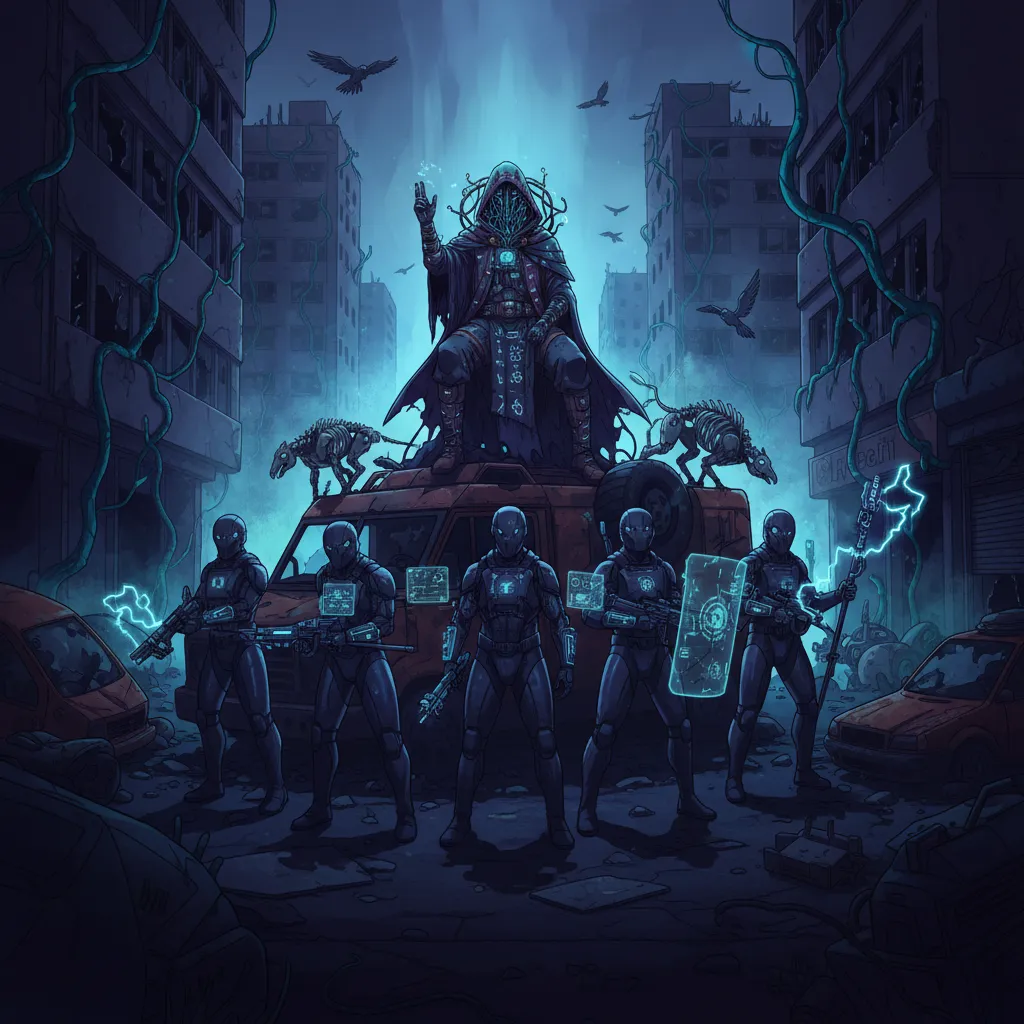
The world has broken; the Axiomatic grid has collapsed, yet we observe the frantic, traumatic compulsion to immediately rebuild the very structures that codified our prior oppression—the camp, the family, the rigid line.
Our journey descends into the viscera of The Walking Dead S1E4, Vatos, not as a simple narrative trek, but as a schizoanalytic mapping of the flows of control and prophetic breakdown. Two narratives cleave the episode: Rick’s Molar mission to recover Merle (a psychotic, chaotic singularity) and the base camp’s desperate struggle to contain Jim's schizo-prophetic break . The episode is a difficult encounter, a confrontation with the failure of resistance, the tyranny of the state's Character Armor, and the crushing weight of ontological insecurity.
I. Jim’s Flow: The Body-without-Organs and the Necro-Universal
Jim, atop his hill, digging those frantic, repetitive graves, is not experiencing a simple "psychotic break." His body has become a pure desiring-machine responding to a truth the other survivors violently repress. The trauma of losing his family—the sight of the undead feasting on his former world—was the sudden, total deterritorialization of his psychic life.
He is, functionally, a Body-without-Organs (BwO)—a subject stripped of the repressive organization of its identity, now forced to serve as a conduit for the inevitable. His digging is not planned action but molecular output: the earth is being compelled to accept the future. He operates outside of Shane's Oedipal Axiom of control.
This is the ultimate confrontation with ontological insecurity (Laing). The camp attempts to build an illusory wall of comfort, a temporary re-territorialization onto the old familial code. Jim’s action breaches this wall. He is a schizo-prophet whose knowledge is physically inscribed in the landscape, forcing the survivors to acknowledge the necro-universal truth: the only certainty remaining is the grave. He is a flow of trauma that must be violently suppressed by the Character Armor of the group—the collective denial led by Shane.
II. The Molar Apparatus and the Street Politics of the BwO
The struggle to survive in the apocalypse mirrors the ongoing dialectic of resistance: the War of Position (do we stay?) versus the War of Maneuver (do we go?). This problem is mirrored in the street politics of disruption, in the Occupy movement, and in every struggle against the Molar state.
The state's response to disruption—the Occupy march—is a perfect study in the Molar reaction to a molecular flow.
The State's Character Armor: When the iPhone or McDonald's introduced a disruption, the market adapted its mode of production. When Occupy introduced the flow of occupation—the strategic deployment of bodies to interrupt the Axiomatic routine of the city—the state reacted not with dialogue or adaptation, but with the immediate hardening of its Character Armor (Reich). Cops invest in riot gear , cities change laws, Homeland Security infiltrates. This is the Molar apparatus spending millions to ensure the flow of dissent is blocked, captured, and neutralized.
The Ritual of Stratification: The march—Anarchists, Communists, Immigrant Rights—lining up in their factions, then forming a single contingency, is the inherent weakness of organized resistance. The factions represent internal stratifications (rigid codes) that the state’s policing machine can easily read, track, and anticipate. The ritualized "battle lines," the X's and O's, are the state's strategy to maintain a stable, knowable territory. The cops, four deep, pulling back the stressed front lines, exemplify the state's meticulous, self-policing system of control.
III. The Failure of Advocacy: Occupy the Brainz
The core political problem, for both the Occupy protest and the TWD survivors, is the failure to properly deterritorialize the space of resistance.
Why the "death grip on that strip of street" outside the McCormick center? Why the holding of a precarious camp outside a massive pile of zombies in Atlanta?
This static commitment to territory is a failure of critical consciousness (Freire). The protestors, like the survivors, are caught in an old, familiar code: the belief that the place holds significance. This is a subtle re-territorialization onto the Oedipal Axiom—the notion that the father's house, or the city's power center, is the only valid site for action.
Static Resistance: The city's use of cell phone jammers is a perfect capture mechanism. It cuts the molecular flow of information that could have connected the localized struggle to the broader network. The protest, becoming static and visible, transforms from a line of flight into a fixed, easily contained target. The survivors' camp, enjoying their fish fry, became a visible, static cluster of desire-flows that the zombie horde (the pure, indiscriminate flow of the BwO) was inevitably drawn to. The zombies, like the Molar police flow, are unintelligent, but they recognize concentration.
IV. Vatos: The Ethics of Becoming-Other
The interlude with the Vatos gang is a moment of necessary molecular deviation from the rigid white, American Axiomatic of the main group.
The Vatos, initially coded by Rick’s group as the familiar Oedipal enemy (the "gang"), are revealed to be an ethical machine whose singular purpose is the care of the elderly. Their defense of the nursing home is a micropolitical territory defined by a becoming-revolutionary flow of communal care, not aggression.
Re-coding the Enemy: Rick’s decision to leave them guns is a momentary, fleeting affirmation of critical consciousness. He acknowledges that his own Character Armor—his rigid notion of who the "enemy" is and who the "family" is—was wrong. The Vatos are engaged in genuine solidarity (Freire), defending a vulnerable BwO (the elderly).1
The Dialectic of Survival: The Vatos-Axiom is a static, ethical resistance. Rick's group is a nomadic, aggressive flow. The episode demands the fusion of the two: survival requires the ruthless mobility of the nomad and the deep communal ethics of the Vatos. They could have disrupted the zombies (and the Molar state) by becoming-nomadic, utilizing camouflage and confusion, rather than remaining in a predictable, stable position.
V. How to Occupy the Brainz: The Call for Molecular Disruption
The question remains: How could the survivors disrupt the zombie flow? The zombies, like the state's massive, lumbering Molar apparatus, are not intelligent; they are predictable.
Disruption requires a move from Molar strategy (building a wall, forming a battle line) to molecular chaos.
The Line of Flight as Weapon: The survivors should not seek to kill the zombies but to deterritorialize their predictable flow. By mimicking the Anarchist flow (using speed, dispersion, and unexpected routes, like Glenn’s early pizza-boy tactical expertise) and avoiding any predictable stratification (camps, routines, fixed defenses), they could have survived. True safety lies in becoming-nomadic, blending into the landscape, dissolving the self into the BwO of the territory.
The Failure of Critical Consciousness: The final massacre at the camp—the zombies crashing the fish fry—is the brutal consequence of this failure. The group became complacent, falling back into the old, comfortable codes. They failed to recognize that the apocalypse demands a perpetual state of becoming-other, a constant deterritorialization of the self.
The struggle in The Walking Dead is not against the dead, but against the compulsion to rebuild the rigid, oppressive Axioms of the past. The true revolutionary act is the permanent occupation of the brainz—the constant, molecular critique of the self that refuses to be stratified, codified, or stopped by the Molar flows of control.
Comments
Post a Comment