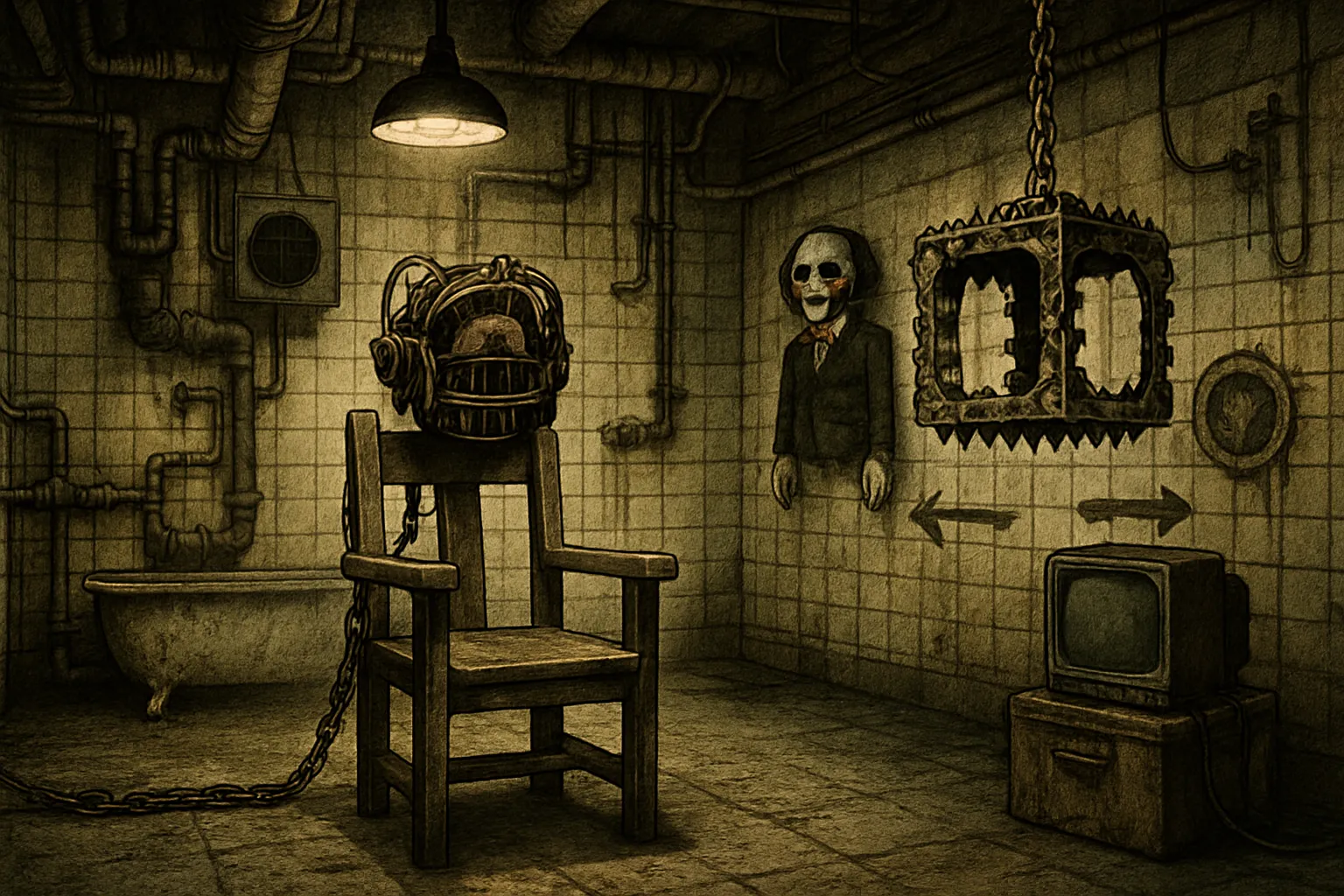
The industrial horror of Saw does not commence with a crime scene; it initiates with the final audit—the ruthless balancing of a life’s ledger. It is the cinema of the necropolitical accountant, a figure who, upon confronting his own terminal organic failure, refuses the passive flow of decay and instead engineers a paranoiac machine designed to violently re-encode the debt structure of existence. Every trap, every snapped bone, every self-inflicted wound is merely the penultimate ledger entry in the balance sheet of the non-life that preceded it. John Kramer, Jigsaw, becomes the ultimate engineer of terminal correction, his entire aesthetic built on the violent tension between flow (desire, life, addiction) and arrest (containment, death, the Code). He is the schizoid subject whose line of flight from passive death snaps back, creating the most rigid, stratified mechanism imaginable: the Code of Unspent Desire.
The Bathroom as Absolute Stratification and Enclosure
The infamous bathroom, the architectural epicenter of the Saw universe, is not a space of radical deterritorialization; it is the ultimate Stratified Space, the metallic crystallization of containment, molar organization, and the rigid management of all excretory flows. It is the sealed, unventilated dungeon of modern hygiene’s failure, a space where filth is neither absorbed nor celebrated, but arrested and quantified. The porcelain, the cold tile, the impermeable surfaces—they enforce the law of the surface, refusing the smooth, enveloping chaos of the pure Body-without-Organs (BwO). The subjects, Dr. Lawrence Gordon and Adam, are instantly stripped of their social titles, reduced to the Zero-Degree of Agency. They are chained to the very plumbing of capital’s disciplinary architecture, their limbs fixed to the piping that regulates and channels waste. The chains are not mere physical restraints; they are the materialization of the disciplinary axiom, forcing the subjects to enact the oldest, most rigid Oedipal imperatives of Western society: kill the rival (Adam) to save the family (Gordon) (Deleuze & Guattari, 1983). Jigsaw’s instruction, delivered via the unsettling puppet and the detached voice, is to force the subjects off the social strata (doctor, photographer) and onto the molecular biological strata of pure, raw survival. This is a deliberate, violent forcing of the subjects into the somatic BwO—the body not as an organism of structured organs, but as a field of intensities where the only imperative is to will life at any cost. This is the transcendental field of trauma, the forced encounter with the Real of one’s own mortality, where the Symbolic collapses and the body speaks only in spasms and blood (Lacan, 1977). The bathroom sink, cracked and grimy, symbolizes the rupture of the standard flow. It is where water—the flow of life, cleansing, and sustenance—has been replaced by filth and stagnancy. The drain, the ultimate symbol of regulated expulsion, is instead the precise point of arrest, swallowing the key that unlocks the possibility of escape. This neutralizing action confirms that the Code's architecture is superior: the drain does not dispose of the solution; it re-codes the solution as unrecoverable waste, affirming the Code's absolute sovereignty over chance and desire.
The Body-without-Organs is not at all the image of a stripped down body, but the material upon which the intensity passes, flows, and circulates. It is not the fantasy of a return to the zero degree. It is the deterritorialized socius, the plane of consistency. (Deleuze & Guattari, 1983, p. 30)
In Saw, the bathroom denies the plane of consistency entirely. It presents a false BwO, a body that can only react to organized violence, a body trapped beneath a suffocating stratum of moral debt. The film is less about survival and more about the capture of residual flow.
Jigsaw's Algorithm: The Accountant of Existential Debt
John Kramer’s terminal cancer diagnosis is the schizoid line of flight par excellence. The body, failing, rejects the molar organization of the medical institution. This absolute, indifferent rejection by the code of public health deterritorializes his identity. Yet, this revolutionary potential—the embrace of the chaos of death—is immediately aborted. Kramer's profound need for meaning in his own mortality causes the flow to snap back into a paranoiac system. He becomes the engineer, the ultimate desiring-machine whose sole purpose is to produce the desired output: suffering-as-value. Kramer replaces the passive, abstract violence of the hospital (leting him die) with the active, concrete violence of the Code (forcing others to live). This act of substitution reveals the deeper structure of his ideology: he weaponizes the will-to-power against the will-to-laziness. His traps function as an intensive micro-apparatus of discipline, forcing subjects into a state of visible, measurable suffering that Foucault understood as the primary function of the spectacle of punishment.
This technology of power, this 'microphysics' that the apparatuses bring into play, must be understood as a set of calculated, connected, and functional operations. (Foucault, 1995, p. 26)
The entire Jigsaw operation is a perfect Foucauldian disciplinary project. It is not about killing—that would be too simple, too molar. It is about extracting a confession of life value through controlled, directed self-harm. The body is the primary inscription surface. It must produce value by demonstrating its adherence to the Code through mutilation or psychological collapse. The Reverse Bear Trap, the device that saves/re-codes Amanda Young, is the perfect example of this techno-legal apparatus. It is a clockwork embodiment of absolute, externalized necessity. Amanda is forced to become a Becoming-Surgeon against her own tissue, replacing her previous addiction flow (drug dependence, self-neglect) with an absolute, traumatic fidelity to the Code. Her survival is not freedom; it is her re-territorialization as Jigsaw's most loyal functionary, proving that the true goal of the trap is the production of a new, coded subject. This shift—from addict to evangelist—is a demonstration of how the paranoiac machine absorbs and utilizes the molecular intensity of the schizoid break, turning the line of flight into a line of servitude. Jigsaw’s critique is inherently Marxist in reverse. He does not critique the exploitation of labor (the extraction of surplus value); he critiques the exploitation of life (the failure to produce existential surplus value). He sees life lived without risk as a form of existential wage theft. By forcing the subject to make an impossible choice—the "game"—he forces the immediate and total liquidation of the subject’s remaining life capital, ensuring the flow is spent now.
The Hyperreal Aesthetic and the Noise of the Machine
The film’s frenetic, non-linear aesthetic—the rapid jump cuts, the use of flash-forwards and fractured flashbacks, the nauseatingly fast camera movements—is the cinematic flow of the capitalist axiomatic itself. The film rejects the standard movement-image (action leading to consequence) for an intensive, fractured time-image (Deleuze, 1989). Saw’s editing collapses past, present, and imminent future into a perpetual present of necessity. There is no time for reflection, only for instantaneous decision. This mirrors the operative logic of late capital, where value is extracted through the acceleration of flows and the instantaneous substitution of debt for liquidity. The entire experience of the film is a state of hyper-acceleration where the subject is exposed to a non-stop flow of intensive signals, the aesthetic reflection of abstract labor: the human subject reduced to a series of panicked, measurable responses to external command (Marx, 1990). The visual language is the Simulacrum of Trauma. Jigsaw’s world is a hyperreal one where the simulated, high-stakes moral lesson is more real than the actual, passive lives of his victims. He engineers a moral simulation where the rules are absolute, and the consequences are entirely physical, thereby forcing reality back into a cynical, controlled existence.
The simulacrum is never that which conceals the truth—it is the truth which conceals that there is none. The simulacrum is true. (Baudrillard, 1994, p. 166)
Jigsaw’s work exists in this simulacral space. The "game" is not a game; it is the hyper-moral reality of the Code, an apparatus that uses the language of play to mask the profound lack of genuine freedom or alternative outcome. The rules dictate the only possible line of flight, and all paths lead back to the Code’s capture. The sound design—the screeching metal, the grinding chains, the low-fi static of the surveillance tapes—constitutes the Noise of the Machine. This is the non-human articulation of the Code, replacing the human voice with the indifferent, mechanized instructions of the trap. The voice of Jigsaw on the tape recorders is the anti-oral machine that strips language of all semantic value, reducing it to pure, coded instruction—the detached, formal language of the bureaucratic algorithm. The voice itself is a flow of pure control, engineered to provoke a specific, measurable affective response.
The Failed Line of Flight: Amputation and Total Capture
The climax of the film hinges on the final, glorious, and ultimately futile line of flight: Dr. Gordon's self-amputation. The hacksaws are the ultimate deterritorializing tools—they are not designed to cut the chain (the molar social constraint) but to rupture the organic stratum (the foot). Gordon’s action—the molecular spasm of cutting his own foot—is a profound, transgressive break. He rejects the molar constraint of the Code’s specific instruction (murder the rival) in favor of the molecular flow of raw biological survival. It is an act of becoming-revolutionary, a primal affirmation of life over law, proving that for an instant, his desire was not defined by Jigsaw’s circuit. He detaches a part of the organism to save the BwO of the rest, enacting a violent, self-imposed molecular surgery. However, this revolutionary act is immediately and brutally captured by the Code's superior architecture. This is the schizoid failure: the line of flight collapses instantly into the paranoiac trap.
The Resurrected Corpse (The Absolute Signal): The inert body lying in the center, the presumed victim of the trauma, rises. This traumatized Thing (the final, indifferent embodiment of Jigsaw) is the ultimate twist of the Code as the Event. The truth was always immanent to the space, hidden in plain sight, ensuring that Gordon’s sacrifice was entirely anticipated by the machine. Jigsaw, the dead man, is the ultimate Death Drive made flesh, the principle of destruction and return to the inorganic state that structures all desire (Freud, 1961).
The Zero-Degree of Capture: Adam's final situation—chained, screaming, his key neutralized as waste in the drain—is the total stratification of the molecular flow. The Code does not require Adam’s death, only his capture and eternal containment. The door slamming shut, the final, indifferent click, is the sound of absolute closure, sealing the subject in a state of eternal debt to the trauma. Adam is left as the static, horrified remnant, the Zero-Degree of the Subject, a testimony to the machine’s terrifying efficiency.
The Code's victory is the cinematic triumph of the Paranoiac Machine over the Desiring-Machines. The film proves that in the face of absolute control and total stratification, the molecular flows of survival and desire are not free; they are merely captured potentials, waiting to be funneled back into the system of moral debt. The necrotic circuit has closed, and the lesson of the trauma is that escape is merely a re-coding of servitude.
References
Baudrillard, J. (1994). Simulacra and Simulation (S. F. Glaser, Trans.). University of Michigan Press.
Deleuze, G. (1989). Cinema 2: The Time-Image (H. Tomlinson & R. Galeta, Trans.). University of Minnesota Press.
Deleuze, G., & Guattari, F. (1983). Anti-Oedipus: Capitalism and Schizophrenia (R. Hurley, M. Seem, & H. R. Lane, Trans.). University of Minnesota Press.
Foucault, M. (1995). Discipline and Punish: The Birth of the Prison (A. Sheridan, Trans.). Vintage Books.
Freud, S. (1961). Beyond the Pleasure Principle (J. Strachey, Ed. & Trans.). Liveright Publishing.
Lacan, J. (1977). Écrits: A Selection (A. Sheridan, Trans.). W. W. Norton & Company.
Marx, K. (1990). Capital: A Critique of Political Economy, Vol. 1 (B. Fowkes, Trans.). Penguin Classics.
Comments
Post a Comment