Pokémon / Power Rangers (1995-2000) The Biopolitical Capture of Children’s Desire: How the Abstract Machine Trains the Body-without-Organs for Capital
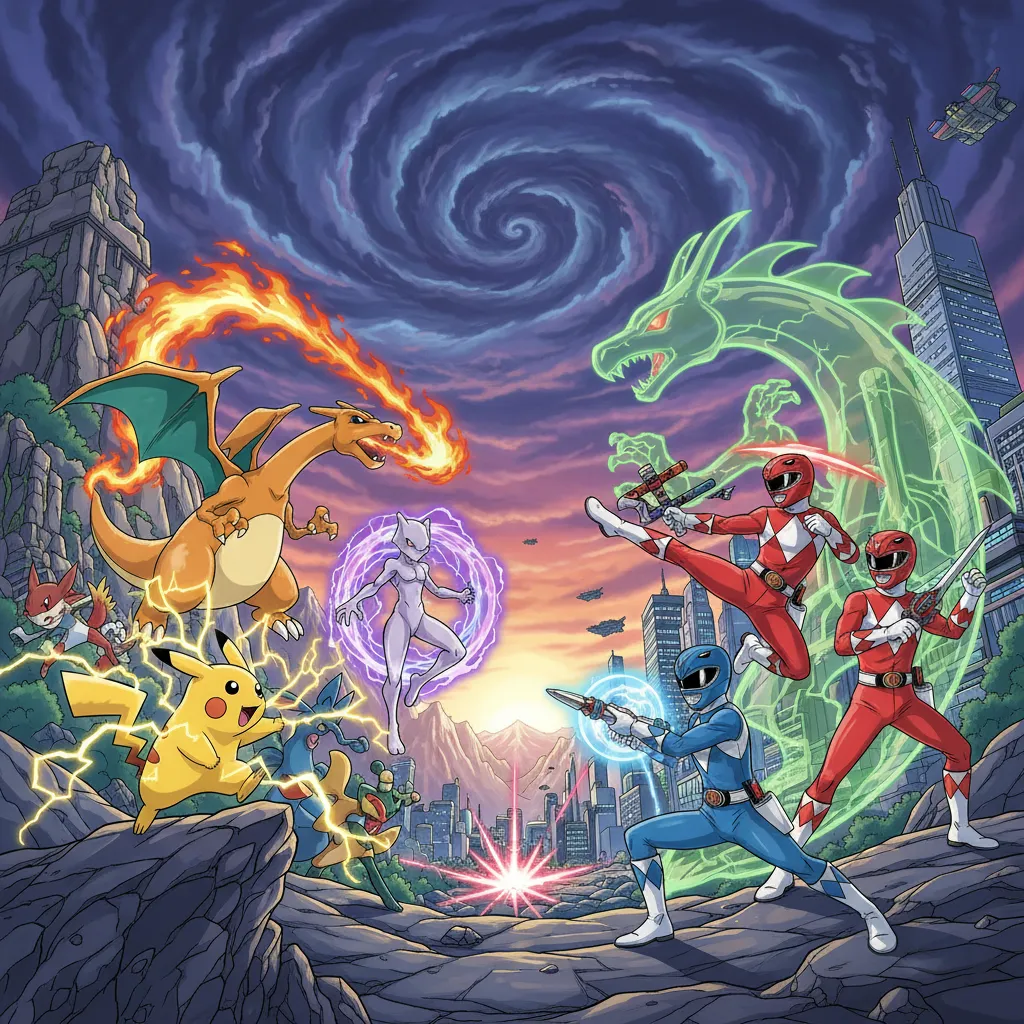
The playground is not a site of pure play; it is the earliest laboratory where the Abstract Machine of Capital begins its intensive process of biopolitical capture, inscribing the smooth, nomadic surface of the child’s Body-without-Organs (BwO) with the harsh geometry of debt, collection, and formalized violence (Deleuze & Guattari, 1983). We begin not with the creature or the hero, but with the object, the prosthetic tool of control: the Poké Ball and the Power Coin. These are not toys; they are technological stratification devices, immediately transforming the raw, energetic flows of childhood desire into measurable, predictable commodities ready for the market.
The schizo is out for a walk. He sees a child clutching a plastic ball and another striking a posed, rigid stance, and he recognizes the immediate, visceral moment of reterritorialization. What the source text identified as Foucault’s apparatus of discipline and power (Foucault, 1977) applied to the individual is here magnified, made explicit, and rendered cute for mass consumption: the perfect, self-policing mechanism of late capitalism.
I. The Immediate Stratification of the Flesh: Poké Ball, Power Coin, and the BwO
The Body-without-Organs (BwO) is the realm of pure, intensive flows, the untamed potential of the cosmic body before it is organized, segmented, and given its definitive organs by the socio-historical socius. Childhood, at its core, holds the promise of this flow: associations unbound by logic, energy ungoverned by utility, and objects valued for their intensity rather than their exchange value.
The Poke Ball as the Castrating Device
In the world of Pokémon, the first act of the hero—the child trainer—is a violent, yet normalized, act of territorialization. The Poké Ball does not contain the creature; it codifies it. It takes the untamed, free-floating, molecular flow of the monster—its roar, its speed, its elemental power—and reduces it to digital information, a specific set of attack statistics and a predetermined evolutionary tree. The Poké Ball is the Castration Complex made physical.
Freud argued that the Complex organizes the subject’s desires around a perceived lack enforced by the Father’s Law (Freud, 1923). In Pokémon, the lack is the un-caught, the missing entry in the Pokédex. The trainer is perpetually driven by this lack—"Gotta Catch 'Em All"—a slogan that is not an encouragement but an infinite debt placed upon the subject by the machine. The trainer, in their obsessive collection, seeks to fully oedipalize the entire natural world, bringing every wild, untamed flow back into the digital ledger, the ultimate recording surface of the Capitalist Axiom. The ball itself is a smooth, perfect orb, concealing the chaotic, schizo-flow it has violently internalized. It is the perfect, portable neurotic assemblage.
The Morpher and the Muscular Armor
The Power Rangers' Morpher, by contrast, does not capture a wild flow, but imposes a flow upon the subject—a flow of pure, pre-coded, militarized function. The adolescent body, inherently chaotic and prone to the flux of ontological insecurity (Laing, 1960), is suddenly rigidified. The Morpher is the immediate application of Character Armor (Reich, 1949). The emotional, awkward teenager is instantaneously replaced by the fully Molar, functionally aggressive superhero, a body built for war.
Reich’s concept of character armor describes the habitual, somatic blockage of emotional truth, the defense mechanisms hardened into a social identity. The Power Rangers transformation is the ultimate expression of this:
Character armor is the sum total of the chronic, specific ways in which an individual has restricted his original total mobility (Reich, 1949, p. 144).
The color-coded uniform and the rigid, choreographed fighting style restrict the Ranger's mobility—both physical and ethical—down to the precise demands of the mission. The muscular armor of the suit is the visible, metallic inscription of the Law of Zordon, forcing the soft, molecular body of the teen into the service of the Molar War Machine. The subject, now a divided self (Laing, 1960) between their clumsy civilian life and their aggressive heroic function, manages this split not through introspection, but through violent, pre-determined action. The Morpher forces the ego into a single, functional, non-negotiable identity.
II. The Desiring-Machines of Collection: Debt, Fetishism, and the Anti-Production
The core logic of the Pokémon universe is the conversion of raw, natural energy into economic and status value through systematized aggression. This is the desiring-machine working in overdrive.
The Obsessive Fetishism of the Roster
The goal is not to train; the goal is to collect. The Pokédex is not a reference guide; it is the ledger of infinite debt. The desire driving the trainer is the schizo-flow of pure production, but it is immediately hijacked and reterritorialized by the Capitalist imperative of the list.
The fetishistic obsession with completing the list is the subject’s violent attempt to overcome the fundamental lack coded by the Oedipal/Capitalist system. Žižek (2009) reminds us that the ideological fantasy operates not to hide reality, but to perpetuate the lie that drives the system. The lie here is that total fulfillment—the complete, 150-entry Pokédex—is possible, or even desirable. The actual purpose of the list is perpetual, differential production, ensuring the subject must always move, always trade, always expend labor to fill the empty set coded into the machine.
The moment of the catch is the moment the animal is transformed into a commodity fetish (Marx, 1867/1976), where the social relationship of power (trainer over Pokémon) is masked by the object’s magical aura (its stats, its rarity). The creature’s existence is now defined by its exchange value in the system of battles and trades, completely annihilating its use value as a wild entity.
The Molecular Madness of Evolution
Evolution, the supposed great liberation in the Pokémon process, is merely a higher degree of stratification. The subject is excited by the intensity of the change, but the evolutionary path is rigorously predetermined and controlled by the Molar forces of level-up or specific stones. The becoming-animal (Deleuze & Guattari, 1987) that should lead to a line of flight—a true break from the human norm—is instead channeled into the acceptable, marketable form of the next commodity fetish.
When we observe the initial source text’s commentary on dreams and the obscurity of sexual flow, we see how the schizo-flow of the dream factory produces un-codable energies. The Pokémon evolution is the systematic re-coding of those energies, ensuring that the dream of change is only ever realized in the form of a pre-approved, higher-value asset. The monster’s aggressive desires are harnessed, not liberated.
III. The Molar War Machine: Zords, Megazord, and the Violence of the Aggregate
Power Rangers presents the Molar organization of the subject for total, spectacular war. If Pokémon uses molecular capture, Power Rangers uses molecular aggregation to form a giant, rigid political body.
The Five-Fold Neurotic Assemblage
The team structure—five distinct colors, five distinct personalities—is the deliberate creation of a Neurotic Assemblage. Each Ranger’s identity is already fractured, an adolescent struggling with ontological insecurity (Laing, 1960). The team’s constant low-level bickering and reliance on Zordon’s authoritarian guidance demonstrate their collective inability to manage the raw flows of their own desires. They are trapped in a neurotic loop, requiring external threats (the monster of the week) to enforce internal cohesion.
The Zord is the prosthetic machine of aggression, an immediate escalation of Reich’s muscular armor. It represents the transference of the adolescent’s blocked, armored aggression into a spectacular, socially sanctioned form of violence. The Zords are the material reality of the subject’s repressed destructive impulses, given mechanical form and political justification by Zordon (the symbolic Father/State figure).
The Megazord as the Biopolitical State
The Megazord is the ultimate expression of biopolitical power (Foucault, 1977). It is not just a robot; it is the perfectly functioning Molar War Machine—a single, massive, unified body formed from the voluntary aggregation of the five smaller, armored units. This aggregation is not a union of equals; it is the complete liquidation of molecular difference in favor of Molar function. The five distinct flows of the teenagers are now perfectly synchronized, forced into the shared, single consciousness required to operate the giant body of the State.
The Megazord’s appearance, always timed for the peak of the threat, is the obscene fantasy (Žižek, 2009) of the social contract made manifest: the fantasy that individual freedoms (the teenagers' distinct lives) must be violently subsumed into a single, monolithic, armored identity to ensure collective survival. It is the spectacle that ensures the perpetuation of the lie—the lie that this unified, violence-producing structure is necessary and good. The Megazord is the State giving itself permission to enact total, spectacular violence in the name of peace.
IV. Ethical Flights and the Reterritorializing Wall of Zordon’s Law
The true political function of these machines is not to fight the enemy, but to contain the potential for revolutionary thought within the subjects themselves.
The Failure of the Event
Alain Badiou (2005) defines the Event as the rupture, the moment when an ethical truth arises that cannot be accounted for by the existing codes of the situation. The true Event in Power Rangers would be the Rangers refusing to morph, refusing the violence, and engaging in a critical dialogue (Freire, 2000) with the monster, the source of the trauma, and Zordon’s unquestioned Law.
But the narrative always ensures the failure of the Event. Any potential line of flight—a Ranger questioning the mission, or a monster showing empathy—is immediately and violently reterritorialized. The monster is always defeated, the Molar structure of the Megazord is always successful, and the teenagers revert back to their pre-Morphed, neurotic, and socially acceptable lives. The return to civilian clothes is the final, sad moment of codification: the molecular chaos is swept clean, and the Character Armor is temporarily shed, only to be put on again for the next, inevitable command.
Nietzsche and the Will to Power as Duty
The Rangers’ will to power (Nietzsche, 1967) is not a creative, life-affirming force; it is a reactive one. Their power is granted by an external authority (Zordon), and their actions are pure, reactive duty. This form of power is the termination of the living flow, the perfect domestication of youthful energy. They are not powerful because they will to be, but because the Abstract Machine demands their function.
The subtle ethical layer of Freire’s liberation theory (Freire, 2000) provides the final critique. These children are never taught critical consciousness. They never question the why of their servitude, only the how. They are the oppressed who have fully internalized the values of the oppressor (Zordon’s Law). They perform endless, non-recuperable labor (fighting the monster) for no material gain, only the psychic reward of restored status and the removal of the ontological insecurity that the non-Morphed world brings.
V. Conclusion: The Training Montage as the Biopolitical Future
The two franchises, side-by-side, represent the dual imperative of late-stage global capitalism: the Pokémon flow trains the subject for flexible, digital, decentralized collection and competition (the collection of data, the gig economy’s ceaseless micro-labor), while the Power Rangers machine trains the subject for rigid, coordinated, spectacular aggregation and militarized obedience (the formation of massive corporate or state bodies).
They are the dialectic of the child's existence under the Capitalist Axiom: one flow says "Catch, collect, compete, and individualize your debt," and the other says "Aggregative, militarize, and dissolve your individuality into the necessary Molar War Machine."
The ultimate victory of these franchises is that they make the tools of surveillance, control, and formalized violence desirable. The child asks for the Poké Ball; the child demands the Morpher. They voluntarily seek the instruments of their own stratification, making the biopolitical capture a flow of self-driven, ecstatic consumption. The chaotic energy of the schizo-flow is thus channeled, codified, and placed into the service of a system that needs its desire not to be destroyed, but to be produced and controlled for the next generation of debt and labor. The child is, quite literally, trained to love their Character Armor.
References
Badiou, A. (2005). Being and event (O. Feltham, Trans.). Continuum.
Deleuze, G., & Guattari, F. (1983). Anti-Oedipus: Capitalism and schizophrenia (R. Hurley, M. Seem, & H. R. Lane, Trans.). University of Minnesota Press.
Deleuze, G., & Guattari, F. (1987). A thousand plateaus: Capitalism and schizophrenia (B. Massumi, Trans.). University of Minnesota Press.
Foucault, M. (1977). Discipline and punish: The birth of the prison (A. Sheridan, Trans.). Vintage Books.
Freire, P. (2000). Pedagogy of the oppressed (M. B. Ramos, Trans.). Continuum.
Freud, S. (1923). The ego and the id. Hogarth Press.
Laing, R. D. (1960). The divided self: A study of sanity and madness. Penguin Books.
Marx, K. (1867/1976). Capital: A critique of political economy, Vol. 1. Penguin Classics.
Nietzsche, F. (1967). On the genealogy of morals (W. Kaufmann & R. J. Hollingdale, Trans.). Vintage Books.
Reich, W. (1949). Character analysis (T. P. Wolfe, Trans.). Orgone Institute Press.
Žižek, S. (2009). The parallax view. MIT Press.
Comments
Post a Comment