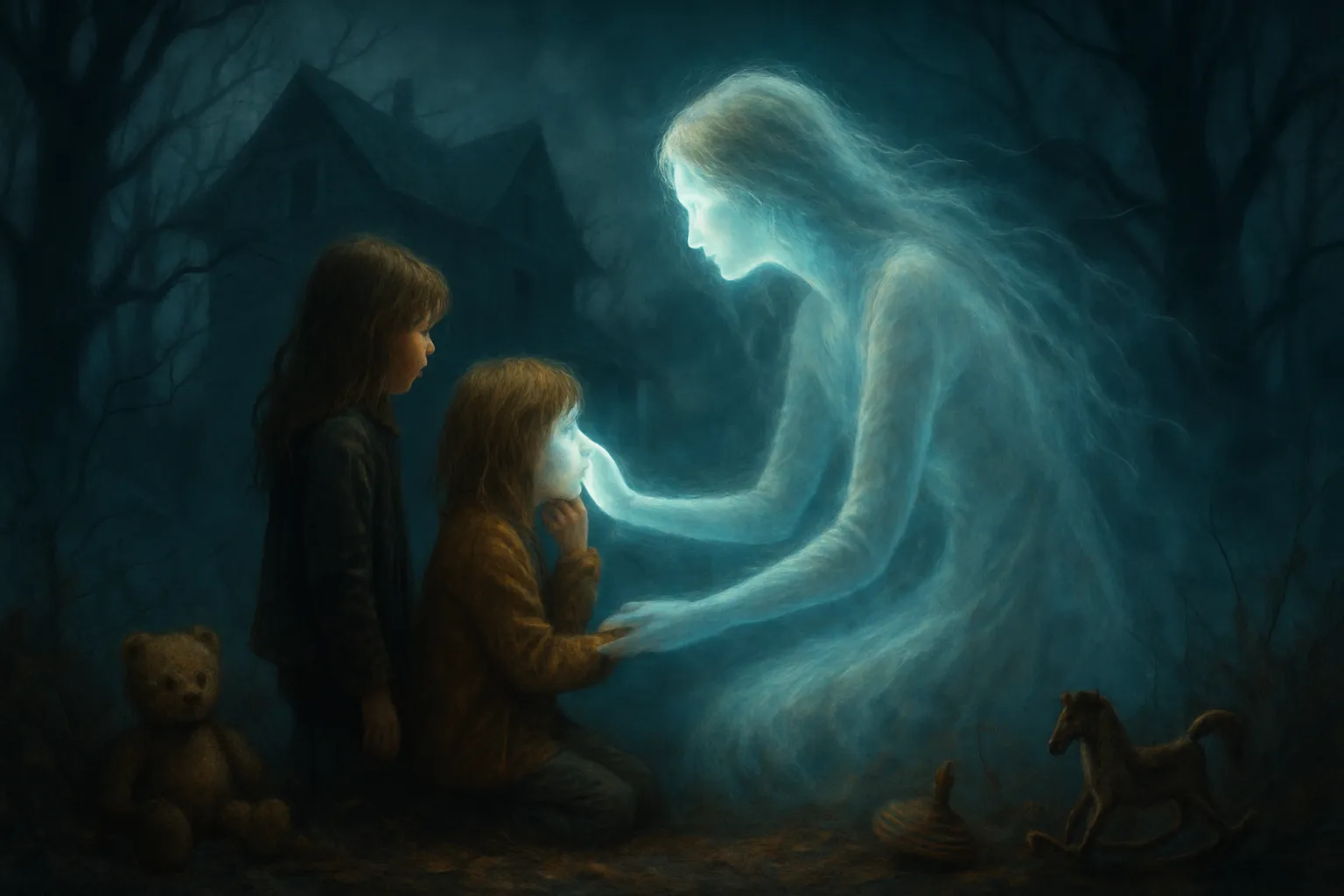
The cinematic text of Mama (2013) is not a story of domestic haunting, but a surgical incision into the very core of the Oedipal machine, exposing the terrifying flows that capitalism seeks to segment and repress. When the nuclear family is brutally shattered by a crash in the snow, two small bodies are cast onto the Body without Organs (BwO), finding themselves immediately plugged into a spectral desiring-machine known only as Mama. This ghost is the ultimate excess of maternal trauma, the Lacanian Real persisting, a force that violently codes the children's survival instincts into a feral counter-language. The film documents the intensive, molecular conflict that erupts when the Symbolic Order attempts to recapture this pure, non-human flow, forcing the children to choose between the stratified comfort of civilization and the psychotic confidence of absolute, non-human love.
Feral Desire
The standard sociological discussion, paralyzed by the tired armature of Nature versus Nurture, fails to register the molecular reality: that both concepts are themselves stratifications, territorializing operations designed by the reigning social machine (the Socius) to contain and categorize the limitless, undifferentiated potential of the human Body without Organs (BwO) (Deleuze & Guattari, 1987). Mama (2013) begins, brutally, by deterritorializing the nuclear family unit—the cornerstone of Oedipal stratification—through a moment of pure, indifferent chaos: the car crash in the snowy woods. This rupture is the initial line of flight, severing Victoria and Lilly from the code of the father and casting them onto the smooth, unsegmented plane of the forest BwO.
Their father, Jeffery, in his madness, attempts a final, violent re-territorialization (murder) before being interrupted by the creature known only as Mama. This ghost-mother is not merely a supernatural entity; she is a desiring-machine born from the ultimate excess of maternal trauma, an embodiment of the Lacanian Real that has been rejected by the Symbolic Order (Lacan, 2007). She is the pure, demanding maternal superego, a psychotic confidence that plugs into the very flow of the children’s survival desire, generating an entirely new, feral schizo-flow of existence.
The cinematic flow—represented by the disturbing opening credits composed of children's drawings—shows the arrest of normative human development. The girls' becoming-animal—specifically, their movement "around on hands and feet like a fox" and their diet of cherries—is the physical inscription of this new code onto their bodies. This is the BwO as a plane of consistency where desire is no longer directed toward production (language, social integration) but towards anti-production: running, grunting, and playing in perpetual, self-contained intensity. They have been stripped of the Oedipal code, reduced to a minimal, affective vocabulary (grunts) and spatial intelligence (feral movement), confirming Nietzsche's analysis that the master/slave dynamic of societal morality is often just the channeling of raw will to power through a specific social filter (Nietzsche, 1968). Mama’s filter is the trauma of absolute, possessive lack, which she transforms into absolute, possessive care.
Oedipal Machine
Annabel, the eventual adoptive mother/partner, begins the film as a subject actively resisting the Oedipal Axiom imposed by the dominant Socius (Deleuze & Guattari, 1983). Her joy at a negative pregnancy test is not just relief; it is a declaration of independence from the reproductive demands of the capitalist system, which constantly demands the production of new subjects and the perpetuation of the family unit. Her statement to Lucas, "It's your brother, if you want to spend all your money trying to find them it's ok with me. It's cheaper than therapy. ...and so am I," is a perfect articulation of life within late capitalism: she equates their relationship to a commodity exchange—a cheaper form of emotional maintenance (therapy)—and actively positions herself outside the flow of familial reproduction. She wants the man who wants children, but without the messy, non-commodity actual children.
Her entire existence is a minor line of flight, a resistance to the stratification of motherhood as a pre-coded female destiny.
"The essential thing is that we have become accustomed to conceiving of the human being not as an organism but as a social organization. The organism is an effect of the Socius." (Deleuze & Guattari, Anti-Oedipus, 1983, p. 109, modified)
Annabel’s line of flight, however, is immediately captured and recuperated by the introduction of Victoria and Lilly. She is forced into the role of motherhood, or she faces the loss of her relationship—the loss of her self-defined stability. The children, previously products of the feral BwO, are now the producer of the new mother. They are the intensive force that creates the parent, forcing Annabel’s body and desire into the mold of the self-sacrificing maternal ethos she previously rejected. This dynamic brilliantly inverts the traditional power structure (Foucault, 1995), demonstrating that the flow of influence runs from the molecular intensity of the traumatized child to the molar structure of the adult subject. Annabel's transformation from hesitant partner to embodying sacrificial motherhood is the successful re-territorialization of her desire onto the plane of the Symbolic Law, albeit a law rewritten through intense, affective labor.
The Failure of the Symbolic Code
Mama, the ghost, functions as the Sublime Object of Ideology (Žižek, 1989). She is the pure, demanding Big Other who promises wholeness but delivers only psychotic attachment. Her love is not nurturing but absolute possession, demanding fidelity to her traumatic, unassimilated history.
Mama's backstory—a woman driven mad by the loss of her baby and suicide, whose maternal desire persists in a state of spectral intensity—represents the Archival Desire, a traumatic kernel that refuses to yield to the Symbolic Order. The symbolic process (language, law, social integration) is designed to bury the raw Real of trauma, but Mama is the Real persisting, the body's refusal to accept its own death and the loss of its object. She haunts the Symbolic—Annabel's normal life, the therapist's analysis, the structured home—demanding that reality conform to her psychotic code.
In the film's climax, the children are forced to choose between the two maternal codings:
Mama's Code (Feral-Possessive Flow): Pure intensity, immediate connection, absolute protection, but demanding fidelity to the traumatic and the non-human. This is the BwO as the plane of immediate, unmediated connection, but devoid of ethical choice.
Annabel's Code (Symbolic-Sacrificial Flow): Mediated love, language, ethical self-sacrifice (Annabel risking her life), demanding integration into the social contract and human language. This is the stratification of love onto the Oedipal plane.
The true conflict is therefore not Nurture versus Nature, but the violent collision of two distinct codes of desire. Mama’s code is a repressive regime parading as radical freedom, freezing the children in a state of arrested, non-linguistic development, forever outside the Symbolic. Annabel’s code offers the possibility of symbolic integration, of naming the trauma and entering the law, even if that law is oppressive.
Victoria, the older child, remembers the Symbolic Rupture of the car crash and the initial familial code, allowing her to choose Annabel and the human world. Lilly, the younger, whose schizo-flow was established entirely in the smooth space of the forest BwO, chooses Mama, choosing the pure, unmediated flow of intensity and non-human becoming.
When Lilly is pulled into the fall, she embraces the spectral, her becoming-ghost completing her becoming-animal. Lilly’s final, molecular choice—her acceptance of the ultimate line of flight into non-existence alongside Mama—confirms the enduring, unrecuperated power of the traumatic code over the Symbolic Law for the subject whose identity was entirely produced on the feral plane. This ending denies the typical horror film recuperation, ensuring the molecular intensity of the BwO triumphs over the molar structures of the family.
References
Baudrillard, J. (1994). Simulacra and Simulation. (S. F. Glaser, Trans.). University of Michigan Press.
Deleuze, G., & Guattari, F. (1983). Anti-Oedipus: Capitalism and Schizophrenia. (R. Hurley, M. Seem, & H. R. Lane, Trans.). University of Minnesota Press.
Deleuze, G., & Guattari, F. (1987). A Thousand Plateaus: Capitalism and Schizophrenia. (B. Massumi, Trans.). University of Minnesota Press.
Foucault, M. (1995). Discipline and Punish: The Birth of the Prison. (A. Sheridan, Trans.). Vintage Books.
Lacan, J. (2007). Écrits: The First Complete Edition in English. (B. Fink, Trans.). W. W. Norton & Company.
Nietzsche, F. (1968). The Will to Power. (W. Kaufmann, Ed., & W. J. Hollingdale, Trans.). Vintage Books.
Žižek, S. (1989). The Sublime Object of Ideology. Verso.
Comments
Post a Comment