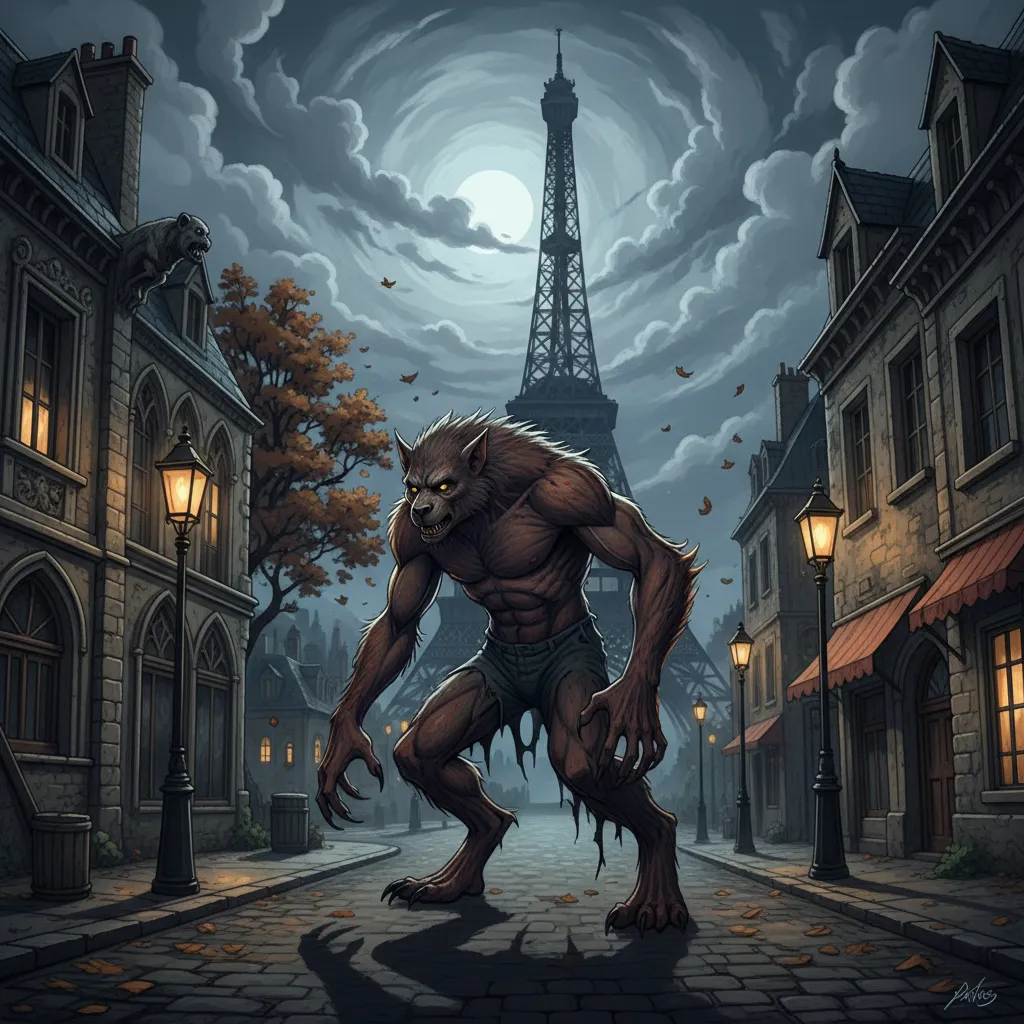
Growing up, horror movies terrified me so much I used to hide behind the couch—until one late night stumble into 'An American Werewolf in Paris' changed the game. Paris, bungee cords, and a werewolf packed with existential dread? I wish I could say it was just another monster movie—yet its tangled mess of romance, guilt, and excess begged for something deeper. Diving into Gilles Deleuze and Félix Guattari’s wild concepts made it clear: sometimes, the scariest thing isn’t the werewolf but the labyrinth of desire, identity, and history it drags behind. Grab a croissant (or a silver bullet), because this is no ordinary film analysis.
A City of Codes: Paris as Body-without-Organs and Cultural Backdrop
In An American Werewolf in Paris, the city is far more than a scenic backdrop or a romantic cliché. Instead, Paris emerges as a densely coded, historically weighted site—a living archive of cultural, architectural, and psychological strata. The film’s schizoanalytic reading, as explored in “The Lycanthropic Line of Flight: Paris as the Body-without-Organs and the Schizo-Sexual Economy of An American Werewolf in Paris (1997),” positions Paris as the ultimate “Body-without-Organs” (BwO) of culture. Here, the city is not a static collection of monuments, but a throbbing, anti-structured field where libidinal energies and traumatic histories collide.
The concept of the BwO, drawn from Deleuze and Guattari, serves as a theoretical entry point: Paris is depicted as a living, breathing anti-structure, resisting easy consumption or comprehension. Its labyrinthine streets, layered with centuries of revolution, romance, and repression, become a site where the protagonist’s American fantasies of escape and reinvention are both enabled and frustrated. The city’s mythic density is not just visual; it is felt as a force that shapes and resists the flows of desire and identity.
Throughout the film, urban adventures unfold across iconic sites—from the shadowy catacombs to the illuminated heights of the Eiffel Tower. Each location is more than a tourist attraction; it is a node in the city’s complex network of codes. The catacombs, with their ossuaries and subterranean passages, evoke the buried traumas and repressed histories of Europe, while the Eiffel Tower, site of the protagonist’s bungee jump, becomes a stage for ritualized risk and fleeting access to the BwO. These journeys overlay personal trauma with collective memory, making every chase and transformation a negotiation between the individual and the city’s cultural apparatus.
On a personal note, consider the sensation of wandering a city at night—feeling both invisible and hyperaware, at once lost and deeply present. This is Deleuze’s Paris: thick with meaning, stratified with history, and uncanny in its ability to mirror the wanderer’s inner state. The film captures this mood, presenting Paris as a space where the protagonist’s search for freedom becomes entangled in the city’s own labyrinthine logic. Rather than a playground for youthful adventure, Paris becomes a mirror to the protagonist’s escape fantasies—a maze that reflects and refracts his desires.
The film’s schizoanalytic framework emphasizes the interplay between molar (large-scale, institutional) and molecular (micro, affective) flows within the city’s mythic history. Paris is both a “molar apparatus”—a site of grand narratives, laws, and codes—and a field of molecular experiences, where fleeting encounters and libidinal flows disrupt the surface order. The protagonist’s journey through Paris becomes a negotiation between these scales: his American “Character-Armor” is tested against the city’s ancient, coded labyrinth, and his attempts at deterritorialization are continually reabsorbed by the city’s dense cultural machinery.
In this way, Paris functions as a living BwO, a site where the boundaries between self and city, desire and discipline, are constantly redrawn. The city’s coded layers do not simply provide atmosphere; they actively shape the schizo-sexual economy of the film, making Paris an essential player in the drama of lycanthropic transformation and libidinal disruption.
Adrenaline Economics: Bungee Jumping and the Capitalist Axiomatic
The opening sequence of An American Werewolf in Paris sets the tone for its schizoanalytic critique by centering on a ritualized bungee jump from the Eiffel Tower. This act, far from being a spontaneous outburst of youthful rebellion, is carefully staged as a commodified spectacle—a “point-scoring” game among American tourists. Here, risk is not a genuine confrontation with danger or mortality, but a purchasable thrill, a packaged experience that can be bought, performed, and shared. The film’s protagonist, in leaping from one of the world’s most iconic structures, is not escaping social codes but rather participating in a new kind of capitalist ritual, where masculinity and self-worth are measured by the willingness to engage in “extreme” but ultimately safe, consumer-friendly risks.
This is the logic of what Deleuze and Guattari call the Capitalist Axiomatic: the reduction of all flows—desire, adventure, even fear—into quantifiable, exchangeable units. The bungee jump becomes a symbol of how contemporary subjectivity is shaped by the market. The thrill is not transformative; it is simulated and scored, a fleeting access to the Body-without-Organs (BwO) that is instantly reterritorialized as a social achievement. The protagonist’s emotional vulnerability, his supposed “daredevil” authenticity, is itself a product, available for purchase and display. The film suggests that even our most intimate experiences of risk and excitement are now mediated by consumer logic.
This commodification of risk is not just a cinematic device. It echoes real-life experiences—like the time one might impulsively buy a skydiving voucher, only to back out at the last minute. The paradox is telling: the act of not jumping, of refusing the purchased risk, can feel oddly liberating. It raises the question: Why do we buy risk? Is it the thrill itself, or the social capital that comes with having “done something extreme”? The film’s protagonist, like many in contemporary youth culture, seems driven less by a genuine desire for transformation and more by a need to prove himself within a system that rewards spectacle over substance.
Drawing on R.D. Laing’s concept of ontological insecurity, the protagonist’s daredevil acts are revealed as symptoms of deeper anxiety about self-worth and identity. The bungee jump is not a true line of flight—a radical escape from social codes—but a carefully circumscribed performance. The safety harness, the crowd, the scoring system: all ensure that the risk is contained, the danger simulated. The protagonist’s search for meaning is thus continually frustrated, as each act of “extremity” only reinforces the boundaries he seeks to escape.
This dynamic invites reflection on the broader question: Is adventure just a product now? The film’s portrayal of risk as a commodity, masculinity as spectacle, and emotional vulnerability as simulation points to a culture in which even the most primal experiences are subject to the logic of the market. The bungee jump, far from being a moment of liberation, becomes a ritual of reterritorialization—a return to the safety of the known, the commodified, the scored.
Becoming-Wolf: Lycanthropic-Flow, Schizo-Sexuality, and Romantic Subjectivity
In An American Werewolf in Paris, the werewolf is not simply a monster or a victim of a supernatural curse. Drawing from schizoanalytic theory, the film’s lycanthropic motif is best understood as a libidinal eruption—a force that violently disrupts the protagonist’s psychological defenses, or what Deleuze and Guattari term Character-Armor. Rather than a fixed identity or tragic fate, lycanthropy emerges as a process, a Lycanthropic-Flow that destabilizes the boundaries of self and the codes of love, sex, and subjectivity.
This schizoanalytic reading reframes lycanthropy as an event rather than an essence. The transformation is not about becoming a “werewolf” in the traditional sense, but about experiencing a BwO-Event—a moment when the body and psyche are thrown into a state of flux, breaking free from the usual social and psychological structures. In this sense, love, sex, and even infection are not stable identities, but unpredictable, risky encounters that challenge the subject’s sense of self. The American protagonist’s Character-Armor—his learned defenses, moral codes, and consumerist bravado—are all tested and ultimately undone by the lycanthropic process.
A key dynamic in the film is the schizo-sexual fascination that drives the male lead. He is not simply attracted to the woman’s appearance or personality, but to her willingness to risk everything—her existential gamble with death. This attraction is less about desire for a person and more about a longing for the intensity and authenticity of her experience. The woman, poised on the edge of suicide, represents a Deterritorialized-Ego, a subject who has broken away from the safe, coded world of American normalcy. The protagonist is drawn to her not as an object of love, but as a Desiring-Machine plugged into the “death-flow,” embodying a radical escape from the ordinary.
It’s reminiscent of that friend who always falls for the messiest, most chaotic partner—drawn not to comfort or safety, but to the thrill of genuine danger. The attraction is not to the person, but to the event, the risk, the possibility of being changed by contact with something uncontrollable.
Yet, the union between the protagonists is never a pure escape. Their sexual encounter, especially the moment when the woman is “on top of him on the bed,” is charged with the promise of merging their Bodies-without-Organs—a fleeting attempt to exist outside social codes. However, this union is always tainted by the lycanthropic virus. Infection, in this context, is not just a plot device but a metaphor for how every attempt at liberation or connection is already entangled in new flows of risk and instability. The lycanthropic-flow transforms love and sex into dangerous events, where the boundaries between self and other, pleasure and destruction, are constantly renegotiated.
In this schizoanalytic framework, becoming-wolf is not a heroic journey or a tragic fall, but a continual process of deterritorialization. It is a movement through libidinal labyrinths, where romantic subjectivity is always at risk—never stable, always in flux, and forever haunted by the possibility of transformation.
Spectral Guilt: Ghouls, Conscience, and the Re-Territorialized Ego
In An American Werewolf in Paris, the recurring appearance of “ghouls”—the spectral victims of lycanthropy—serves as a powerful metaphor for the protagonist’s divided self. Drawing on Laing’s theory of ontological insecurity, the ghouls are not simply ghosts haunting the living; they are externalized fragments of the protagonist’s psyche, representing unresolved trauma and the visible cracks in his Character-Armor. These apparitions operate as both conscience and symptom, embodying the schizoanalytic idea that guilt is never truly resolved but instead continually recodes identity.
From a Freudian and Oedipal perspective, guilt is typically understood as the internalization of social and parental rules. The ego polices itself, and the conscience is an inner voice. However, the film disrupts this model by making conscience visible and external. The ghouls appear to the protagonist as reminders of his violence and failure, but they are also more than simple moral judges. They are the living proof that trauma is never fully processed or closed off. Instead of being integrated and resolved, guilt returns in spectral form, always unsettled and always demanding attention.
This dynamic is central to the schizoanalytic reading offered in the article. Guilt, in this context, becomes a kind of operator—a force that never allows the protagonist to settle into a stable, coherent self. Each encounter with a ghoul is a moment of re-territorialization, where the ego tries to reassert control and return to normative codes of masculinity and morality. Yet, these efforts are always incomplete. The ghouls, as Molar Apparatus of Conscience, enforce a return to Oedipal and moral codes, but paradoxically, they also require the curse—the lycanthropic flow—to persist. Without the curse, the ghouls would vanish; their existence depends on the protagonist’s ongoing cycle of violence and guilt.
Ever felt haunted by past embarrassments just when you thought you’d moved on? That’s the protagonist’s experience, magnified. No matter how much he tries to escape or repress his actions, the ghouls return. There is no peace—only the endless return of what was supposed to be left behind. This cycle mirrors everyday experiences of guilt and regret, but in the film, it is dramatized through the supernatural.
The schizoanalytic approach highlights how guilt functions as an open system, never allowing for true closure. The protagonist’s encounters with the ghouls are not just about personal responsibility; they are about the impossibility of fully re-integrating the self after trauma. The ego becomes a shifting, re-territorialized site—never whole, always haunted. The ghouls are both the enforcers of conscience and the evidence that conscience is never fully internalized. They thrive on the persistence of the curse, ensuring that the protagonist’s identity remains in flux, caught between the desire for liberation (the BwO-event) and the pull of normative codes.
In this way, An American Werewolf in Paris uses the motif of spectral guilt to illustrate the endless process of identity formation and deformation. The ghouls are not just reminders of past wrongs; they are active agents in the ongoing schizoanalytic drama, ensuring that the protagonist’s ego is always being re-coded, never at rest.
Heart-Eating and Monstrous Appetite: Cannibalizing the Symbolic Order
One of the most striking motifs in An American Werewolf in Paris is the act of heart-eating—a visceral, ritualistic violence that transcends mere horror spectacle. Within the schizoanalytic framework, this act is not simply about physical consumption but about devouring the very organ that, in psychoanalytic tradition, stands for love, affect, and the Oedipal bond. The heart, as the canonical symbol of romance and emotional connection, becomes the target of the werewolf’s monstrous appetite, marking a radical rejection of the symbolic order that structures human relationships.
The film’s werewolf does not just consume flesh; it cannibalizes meaning itself. By tearing out and eating the heart, the lycanthropic Body-without-Organs (BwO) enacts a violent refusal of the codes and rituals that define love in both American and European cultural imaginaries. This act is a literalization of anti-romance: the rituals of love—courtship, sacrifice, union—are not just subverted but digested and annihilated. The heart-eating scene transforms what is typically a metaphor for emotional vulnerability into a schizo-sexual event, where the boundaries of self, other, and meaning are dissolved in the monstrous flow of desire.
Cannibalism here functions as a symbolic rejection, a schizoanalytic “line of flight” from the Oedipal order. The werewolf’s appetite is not just for blood but for the stratified categories that organize subjectivity: lover and beloved, victim and predator, human and monster. In consuming the heart, the werewolf attempts to incorporate the victim’s stratification, annihilating symbolic meaning and inscribing its own anti-categorical, deterritorialized reality. The act becomes a metaphor for the libidinal economy described by Deleuze and Guattari, where desire is not about lack or fulfillment but about breaking down boundaries and consuming the codes that constrain it.
I remember biting the heads off chocolate bunnies at Easter—never realized I was critiquing the Oedipal order.
This playful tangent highlights how acts of consumption, even in childhood rituals, can be read as unconscious critiques of symbolic authority. In the film, however, the violence is neither playful nor innocent. The heart-eating is a ritualistic violence that serves as a radical anti-stratification, a monstrous appetite that refuses to be contained by social or psychological categories. It is the ultimate schizoanalytic gesture: to eat the heart is to destroy the possibility of closure, to resist the re-territorialization of desire into safe, familiar forms.
- Heart-eating motif: Devouring the Oedipal organ of love and affect.
- Cannibalism as symbolic rejection: The werewolf consumes not just flesh, but symbolic meaning itself.
- The anti-romance: Love’s rituals are literalized, digested, annihilated.
- Ritualistic violence: Radical anti-stratification; monstrous appetite as metaphor for anti-categorical desire.
Through the lens of schizoanalysis, the heart-eating motif in An American Werewolf in Paris emerges as a powerful metaphor for the destruction of the symbolic order. It dramatizes the monstrous, deterritorialized flows of desire that threaten to consume not just the body, but the very codes that make meaning possible.
Philosophical Outliers: A Thousand Plateaus, Multiplicities, and the Impossible Wolf-Pack
Deleuze and Guattari’s A Thousand Plateaus offers a radical rethinking of identity and collectivity, moving away from the idea of the individual as a stable, self-contained unit. Instead, they introduce the concept of multiplicity—a way of being that is always in motion, always connected to others, and never reducible to a single form. This framework is crucial for understanding the schizoanalytic reading of An American Werewolf in Paris, where the werewolf is not just a lone monster but a participant in a larger, shifting pack. The werewolf, in this sense, is only truly “an event” when it becomes part of a multiplicity; alone, it is simply a body in waiting, but in a pack, it becomes a force that can disrupt, transform, and deterritorialize.
In the film, lycanthropy is not merely a personal curse or biological affliction. It is a ritualized process that codes collective identity through cinematic rules and shared behaviors. The transformation scenes, the secret gatherings, and the rules of the wolf-pack all function as rituals that bind individuals into a temporary, unstable community. These rituals echo the “codes” that Deleuze and Guattari describe—systems that organize desire, behavior, and even the body itself. The werewolf’s pack is a living example of what they call a rhizome: a network with no clear center, always growing and changing, always threatening to dissolve back into chaos.
This idea of the pack as a site of becoming is central to the film’s schizoanalytic interpretation. The protagonist’s journey is not about finding his “true self” but about entering into a series of becomings—becoming-wolf, becoming-pack, becoming-other. The pack is not a fixed group; it is an impossible wolf-pack, always on the verge of falling apart, always threatened by the forces of reterritorialization that seek to return its members to stable, individual identities. The film dramatizes this tension: the American werewolf’s attempt to join the Parisian pack is always incomplete, always haunted by the threat of being pulled back into the codes of American masculinity and consumer identity.
On a personal note, the challenge of forming a true pack is not limited to the world of werewolves. Once, the author tried to start a film club—an experiment in collective identity. Despite initial excitement, the group dissolved after just two meetings. Perhaps, as Deleuze and Guattari suggest, true multiplicities are rare and fragile. The wolf-pack, whether in cinema or real life, is always a difficult and unstable formation, easily undone by the pressures of individualism and social codes.
Philosophically, the werewolf occupies a liminal position: it is neither fully human nor fully animal, neither fully individual nor fully collective. This liminality is both its power and its vulnerability. The werewolf’s becoming is always at risk of being captured by new codes—romantic love, guilt, consumer rituals—that threaten to reterritorialize its wild potential. In An American Werewolf in Paris, the impossible wolf-pack stands as a symbol of the ongoing struggle between the forces of liberation and the pressures to conform, a living example of Deleuze and Guattari’s vision of multiplicity and non-individual becoming.
Escape, Irony, and the Cynicism of Repetition: The Political Limit of Becoming-Wolf
In An American Werewolf in Paris, the promise of escape—of breaking free from the strictures of identity, morality, and the Oedipal order—is dangled before both protagonist and viewer. Through the lens of schizoanalysis, the film’s lycanthropic transformation is not simply a monstrous affliction, but a potential line of flight: a chance to dissolve the rigid Character-Armor of the American psyche and access the Body-without-Organs (BwO) of pure, unstratified experience. Yet, as the article “The Lycanthropic Line of Flight: Paris as the Body-without-Organs and the Schizo-Sexual Economy of An American Werewolf in Paris (1997)” argues, this escape is ultimately revealed as ironic and circular—a repetition that exposes the political limits of “becoming-wolf.”
The film’s narrative arc, which begins with a bungee jump off the Eiffel Tower and ends with the couple repeating this act, is a telling metaphor. What first appears as a daring rupture—a leap into the unknown—quickly becomes a commodified ritual. The thrill of risk and the intensity of romance are packaged as repeatable, consumable experiences. The Chrono-Axiom of late capitalism ensures that even the most extreme gestures of rebellion are folded back into the logic of the marketplace. As Paulo Freire might observe, there is no true emancipation here; even the act of “becoming-wolf” is stripped of its revolutionary potential and sold back to the subject as a lifestyle choice.
This is the cynicism of repetition: the line of flight becomes a treadmill, not a revolution. The protagonist’s journey through Paris—its catacombs, its monuments, its labyrinthine streets—mirrors the internal journey of the Deterritorialized-Ego. But each act of chaos, each eruption of lycanthropic violence, is ultimately contained and reterritorialized. The werewolf’s rampage does not shatter the molar apparatus of culture; instead, it is absorbed, overcoded, and neutralized. The Schizo-Sexual union, the heart-eating, the spectral ghouls of guilt—all these are folded back into the system, ensuring that the subject remains trapped in a cycle of desire, guilt, and failed escape.
There is a certain dramatic irony at play. The film’s wildest moments—its orgiastic violence, its desperate romance—promise liberation but deliver only a new form of captivity. Lycanthropy, far from freeing the protagonist, becomes another apparatus of control, a curse that overcodes and consumes. The American werewolf, armed with the tools of consumerist extremity, finds himself right back where he started—perhaps a little more wounded, a little more aware of his divided self, but fundamentally unchanged. As the article wryly notes, sometimes even the wildest nights out end with us right back at a chain café, nursing a coffee (or a wound), the promise of escape replaced by the comfort of repetition.
In the end, An American Werewolf in Paris stands as a sharp political critique. It exposes the limits of “becoming-wolf” in a world where even the most radical gestures are commodified and contained. The film’s irony is that, despite all the chaos and transformation, nothing truly changes. The cycle repeats—romance, risk, and rebellion, all available for purchase, all leading back to the same place.
TL;DR: Deleuze’s schizoanalytic lens transforms 'An American Werewolf in Paris' into a provocative meditation on risk, love, and the commodification of youth rebellion. Lycanthropy here isn’t just horror—it's a messy map of fragmented identities, urban anxieties, and the wild hope for escape. Whether you’re a werewolf fan, city-dweller, or theory buff, prepare for a leap into the unknown.
Comments
Post a Comment