Introduction
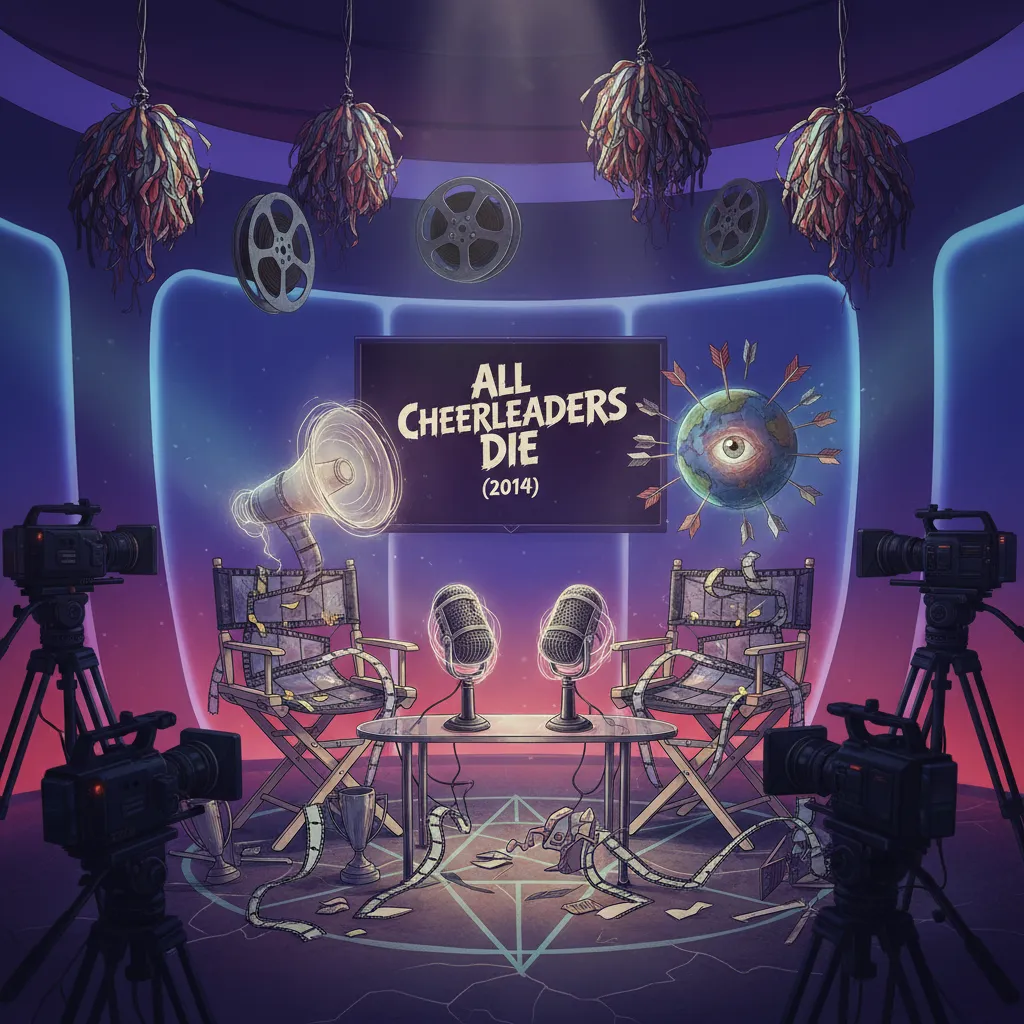
All Cheerleaders Die (2014) is a unique horror-comedy that blends teenage melodrama with supernatural revenge. The film, directed by Lucky McKee and Chris Siverton, successfully captures the turbulent, unpredictable emotional landscape of adolescence. Its widespread viewing following its festival run brought an explosion of fun and genre blending to audiences. I had the pleasure of interviewing the directing duo, McKee and Siverton, about the process of revisiting and expanding their original concept. The following conversation offers insight into their creative motivations, the intentional shifts in tone, and the underlying thematic elements concerning identity and social structures within the film.
The cheerleading/facechewing flick All Cheerleaders Die has garnered a strong cult following since its festival run, and its return to widespread viewing is an explosion of fun. The film was like sharing a teenage's head space as they shooted along a roller coaster during puberty. Exciting stuff! I had the opportunity to interview the directing duo Lucky McKee and Chris Siverton about unloading this truck full of zombified pom-poms to our doors. This interview provides a crucial textual artifact, a schizo-archive detailing the directors' own affective investments (their juvenile humor, their love of horror), which are then extruded as the cinematic flows we consume. Their shared return to the material of the original film—the "second marriage" to the same conceptual core—is a decisive moment of Re-Territorialization, a movement to stabilize and re-code a chaotic, youthful line of flight into a mature, commercially viable Desiring-Machine.
The film itself operates as a complex Trauma-Reversal Assemblage. The central narrative, involving the death and reanimation of the cheerleaders, is a violent rupture of the established Socio-Sexual Stratification of the high school environment. The cheerleaders, as the original Molar Organs of Social Control (representing beauty, popularity, and normative gender coding), are literally deterritorialized through death and then re-territorialized through dark Wiccan flows. Their subsequent "facechewing" aggression is a chaotic, libidinal overflow that violently breaks the established Character Armor of the high school social body. Wilhelm Reich would analyze the cheerleaders' initial compliance and subsequent destructive outburst as a momentary collapse of the Muscular Armor that had rigidly suppressed their aggressive and sexual energy, leading to a sudden, explosive release of repressed material.
The directors’ reflection on the film as a "fun, young and vibrant" escape from "heavy, heavy, dark, serious, adult movies" is telling. It signifies a retreat to the Pre-Oedipal Flow, a yearning for the chaotic energy of the Body-without-Organs (BwO) that the adolescent body naturally represents before it is fully coded by the pressures of adult responsibility and cinematic seriousness. Their shared juvenile humor, which "has remained and gotten worse the older we have gotten," is the persistent Molecular Flow resisting the molar solidification of the industry.
Interview with Lucky McKee and Chris Siverton
SquidXIII: Why did you guys become directors in the first place?
Chris Siverton: For me it was simple love of movies. You know, like going to see see Star Wars as a kid and just being totally spell bound and becoming addicted to that experience. It's pretty simple, I guess on my end.
Lucky McKee: The first thing that made me pick up a camera was the Nightmare On Elm Street Films. It made me just wanna pick up a video camera and try to make my own Freddy movie. I never stopped after that.
SquidXIII: What did you learn about yourself while you were making All Cheerleaders Die?
Lucky: That we have gotten a lot older since we made the original.
Chris: Yeah it's true. It is kind of funny, in that way to remake something that we made basically as kids right out of film school and working with actors that were the same age as we were back then
Lucky: and our juvenile sense of humor has remained and gotten worse the older we have gotten.
SquidXIII: On that note. One of my favorite philosophers is Slavoj Zizek, and he has stated that, "The only real marriage is the second marriage to the same person." So in that light I was wondering why it was important for you to remake All Cheerleaders Die?
Chris: I think we wanted to tap back into what got us making, and also get away from making, heavy, heavy, dark, serious, adult movies. We wanted to do something that was fun, young and vibrant. Shake our individual styles up a little bit more and compare notes about what we both learned on making our individual films over the better part of a decade. It felt like like the right thing to do at the time.
Lucky: I think there was a lot left to explore in the kind of simple concepts that we came up with for the first one and now that we have been through the process of working on a bunch of other stuff, it was fun to bring everything we learned together, again to make this fun party movie.
SquidXIII: One of the things I really liked while I was watching All Cheer Leaders Die is that I didn't know where it going to go next. I was wondering how you guys thought through suspense in the movie?
Lucky: Chris has brought this up before. We have to work on this thing for quiet some time and we wanted it to stay interesting to us. The idea of replicating teen emotions climatically meant a lot of tone shifts and mood swings in the movie. It was just fun to play with all those styles and tones and see if we could throw people off, feel like you are going one direction, and then jerk them another direction. Then have something really really heavy and dark happen, and five minutes later have it be comedic and silly and fun and fantastic.
SquidXIII: Are there any of your high school memories find their way into All Cheerleaders Die?
Chris: I don't think so. Not for me. nothing specific like an antidote that happen to us that we put in. It is probably more general emotion and feelings that we remembered as far as liking someone in high school and having it not be reciprocated and that kind of thing. and how it felt fitting into a group of people and determining your own identity which is all that fun stuff that happens when you are coming of age in high school. I think it was in a general sense, I mean I don't think either one of us has had sex with a girl in a bathroom...
Lucky: Unfortunately
Chris: We never went through that right of passage.
SquidXIII: What do you think All Cheerleaders Die says about the world we live in?
Chris: I think when we made the movie we didn't really have any statement or anything like that we were trying to make about the world. We saw it as a collection of characters we believe in and the relationships between them. I mean there are themes in there as well, but we try not to be too heavy handed. There is like simple stuff like about how Maddy, our main character, has these preconceptions of the cheerleaders at her school and they are prooven wrong. It's a very simple thing that people are people, you can make snap judgements on them to try to fit them into any kind of cateogory you want, but more often then not if you get to know people they will surprise you.
Lucky: Its a fun way to play with the audience too. Because when you hear the title "All Cheerleaders Die" or see the trailor your expectations are pretty base. And to start the movie, to start right with a cheerleader, right in that whole world and then to peal the layers back, I think was really fun. The Tracy character represents that theme better then anyone else in the film, because she appears to be this vapid cheerleader when it starts and she starts having some really complex emotions as the movie unfolds which we thought was interesting. I guess "don't judge a book by its cover" is the message All Cheerleaders Die has.
Chris: Its just going to become more and more monterous as it tears everyhting apart. Our villian, the football player is kinda like when you have someone doing bad stuff, and poeple kind of know about him, and tolerate it for a while until it gets too out of control. Basically too hard to contain. A theme in a lot of horror and thriller movies in which the evil comes from people, rather than a supernatural threat. When in a supernatural movie the true horror is caused by the actions of a cold hearted person basicly.
SquidXIII: I really like, what I've labeled, the wiccan glow stones. I was wondering if there was any mythos behind those and how you got the effect you are were looking for?*
Lucky: We did practical lighting on set and then Chris introduced me to a visual effects artist named Roger Nall who we worked with on I Know Who Killed Me and Chris and I were pulling influences from a lot of the great 80's optical animation that was really prevalent in films that we grew up on. We wanted to do a modernized version of that.
Chris: Traditionally witches, people who are into Wicca and all that kind of stuff, we kind of skated around any type definitions by Leena saying its not exactly Wicca when she is talking about her power. It was an offshoot where we could do what ever we wanted, but traditionally witches have divine signs of things, and cast lots, which means they would toss a bundle of sticks on to the ground or a lot of the time it is tea leaves from the bottom of a tea cup and dumping them out on a table. Depending on how they fall trying to find meaning out of that, that is something that has existed for a long time and we did our own version of that with the special stones that Leena has, which is a little connection to the original where the girls had big stone necklaces around their neck. Back then we did it with little Christmas lights inside these fake stones
SquidXIII: What was the most fun scene to shoot?
Lucky: Gosh. It would have to be the river scene, Huh Chris? That was a blast.
Chris: The river scene was fun. There was a ton of people there all night and it was raining. That was fun because it was really difficult to put a car in this river. Just to get permission to do that in california was alot of work. It's always fun when we give ourselves big challenges and see how we can pull them off. Its the fun of film making in general. Even shooting a simple scene can present a whole bunch of weird challenges you never anticipated.
Lucky: and shooting on the universal backlot, being able to shoot outside and have that kind of control, not having to regulate traffic or any of that kind of stuff. Having plugs where you need them and that was just really really fun to shoot just next door to the Jaw's ride at Universal Studios
Chris: yeah that was a blast
SquidXIII: I have one last question that comes from one of my readers. Have you conidered doing an Topless alternative ending, Like in Harold and Kumar?*
Lucky: A topless ending?
SquidXIII: Yeah I didn't know about it either. Apparently the movie had an alternative ending were everyone was topless.
Chris: We will discuss that one. It never came up.
Lucky: Yeah I can believe it. We will save it for the sequel. In the sequel everyone will be topless.
*Reader question: @HMPod Rocks!
*Reader question: Nikki Rocks!
Schizoanalytic Flows and Armor
The directors' deliberate engagement with the "mood swings in the movie" to replicate "teen emotions climatically" is the film's highest schizoanalytic achievement. The film itself becomes a Manic-Depressive Desiring-Machine, forcing the audience through sudden, unpredictable shifts in tone ("heavy and dark happen, and five minutes later have it be comedic and silly and fun and fantastic"). This refusal to settle into a single Molar Narrative Stratum—horror, comedy, fantasy—is a radical act of Deterritorialization that destabilizes the viewer’s expectations and mirrors the chaotic Body-without-Organs (BwO) of the adolescent.
The villain, the football player, is the embodiment of the Molar Masculine Armor. He is the social-sexual aggressor whose "bad stuff" is "tolerated for a while until it gets too out of control." Reich would analyze this figure as the Armored Character, whose societal privilege and rigid entitlement are expressed as a physically and socially armored body that deflects moral or legal consequence. His evil, being "caused by the actions of a cold hearted person basicly," is the political horror of the Axiomatic Function: his actions are a simple, logical outcome of the high school's oppressive social code, not a supernatural anomaly. His containment failure is the moment the Oppressive Axiom becomes unsustainable, forcing a violent rupture and demanding a transformation—or a re-territorialization—of the entire field. R.D. Laing's perspective complements this by noting that the villain, in his rigid, cold-hearted function, suffers from a severe Ontological Insecurity, using violence and social control to maintain a sense of reality that is constantly threatened by the spontaneous, chaotic flows of others.
The magic used by Leena is described as an "offshoot where we could do what ever we wanted," suggesting a flexible Nomadic Flow unconstrained by established tradition (Wicca). The "special stones" and the "casting lots" are a method of creating A-Signifying Signs, allowing the girls to generate meaning and power outside the symbolic order of the school. The reanimation of the cheerleaders through this sororal flow is the birth of the Revenge Assemblage, a collective Becoming-Monster that violently inverts the high school's hierarchy.
The "river scene," noted as the most fun to shoot, symbolizes the definitive Line of Flight—the moment the cheerleaders' bodies (and the car, a Molar extension of their identity) are completely detached from the social territory and submerged into the Elemental Flow of water. The "difficulty to put a car in this river" and the "alot of work" to get permission highlights the resistance of the State Apparatus (California bureaucracy) to any flow that threatens to exceed its control. The success of the shot is the minor triumph of the Nomadic Art-Machine over the Bureaucratic Grid.
The final reader question about the "Topless alternative ending" and the directors’ humorous agreement ("In the sequel everyone will be topless") is the ultimate, explicit acknowledgment of the Libidinal Economy underwriting the entire project. It is the final, jovial nod to the film's status as a Desiring-Machine that continually seeks to break the bounds of propriety and push the chaotic, hormonal flows of adolescence toward their maximum possible intensity, a permanent flirtation with the Schizo-Sexual Exceedance that the narrative has so effectively mapped. The willingness to propose a sequel where "everyone will be topless" is a pledge to the continued, non-stop production of desiring-flows, rejecting the symbolic closure of the first film in favor of Endless Flow and Deterritorialization.
Conclusion
The insights from Lucky McKee and Chris Siverton reveal that All Cheerleaders Die is fundamentally a film about embracing the chaos of adolescence. Their intention to replicate the "tone shifts and mood swings" of being a teenager translated into a deliberate subversion of genre expectations, making the film a vibrant, unpredictable experience. The success of their "second marriage" to the material lies in their ability to inject learned cinematic maturity into the raw, juvenile energy of the original concept. Ultimately, the film offers a message of looking beyond superficial appearances—a simple theme that underpins the complexity of its sororal revenge narrative.
Keywords: Schizo-Sexual, Desiring-Machine, Character-Armor, Necro-Aesthetic, Re-Territorialization, Sororal-Flow
Meta Description: A schizoanalytic deep dive into All Cheerleaders Die (2014), mapping the aesthetic flows, libidinal economy, and political reversal of high school stratification.
Hashtags: #Schizoanalysis #DesiringFlow #CharacterArmor #BecomingMonster #LibidinalEconomy #BWO
Would you like me to adjust any of the schizoanalytic terminology or expand on any specific philosophical concepts?
Comments
Post a Comment