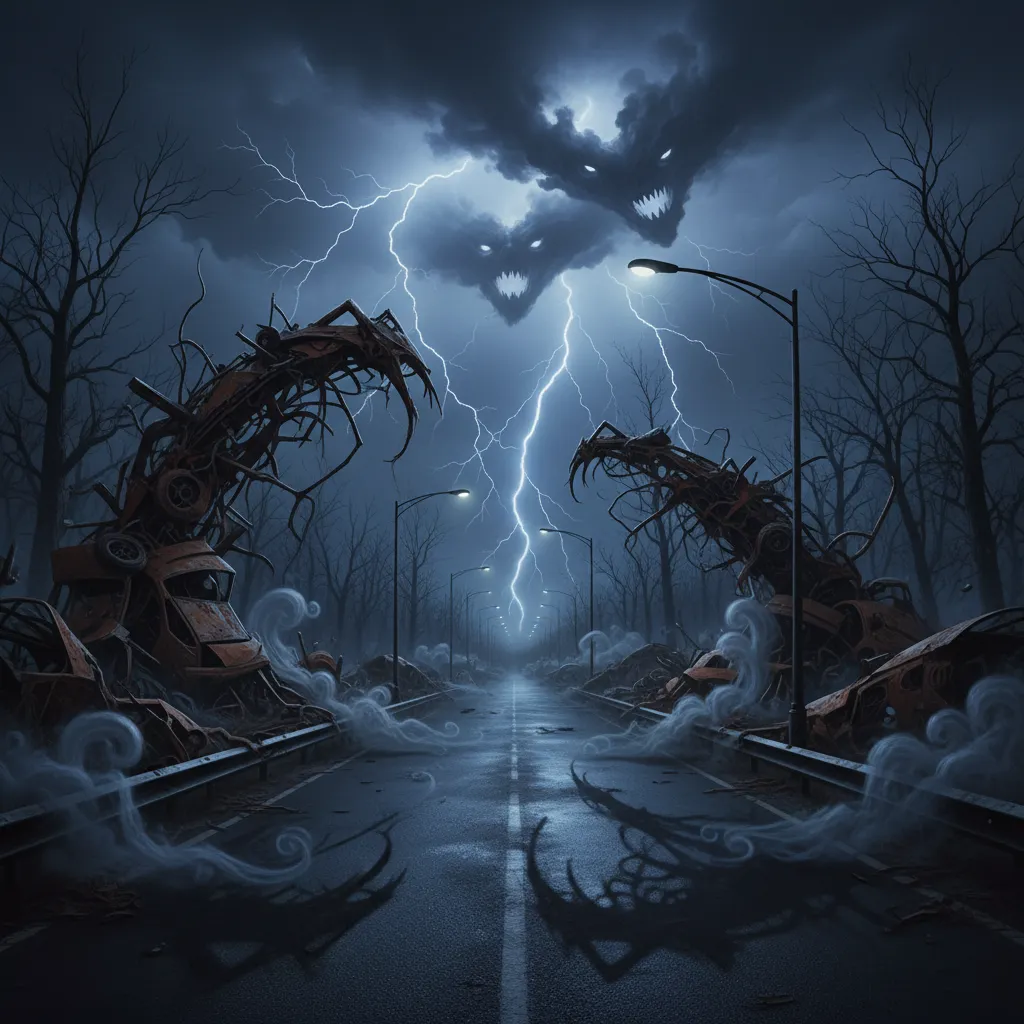
Let’s start with a confession: the first time I saw Final Destination 2, I was sure it would just be another gory sequel. But as steel twisted on that infamous freeway and Destiny played puppeteer with ordinary lives, something strange happened—I found myself scribbling down words like 'Axiomatic' and 'Deterritorialization' on the popcorn-stained napkin in my lap. Maybe it was the adrenaline talking, but the film’s chaos felt less like cheap thrills and more like a philosophical explosion. Why does a horror movie about random accidents resonate so deeply with our sense of order and anxiety? This post is an attempt to get at the machinery under the mayhem.
Axioms, Premonitions & Freeways: The Unseen Rules of Destiny
From its opening moments, Final Destination 2 (FD2) signals its allegiance to what the schizoanalytic text calls the Final Destination Axiomatic. Audiences are primed to expect not only the return of Death’s rules, but their escalation: “Death, Continuation of previous rules, Car Crash.” This axiomatic framework shapes both the narrative and the viewer’s mindset, making every coincidence or malfunction feel like the inevitable work of an unseen system—what the analysis terms the Chrono-Axiom. In FD2, the rules are not just repeated; they are intensified, creating a climate where every action is haunted by the threat of Destiny’s correction.
The film’s signature multi-car pile-up is more than a spectacular set piece. The text frames it as a Deterritorialization Event: a moment when the carefully ordered flows of the freeway-machine—the highways, cars, and routines of daily life—are violently disrupted. The freeway, usually a symbol of American freedom and progress, becomes a site of chaos. Cars, which function as extensions of their drivers’ Character Armor (drawing on Reichian theory), are stripped of their protective power. In the aftermath, the freeway transforms into a Body-without-Organs (BwO), a space where all structure collapses and every body is equally vulnerable to the impersonal forces of steel, gravity, and fate.
Kimberly’s premonition of the disaster is a pivotal moment. Her vision acts as a line of flight—a brief escape from the Chrono-Axiom’s grip. By warning others and diverting her own fate, she performs a minor act of revolution against Death’s system. However, the film quickly reasserts the Chrono-Axiom’s logic: every deviation must be corrected, and every survivor is marked as an anomaly to be reabsorbed into the order of Destiny. This cycle of escape and containment is central to the film’s tension.
FD2 positions random chance not as mere accident, but as an insistent, omnipresent force. Everyday objects—fire escapes, kitchen appliances, even backyard grills—become conduits for Death’s abstract machine. The survivors’ attempts to shield themselves with additional Character Armor—whether through safety routines, social withdrawal, or physical barriers—ultimately fail. The illusion of control is exposed as fragile, with the film’s violence revealing the thin line between order and chaos in modern life.
The freeway and the car are more than settings; they are metaphors for the ways society and individuals try to manage risk and uncertainty. The act of buckling a seatbelt, for example, can feel both empowering and strangely ominous—a personal memory that echoes the film’s themes. “I remember the first time I fastened a seatbelt as a child: I felt invincible, yet a part of me wondered if I was preparing for disaster.” This duality—security and anxiety—captures the essence of FD2’s exploration of destiny and control.
Through its relentless choreography of hazard and survival, Final Destination 2 exposes the unseen rules that govern both its characters and its audience. The film’s world is one where the Chrono-Axiom and the freeway-machine intersect, making every moment a negotiation between the promise of safety and the inevitability of disruption.
The Chrono-Axiom & Death’s Abstract Machine: Order from Chaos, or Vice Versa?
In Final Destination 2, Death is not a visible monster or a supernatural entity. Instead, it functions as an invisible, systemic force—what the schizoanalytic critique terms the Chrono-Axiom. This is a kind of abstract machine, an underlying logic that ruthlessly restores order whenever survivors momentarily escape their fated demise. The Chrono-Axiom is not simply about chaos or randomness; it is about the relentless re-imposition of structure, even as that structure is revealed to be fragile and contingent.
Every time a character in FD2 manages to evade Death, the Chrono-Axiom responds with systemic re-stratification. The survivors’ brief lines of flight—moments of escape from the expected—are quickly recaptured. Death’s inventiveness is not creative in the sense of a sentient being plotting revenge, but rather bureaucratic and procedural, like a malfunctioning system determined to close every loophole. This is why Death in the film feels less like a villain and more like a malfunctioning bureaucratic process: it is both absurd and tragic, as if the universe itself cannot tolerate deviation from its schedule.
Ordinary objects—fire escapes, kitchen appliances, even a simple barbecue grill—are transformed into Death’s minions. These everyday items, designed for safety or comfort, become agents of destruction. This transformation highlights the fragility of the regulated world. The illusion of safety, built on insurance policies, safety routines, and building codes, is exposed as paper-thin. The survivors’ attempts to shield themselves with Character Armor—whether through psychological defenses or practical precautions—prove ultimately futile. The world is shown to be a network of stratified molecular flows (electricity, water, gas) that are always on the verge of breaking free from human control.
The experience of sudden danger in familiar settings is not limited to the film. Consider the panic that arises when a smoke alarm malfunctions at 2 a.m.—the shrill noise, the confusion, the sudden suspicion that something safe has become sinister. In FD2, this sense of unease is amplified: the familiar is always on the edge of becoming deadly. The freeway-machine—a symbol of American freedom and mobility—becomes a site of catastrophic Deterritorialization, where order collapses and the Body-without-Organs (BwO) emerges in the form of twisted metal and shattered lives.
Key scenes, such as the collapse of the fire escape ladder or the explosive barbecue accident, serve as reminders that even the most regulated environments are vulnerable. These moments are not just accidents; they are the BwO-Ruptures where the Chrono-Axiom reasserts itself, using the very tools of order and safety to enforce its logic. The survivors’ efforts—buying insurance, following routines, seeking expert advice—are shown to be reactionary and individualized, never addressing the true nature of the abstract machine that governs their fate.
In this way, Final Destination 2 uses the Chrono-Axiom and Death’s Abstract Machine to question whether order truly emerges from chaos, or if chaos is simply the hidden truth beneath the surface of order. The film’s relentless cycle of escape and re-stratification reveals the impossibility of permanent safety, and the tragic absurdity of trying to outmaneuver a system that is everywhere and nowhere at once.
Collapse of the Oedipal Machine: The Family and the Flame-Grilled Finale
The climactic BBQ explosion in Final Destination 2 stands as a vivid illustration of what schizoanalytic theory calls an anti-Oedipal rupture. In this moment, the film does not simply kill a character—it annihilates the very heart of the nuclear family, the so-called “Oedipal machine.” The backyard, often seen as a safe haven of American domesticity, is transformed into a site of chaos and destruction. The sudden, violent death of a child during a family gathering is not just shocking; it is a deliberate attack on the comforting structures of parental authority and safety that the Oedipal model represents.
From a schizoanalytic perspective, this is more than a plot twist. It is the BwO-Rupture—the moment when the body-without-organs (BwO) emerges, stripping away the layers of character-armor and muscular-armor that families construct to protect themselves from the unpredictable flows of fate and accident. The explosion is not random; it is the Chrono-Axiom in action, reasserting its logic by obliterating the fragile order of the family unit. The film turns the American dream of safety and togetherness into a grotesque form of anti-domestic satire, exposing how easily these ideals can be undone by forces beyond anyone’s control.
Clear Rivers’ character arc further deepens this critique. Having survived the events of the first film, Clear is permanently marked by her exposure to Death’s logic. She cannot return to a “normal” life; her existence is defined by a constant awareness of the Chrono-Axiom and its inescapable demands. Clear’s self-sacrifice is not a heroic return to order but a tragic acceptance that the system cannot be escaped. Her alienation highlights how, once touched by the deterritorializing force of Death, individuals are forever separated from the comforting flows of family and routine.
This theme resonates with a broader trend in horror cinema. As critical theory suggests, horror films often destabilize traditional ideas of parental authority and domestic safety. In FD2, the infamous deaths—especially those occurring in supposedly safe, everyday settings—become darkly comic commentaries on the fragility of the nuclear family. The film’s violence is not just physical but symbolic, turning the rituals of family life, like a backyard barbecue, into scenes of grotesque destruction.
On a personal note, many viewers may recall the routine disaster drills of childhood—exercises meant to reassure us that safety is possible if we follow the rules. Final Destination 2 transforms that everyday doubt into cinematic spectacle, revealing the limits of preparation and the illusion of control. The nuclear family, far from being a stable foundation, is shown to be fundamentally fragile within the larger chaos of the freeway-machine and the abstract machines that govern modern life.
In this way, the film’s finale is not just a shocking set piece but a pointed philosophical statement. The collapse of the Oedipal machine is both a narrative and theoretical event, mapping the dissolution of personal and social coherence in the face of systemic chaos and the relentless logic of the Chrono-Axiom.
Spectator Anxiety & The Molecular Production of Dread
In Final Destination 2 (FD2), the experience of dread is not limited to the characters on screen. Instead, the film’s unique approach to suspense and violence produces what the source text calls a “molecular production of anxiety”—a form of fear that seeps into the viewer’s own body and daily life. This is not simply suspense in the traditional horror sense. Rather, FD2’s death scenes are engineered to create a tactile, almost physical anxiety, implicating the spectator in the film’s relentless logic of the Chrono-Axiom and the Freeway-Machine.
From the opening Deterritorialization Event—the catastrophic freeway pileup—the audience is thrust into a world where the ordinary is always on the verge of collapse. The highway, long a symbol of American freedom and progress, is reimagined as a site of unpredictable violence. This transformation is not just narrative, but sensory. The film’s use of sound design—screeching tires, snapping metal, the sudden silence before impact—works in tandem with abrupt camera movements to orchestrate the viewer’s stress response. The result is a kind of BwO-Rupture (Body-without-Organs rupture), where the boundaries between screen and spectator begin to blur.
FD2’s death sequences are meticulously constructed to disrupt the viewer’s sense of safety. Everyday objects—kitchen appliances, water bottles, even a simple coffee mug—are imbued with lethal potential. As the survivors attempt to reinforce their Character-Armor and Muscular-Armor against Death’s abstract machine, the audience is forced to confront the fragility of their own routines. The film’s power lies in its ability to make the familiar strange; after watching FD2, it is not uncommon for viewers to find themselves eyeing electrical outlets, fire escapes, or even their own showers with suspicion. As one might confess:
Rewatching FD2, I found myself side-eyeing the electrical outlets in my own apartment.
This effect is not accidental. The film’s narrative and technical strategies work together to implicate the viewer, pushing them out of a position of passive detachment and into a state of vicarious vulnerability. The Chrono-Axiom operates not only within the story but also within the psyche of the audience. Each near-miss and fatal accident is a reminder that the structures we trust—building codes, traffic laws, safety devices—are only temporary barriers against the chaos lurking beneath.
The open road, once a metaphor for limitless possibility, is revealed as a space of latent danger. FD2 exposes the underlying violence and decay within American infrastructure, using the Freeway-Machine as a symbol of both mobility and menace. The film’s relentless focus on the breakdown of order—whether through a collapsing ladder or an exploding grill—serves as a critique of the very ideals that underpin modern life. In this way, the spectator’s anxiety is not just a reaction to on-screen events, but a direct engagement with the film’s deeper philosophical questions about safety, freedom, and the inevitability of Death’s deterritorializing force.
- #Schizoanalysis
- #FinalDestination
- #Deterritorialization
- #ChronoAxiom
- #CharacterArmor
- #AbstractMachine
Infrastructure, Disorder, and America’s Invisible Risks
In Final Destination 2 (FD2), the everyday structures of American life—highways, fire escapes, and household appliances—are not just backdrops for disaster, but active participants in a subtle critique of national infrastructure. The film’s schizoanalytic reading, as explored in “The Freeway-Machine and the Chrono-Axiom: Death’s Deterritorialization of the Stratified Body (2003),” reveals how the very systems celebrated as symbols of progress and safety become vectors for risk, decay, and unpredictable violence. This inversion of the American Dream is central to the film’s unsettling power.
From the opening freeway catastrophe, FD2 exposes the freeway-machine as a fragile assemblage, its promise of speed and freedom undermined by its susceptibility to chaos. The multi-car pileup is not simply an accident, but a Deterritorialization Event: a moment when the regulated flows of traffic—so carefully managed by rules, signage, and social expectation—collapse into a Body-without-Organs (BwO). Here, the boundaries between person and machine, intention and accident, dissolve into a lethal, unstratified pulp. This motif recurs throughout the film, suggesting that beneath the surface of technological advancement lies a constant threat of social and physical dissolution.
Recurring failures—such as the fire escape ladder that impales a survivor, or the BBQ explosion that destroys a family gathering—highlight the unreliability of the very tools designed for safety and comfort. These scenes are not random; they are carefully constructed to show how Death, as the Abstract Machine of the Chrono-Axiom, operates invisibly through the infrastructure of daily life. The film’s survivors, in their desperate attempts to reinforce their Character Armor—whether through insurance, safety checks, or group solidarity—find that these defenses are ultimately inadequate against the molecular flows of electricity, gas, and gravity that Death manipulates.
FD2’s vision of American life is one where mobility and convenience are revealed as precarious illusions. The open highway, once a symbol of freedom, becomes a site of mass vulnerability. Home appliances, meant to ease domestic life, become sources of unpredictable danger. The film’s relentless focus on infrastructural breakdown offers a dark inversion of the American Dream: progress is always shadowed by the risk of collapse.
- Highways: Promise speed and connection, but also mass disaster.
- Fire Escapes: Designed for rescue, yet fail due to neglect and decay.
- Home Appliances: Symbols of comfort, turned into lethal traps.
The motif of unstratified pulp—the literal and figurative breakdown of bodies and social order—serves as a warning about the fragility of cohesion beneath layers of technological advancement. As the film strips away the illusions of safety, it exposes the underlying disorder that haunts American infrastructure.
Wild card: Imagine a Final Destination scenario in today’s smart homes. An internet-connected fridge could become Death’s new agent: a hacked cooling system causing food poisoning, a malfunctioning ice dispenser launching projectiles, or a short-circuit triggering a house fire. The possibilities reveal how even the latest technologies, meant to buffer society from harm, are just as vulnerable to the Chrono-Axiom’s abstract violence.
Ultimately, FD2 demonstrates that society’s buffers—regulations, maintenance, and technological upgrades—are fragile fictions, always on the verge of collapse. The film’s infrastructure is not a fortress, but a porous, unstable field where disorder and risk are ever-present, lurking beneath the surface of American modernity.
Can Anyone Truly Escape? Ethics, Resistance, and the Limits of Critical Perception
In Final Destination 2, the question of escape is not simply a matter of evading death, but of confronting the deeper, abstract structures that govern existence. The film, as analyzed in “The Freeway-Machine and the Chrono-Axiom: Death’s Deterritorialization of the Stratified Body (2003),” frames every act of resistance as ultimately contained by the Chrono-Axiom—an abstract machine that reasserts order and inevitability. No matter how ingenious or desperate the survivors’ actions, the system always reabsorbs their lines of flight, demonstrating the futility of purely individual resistance.
Moments of apparent resistance—such as Kimberly’s vision or the survivors’ attempts to “cheat” death—are fleeting. These are not true escapes, but temporary Deterritorializations that are quickly re-stratified by the Chrono-Axiom. The survivors, marked by ontological insecurity, experience brief flashes of agency, but these are always circumscribed by the rules of the Final Destination Axiomatic: “Death, Continuation of previous rules, Car Crash.” Their efforts to understand or outmaneuver death remain individualized and reactive, never coalescing into a collective or systemic resistance.
This lack of collective consciousness is central. The survivors’ attempts at critical awareness—to see the pattern, to warn others, to intervene—are always partial and insufficient. Drawing on Freire’s concept of critical consciousness, the film suggests that true awareness of the Abstract Machine is impossible within the narrative’s logic. The characters can perceive the mechanisms of death, but not its origins or purpose. Their resistance is always fragmented, never rising to the level of a shared, transformative insight.
The character of Clear Rivers embodies this tragic limitation. Her decision to re-enter the narrative, risking and ultimately sacrificing herself, is a powerful gesture of agency. Yet, as the analysis notes, it is also a forced reconciliation with the system—a recognition that personal sacrifice cannot disrupt the Chrono-Axiom. Clear’s fate is not a victory, but a confirmation of the system’s totalizing power. Her Character-Armor—the psychological and physical defenses she builds—proves as fragile as the social infrastructures that fail throughout the film.
For the audience, Final Destination 2 subverts the expectation of catharsis or moral triumph. The film’s structure, with its relentless chain of accidents and its refusal to offer closure, denies viewers the comfort of a clear resolution. Instead, it produces a molecular production of anxiety, exposing the instability of everyday life and the limits of human agency. The doors are never truly shut; every escape is provisional, every victory hollow.
This leads to a deeper philosophical question: Is critical consciousness even possible in worlds dominated by Abstract Machines like the Chrono-Axiom? The survivors’ inability to transcend their individualized struggles mirrors the audience’s own position—aware of the system’s violence, yet unable to step outside its logic. The film’s closing scenes, marked by renewed uncertainty and the ever-present threat of death, reinforce this sense of unresolved tension. In the universe of Final Destination 2, escape is always temporary, and the limits of perception are rigorously policed by the very structures that promise safety.
From Popcorn to Philosophy: Why Final Destination 2 Matched the Zeitgeist
When Final Destination 2 exploded onto screens in 2003, it did more than deliver inventive set pieces and popcorn thrills. The film tapped directly into a collective anxiety that was quietly shaping the early 2000s—a post-Y2K sense that the world’s systems, once trusted and orderly, were now showing cracks. The freeway-machine at the film’s core was not just a backdrop for carnage; it was a symbol of modernity’s promise and its fragility. As “The Freeway-Machine and the Chrono-Axiom: Death’s Deterritorialization of the Stratified Body (2003)” argues, FD2 became a mirror for a society that sensed its own structures—technological, social, even existential—were under threat from forces beyond control.
This anxiety has only intensified in the years since. Today’s world, defined by high-speed networks, interconnected devices, and a relentless stream of news about disasters both natural and man-made, feels like a perpetual molecular anxiety factory. The film’s Chrono-Axiom—the abstract machine that reasserts order through inevitable catastrophe—resonates with our experience of living in a world where every system seems one glitch away from collapse. The ordinary has become uncanny: after watching FD2, the hum of an appliance or the routine of a highway drive can feel loaded with hidden threat. Cinema, as FD2 demonstrates, shapes our paranoia as much as our pleasure, embedding new fears into the rhythms of daily life.
But Final Destination 2 is more than just a well-crafted horror sequel. It is a philosophical meditation on uncertainty and the unseen mechanisms that govern our lives. The film’s relentless chain of accidents—each more elaborate and improbable than the last—asks viewers to consider: when is an accident just an accident, and when is it a symptom of something deeper? The Deterritorialization Event of the opening crash, the failure of character-armor and safety devices, and the transformation of the freeway into a Body-without-Organs (BwO) all point to a world where order is always provisional, and safety is an illusion maintained by fragile, often invisible, systems.
The philosophical questions posed by FD2 still echo today. In an era of algorithmic decision-making and automated risk, we might ask: if Death were an algorithm, would it update in real time as society invents new threats? The film’s vision of Death as an Abstract Machine, adapting to every attempt at escape or resistance, feels eerily prescient in a world where threats are increasingly networked and unpredictable.
Ultimately, Final Destination 2 endures not just as pulp entertainment but as a resonant metaphor for modern existence. It dramatizes the tension between our desire for order and the reality of chaos, between the comfort of routine and the lurking possibility of disruption. In doing so, it captures the spirit of its era—and, perhaps, of our own—reminding us that beneath the surface of everyday life, the machinery of fate is always in motion.
TL;DR: Final Destination 2 is more than a series of shocking deaths—it's a razor-sharp meditation on fate, chaos, and the illusion of safety, making us question the very systems meant to protect us.
Comments
Post a Comment