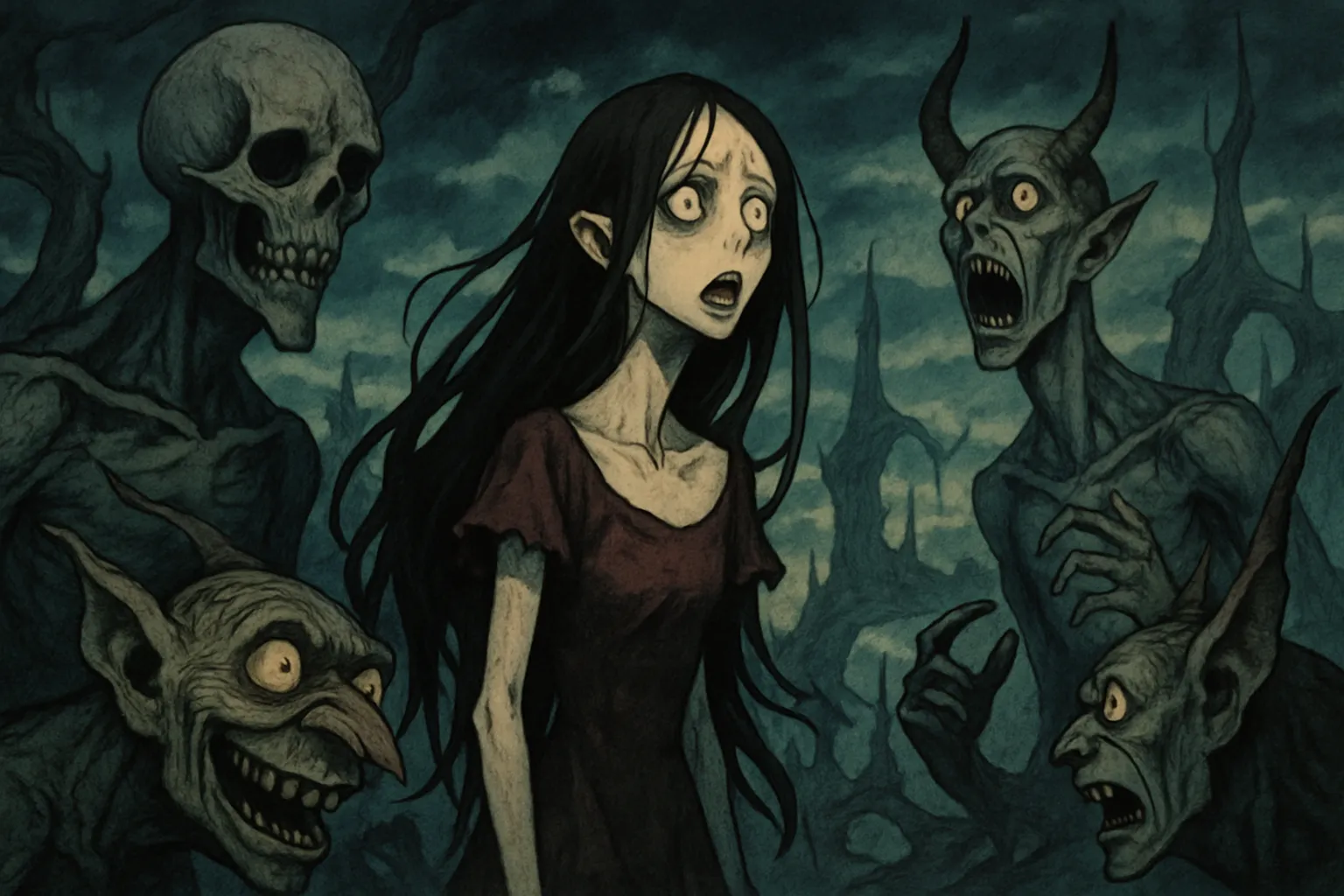
The task of philosophy, since Nietzsche, has been to acknowledge that truth is a seductive, contingent surface. "Supposing truth is a woman—what then?" asks Nietzsche, setting the stage for a critique of previous philosophers, "the dogmatists" who "did not know how to love" (Nietzsche, 2005, p. 11). What he calls "flaying attempts to seduce truth" are nothing but the panicked, molar strategies of the neurosis, attempting to pin down the chaotic, feminine flow beneath the Symbolic code. The philosophical terror—the dread that breeds dogmatism—is the confrontation with the void, the absolute absence of guarantee that the world is anything more than the sum of our fictionalized flows and desires. Grotesque (2009) is the cinematic fulfillment of this anti-dogmatic terror, a rigorously materialist operation that uses mutilation to expose the Real of both desire and relationship, proving that love can only emerge from the total deterritorialization of the Oedipal body.
I. The Stratified Socius and the Capture of Desiring-Machines
The film opens on a familiar, benign, and thoroughly stratified socius: the end of a first date between Kazuo and Aki. This scene is the micropolitics of the neurotic machine at its most banal. Kazuo's desire is a cliché-flow, trapped within the Oedipal circuit of male-as-pursuer, female-as-prize, seeking validation through the Symbolic acquisition of the partner (Deleuze & Guattari, 1983, p. 10). Aki’s hesitant reluctance is the feminine flow attempting to resist this molar capture, sensing the false bottom of affection where the man’s desire is less about her and more about the maintenance of his own fragile masculine Character Armor (Reich, 1970, p. 55).
The arrival of the man in the white van, the Torturer, is the schizoid cut that instantly deterritorializes this mundane neurotic flow. He is not a moral judge or a psychological projection; he is the Immanent Administrator of the Desiring-Machine—a functionary who exposes the latent truth of capitalist exchange and erotic struggle. The immediate act of abduction and restraint on the horizontal slabs is the re-territorialization of the couple’s desire onto a new, perverse apparatus.
The Torturer is the Paranoid Machine stripped of ideological pretense. His stated goal—to see their "desire to survive"—is the demand for pure, unencoded vitality, a focus on the raw flow of life abstracted from moral or social content. He is the ultimate Capitalist Manager (Marx, 1976, p. 302), seeing the human body not as a subject, but as a resource (a desiring-machine) whose maximum potential (the will to live) must be extracted through maximum friction (torture). He makes the body produce its own truth by forcing it to operate outside the Symbolic economy of pain and redemption.
The Torturer's game is a direct attack on the Oedipal triangle. By proclaiming, "as long as Kazuo is able to maintain being tortured, he will not turn his tools upon Aki," he sets the stage for a perverse Oedipal contract. Kazuo is forced into the role of the false martyr, whose suffering is meant to purchase Aki’s Symbolic salvation. However, the subsequent revelation of Aki's "clear inability to sacrifice herself for Kazuo" violently short-circuits this expected neurotic outcome. The machine breaks down because the libidinal exchange is not mutual; the flow from Aki is blocked. This lack of mutuality proves that the pre-torture relationship was merely a Symbolic performance held together by Kazuo's desperate, one-sided energy expenditure, a classic neurotic capture of his own desire flow (Deleuze & Guattari, 1983, p. 58).
II. The Anti-Oedipal Castration and the Body-Without-Organs (BwO)
The heart of the film’s philosophical operation is the grotesque application of the scalpel to Kazuo’s genitals. This is the anti-Oedipal castration—a literal, surgical intervention necessary to dismantle the entire molar stratum of his desire.
Freud conceptualized castration as the Symbolic moment where the Law (the Father) intercedes to prohibit incest, structuring the psyche through the concept of lack and introducing the subject into the Symbolic Order (Freud, 1961, p. 49). Lacan reinforced this, framing castration as the price of admission to language and subjectivity, the loss that grounds desire (Lacan, 2006, p. 520).
Grotesque, however, performs a materialist, schizoid castration. It is not about Symbolic lack or the Father's Law; it is about the mutilation of the desiring-machine itself. By rendering Kazuo's "man parts... irrelevant," the Torturer forcibly extracts the man from the neurotic circuit that defined his existence: the cycle of performing masculinity, the pursuit of the 'chick,' and the ultimate goal of phallic validation.
Kazuo is violently converted into a Body-Without-Organs (BwO). The BwO is "the field of immanence of desire, the plane of consistency" (Deleuze & Guattari, 1983, p. 30). By stripping the organ of its function, the body is forced to exist as a raw, unorganized intensity, a direct flow of pain and survival that bypasses the socially-encoded function. The penis, as the central signifier of Oedipal masculinity, is literally deterritorialized from its symbolic role in reproduction and hierarchical dating. The body becomes an experiment in pure, immediate existence, free from the character armor that previously defined Kazuo’s timid, repressed longing. This operation is not about punishment; it is the necessary surgical prerequisite for the flow of Real love to begin.
III. The Romantic Matrix as Molar Stratification
The final, climactic scene—Kazuo attempting to cross the room while his guts are dragged out of him—is the ultimate deterritorialization of the interior body and a devastating critique of the Romantic Matrix.
The Romantic Matrix is the Molar Stratification of desire that transforms genuine connection into a heroic performance or a commodity chase. The Torturer, acting like a cheerleader, "cheers him on. Like a football coach to an under preforming athlete." This symmetry is terrifyingly accurate: the desperate rush of masculinity (the "dudes chase after chicks") is revealed to be a socially acceptable, self-inflicted form of torture—a constant expenditure of energy and vulnerability (courage) for the sake of an external, validating object (Aki's affection).
Kazuo’s final act, losing his guts to cross the room, is the literalization of the old romantic adage: "giving everything for the one you love." But the film reverses the heroic flow. It is not an act of courage; it is a desperate rush of masculinity whose ultimate reward is nihilistic affirmation (Nietzsche, 2005, p. 28). He is not giving his guts for her freedom; he is losing them to complete the Torturer’s schizoid circuit of maximum energy extraction. He is not a martyr for love—he is a martyr for the Symbolic code of masculinity that demands this self-obliterating performance.
This scene also violently fractures the Kantian imperative. Kant's ethics are predicated on Duty—the action performed purely from respect for the moral law (Kant, 2012, p. 14). Kazuo's action appears to be duty-driven, but it is actually driven by a submerged, neurotic desire for external validation. The physical absurdity—losing his material interior—exposes the false universality of his maxim. His action is revealed to be less a moral law and more a final, frantic attempt to complete the Oedipal Contract through self-immolation.
IV. Love as the Real: The Schizoid Suture
The critical pivot occurs in the makeshift hospital room. After the brutal deterritorialization of their bodies—Kazuo's sexual organ rendered inert, Aki’s body violated—they discuss their skepticism about the "promise of freedom." It is here, suspended between the reality of their mutilated bodies and the shattered fiction of their past, that the Event of Love (Badiou, 2005, p. 119) occurs.
Aki confesses her desire for a relationship with Kazuo. This is the schizoid suture. Love, as the film presents it, is not the Symbolism, memory, and meaning (the Molar Stratum of conventional romance) used to "suture the void between each other." That is the neurotic fiction that must crack under interrogation.
The void is the Real of the relationship, the truth that defies inscription, the "false bottom to our affections" that Žižek argues we desperately try to avoid (Žižek, 2009, p. 3). True love, in Grotesque, is the irrational clinging to meaning after the horror of that Real has been explicitly exposed and internalized.
Before Torture: Kazuo’s love was a neurotic capture, driven by the flow of a socially acceptable, but ultimately self-destructive, Symbolic Phallic desire. Aki’s desire flow was blocked because she was trapped by the same Symbolic code that demanded she be the prize.
After Torture: Kazuo’s castration forces him into the Body-Without-Organs. His desire is now deterritorialized—it is no longer rooted in the phallic signifier. He is liberated from the burden of performance. Aki’s confession, therefore, is her affirmation of his BwO state; she loves the man who exists purely as a flow of intensity, not the man who was desperately trying to acquire her as a fetishized commodity.
The couple's new relationship is built on the shattered plane of immanence, free of the Oedipal code. This is the becoming-revolutionary (Deleuze & Guattari, 1987, p. 301). They have been expelled from the socius by the Torturer—the ultimate functionary of the capitalist system—and their survival now necessitates a new molecular ethics founded on the raw affirmation of their shared trauma and their deterritorialized bodies.
V. The Grotesque as Anti-Capitalist Statement: The Production of Pure Truth
The film’s grotesque aesthetic is not merely shock value; it is the visual language of the deterritorialized body. Baudrillard (1994, p. 54) describes the hyperreality of postmodern society, where signs have lost all reference to the real. The horror genre often attempts to break through this simulation by forcing the viewer to confront the Real of the body. Grotesque does this by performing a materialist de-coding of romantic love.
The Torturer is the schizoid artist of pure truth production. He creates a situation where the desiring-machines (Kazuo and Aki) must produce a truth-flow (the desire to survive) outside of all Symbolic constraints. The money he demands, the commodity of pain, is almost irrelevant; it is the intensity that matters. The film asserts that the only truth we can "irrationally cling to" is the meaning we construct when every other structure of meaning (love, masculinity, morality) has been violently stratified and then explosively deterritorialized.
Grotesque is thus an unexpected, perverse celebration of freedom. The couple is only truly free, truly connected, when their bodies have been utterly alienated from the Capitalist-Oedipal code that demands heterosexual desire be performed as a chase, a performance, and a validation of the male ego. The man’s loss of his genitals is the necessary, non-negotiable price for the production of a Real relationship—a relationship that can affirm the dark void behind the surface, transforming the Nietzschean challenge into a bloody, glorious, and grotesque victory for schizoanalytic freedom. The only escape from the neurotic capture of the Symbolic is the total affirmation of the wound.
References
Badiou, A. (2005). Ethics: An Essay on the Understanding of Evil. (P. Hallward, Trans.). Verso.
Baudrillard, J. (1994). Simulacra and Simulation. (S. Faria Glaser, Trans.). University of Michigan Press.
Deleuze, G., & Guattari, F. (1983). Anti-Oedipus: Capitalism and Schizophrenia. (R. Hurley, M. Seem, & H. R. Lane, Trans.). University of Minnesota Press.
Deleuze, G., & Guattari, F. (1987). A Thousand Plateaus: Capitalism and Schizophrenia. (B. Massumi, Trans.). University of Minnesota Press.
Foucault, M. (1995). Discipline and Punish: The Birth of the Prison. (A. Sheridan, Trans.). Vintage.
Freud, S. (1961). Beyond the Pleasure Principle. (J. Strachey, Ed. & Trans.). Liveright. (Original work published 1920).
Kant, I. (2012). Groundwork of the Metaphysics of Morals. (M. Gregor & J. Timmermann, Trans.). Cambridge University Press. (Original work published 1785).
Lacan, J. (2006). Écrits: The First Complete Edition in English. (B. Fink, Trans.). W. W. Norton & Company.
Marx, K. (1976). Capital: A Critique of Political Economy, Volume 1. (B. Fowkes, Trans.). Penguin Classics.
Nietzsche, F. (2005). Beyond Good and Evil: Prelude to a Philosophy of the Future. (R. J. Hollingdale, Trans.). Penguin Classics. (Original work published 1886).
Reich, W. (1970). The Mass Psychology of Fascism. (V. R. Carfagno, Trans.). Farrar, Straus and Giroux.
Žižek, S. (2009). Violence: Six Sideways Reflections. Picador.
Comments
Post a Comment