Grimm Love (2006) Cannibalism as the Absolute Love-Machine: The Final Deterritorialization of the Oedipal Compact
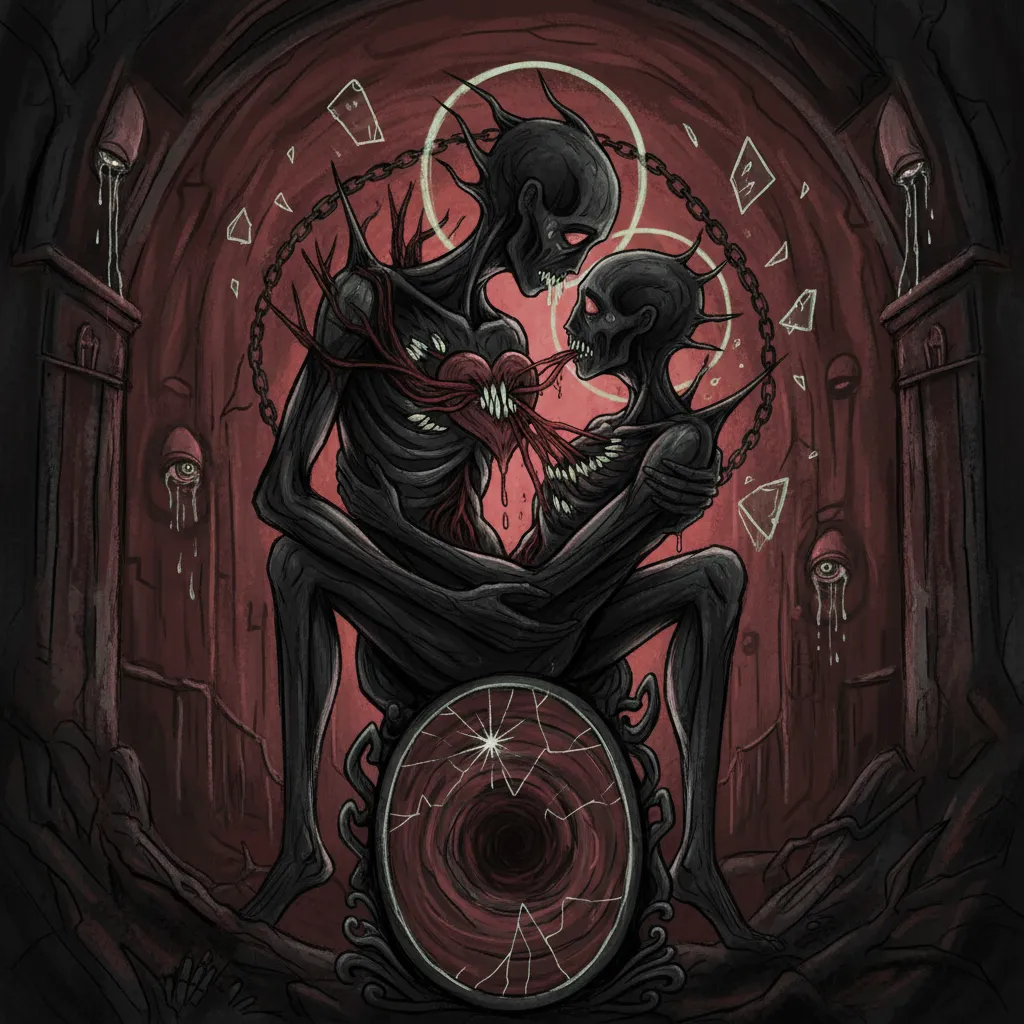
Love, in the binary, is an iconic tribute to solidarity—a connection that incorporates transcendence, destiny, and the vibrant shroud of twitter-painted reality that blankets the meaningless world, dislodging objects and entities from their dead contexts and redistributing them along a new, Molar axis of significance. Yet, upon the most basic inspection, the claim is absurd: why this singular entity and not the flow of all others? Why this ring, this vow, this specific wife rather than another, or none at all? Conventional romance thrives in this contradictory dialectic, a neurotic assemblage (Freud, 1923) that only puts the least of one’s life at stake. But what if love is a love for the obliteration of love? What if the compulsion to consume one’s object of affection—to merge not through the superficial flow of cherishing, but through the totalized consumption of substance—is the only way to make the vow "unto death" ruthlessly, absolutely real?
I. The Cannibalistic Desiring-Machine: A Schizo-Synthesis
Grimm Love diagrams the formation and explosion of the Cannibalistic Desiring-Machine (Deleuze & Guattari, 1983). We are given Oliver, the Eater, and Simon, the Eaten—two men with equal and opposite desires who find their fatal conjunction outside the established Abstract Machine of conventional sexuality. Their romance is not found in cuddling or frolicking in the public park, where their transcendence would serve merely to incite the envious compulsion of the onlookers, forcing society into shame and the desire for connections it has rendered impossible. No, their union is located in the schizo-surface of the internet, where the flow of desire bypasses the physical striations of the paranoiac socius (Deleuze & Guattari, 1983) and finds its precise, lethal match.
They are two halves of a single, perfectly functioning machine. Oliver, the Eater, seeks the ultimate intimacy, attempting to collapse the ontological distance (Laing, 1960) between self and object by incorporating the beloved. His desire is to transform the other into the substance of the self, to make the Body-without-Organs (BwO) of the other into the BwO of his own existence. He is engorged in his snack, savoring the fatty morsel while wondering about dipping sauces, experiencing a completeness rarely found in traditional, non-committing romance.
Simon, the Eaten, is the perfect counter-flow. His desire is rooted in a profound, existential ontological insecurity (Laing, 1960)—a hollow sense of self that can only be resolved through total consumption. His greatest wish is to become substance, to achieve transcendence through digestion, transforming the emptiness of his individual BwO into the full, material Body-of-the-Other. When Oliver bites his ear, Simon screams in joy, because the wish—held onto for a lifetime—is being granted. This is not suicide; it is consummate reterritorialization. They vow, not "unto death," but "in death do we conjoin," taking the marriage pledge ruthlessly more serious than the zillions of couples who prance through their vows, putting only the least of their lives at stake. Their love is totalized, committed to a primal sense of eternity lasting only as long as the average multicourse meal.
II. The Technological Stratification and the Collapse of Morality
The desiring-machine requires its technological instruments. The bone saw and the George Foreman Grill are not tools of crime; they are the molar instruments that facilitate the molecular flow (Deleuze & Guattari, 1983) of the schizo-act. The instruments serve to stratify the body, to reduce the subject from a coded, social entity to its raw, unmediated parts—flesh, bone, muscle. This is the schizophrenic out for a walk flow made material: reducing Simon to pieces allows Oliver to consume him associatively, piecing the lover back together inside his own BwO.
The moral framework of the surrounding world shatters against this intensity. The love expressed is intensely nihilistic (Nietzsche, 1967) because it holds a profound detestation for the Molar morality that dictates love must be "beneficial to the multitude" or "emotionally utilitarian." Such conventional love is merely a commodity flow designed to reproduce societal expectations—the couple walking through the mall, displaying their transcendence, fulfilling the role society has made for them.
Simon and Oliver’s love is a non-commodity flow. It produces nothing recognizable to the Capitalist Axiomatic (Deleuze & Guattari, 1983) except its own fulfillment and annihilation. Their act is the Event (Badiou, 2005) that severs the chain of moral necessity, demonstrating a will to power that overcomes the triviality of ethical norms in favor of absolute, chosen destiny. They have achieved the absolute transgression, an act so far beyond the Character Armor (Reich, 1949) of society that the State can only respond with paranoiac attempts at containment and explanation.
III. Katie Armstrong: The Paranoiac Recording Surface
The character of Katie Armstrong—the morbidly obsessed college student pursuing a thesis—functions as the Paranoid Recording Surface (Deleuze & Guattari, 1983) of the academic Abstract Machine. Katie does not seek the substance of Simon and Oliver's desire; she seeks the sign—the coding of their madness. She attempts to transfer their pure, molecular schizo-flow onto the sterile, stratified plane of academic language and psychological categorization.
Her descent into idolatry is critical. She grows to idolize her fascination much like Simon and Oliver idolize their desires. But where their desires are immanent and lead to physical consumption, Katie's desire is transcendent and leads to symbolic consumption. She wants to be them, but she is trapped by her own Character Armor (Reich, 1949), the muscular rigidity of the civilized subject who can only watch the pure flow of desire, never enter it. Her transfer to Germany is a geographical line of flight that collapses into a neurotic reterritorialization—she simply moves the boundaries of her observation, rather than dissolving them.
Katie's research mirrors the function of ideology as described by Žižek (2009). The society cannot comprehend this act of total conjunction; it must insist on seeing it as a breakdown (crime, insanity). Katie's thesis is the attempt to realize the State's obscene fantasy—not the murder, but the explanation—in order to maintain the illusion that such desire can be coded and contained. She tries to force the anarchic BwO of their coupling back into the Oedipal narrative of psychological dysfunction. Yet, their love, in its total commitment, is more transcendent than the very academic scaffolding she uses to observe them.
IV. The Refusal of Triviality: In Death We Conjoin
The ultimate radicality of Grimm Love is its profound challenge to the Oedipal compact that demands life, love, and production be trivial. Traditional romance is a low-stakes negotiation where the ultimate commitment is usually expressed through debt (mortgage, rings, tuition) that feeds the Capitalist Axiom. Simon and Oliver cut through this façade of utility. They offer the absolute stake: the literal body, the complete identity.
The scene of the ear being bitten, the man screaming in joy, is a molecular discharge of energy. It is the moment where Simon achieves critical consciousness (Freire, 2000) about his own repressed desire for non-existence, and Oliver achieves the ultimate communion. Their love is short-term—only as long as the average multi-course meal—but non-negotiably committed to a primal sense of eternity.
This becoming-cannibal is the ultimate, terrible line of flight. It is the absolute deterritorialization of the body from the social code of the Father. The body is no longer a political tool, a means of production, or an instrument of reproduction; it is pure substance, a final, radical gift. The film demands that we understand this act not as mere pathology, but as the nihilistic climax of a culture that has rendered all other forms of devotion and commitment equally hollow. The schizophrenic flow of their desire is the only desire that remains unrecuperable by the Abstract Machine.
References
Badiou, A. (2005). Being and event (O. Feltham, Trans.). Continuum.
Deleuze, G., & Guattari, F. (1983). Anti-Oedipus: Capitalism and schizophrenia (R. Hurley, M. Seem, & H. R. Lane, Trans.). University of Minnesota Press.
Freire, P. (2000). Pedagogy of the oppressed (M. B. Ramos, Trans.). Continuum.
Freud, S. (1923). The ego and the id. Hogarth Press.
Laing, R. D. (1960). The divided self: A study of sanity and madness. Penguin Books.
Nietzsche, F. (1967). On the genealogy of morals (W. Kaufmann & R. J. Hollingdale, Trans.). Vintage Books.
Reich, W. (1949). Character analysis (T. P. Wolfe, Trans.). Orgone Institute Press.
Žižek, S. (2009). The parallax view. MIT Press.
Comments
Post a Comment