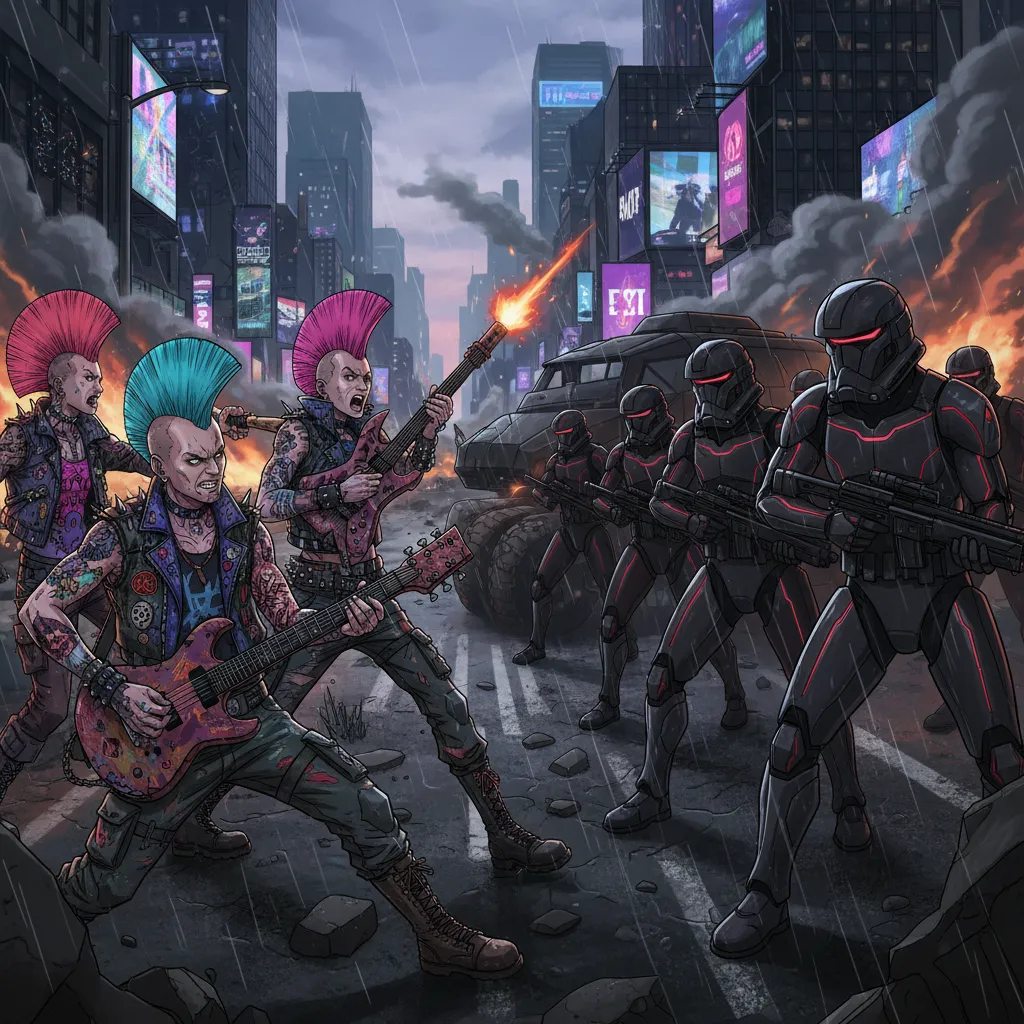
The Ain’t Rights are a sputtering, molecular flow, seeking escape from the strip mall’s flat, coded logic. The band believes its journey is a rebellion of escape, but it is merely a drift, a surface turbulence on the larger, regulated circuit of commodity culture. Their protest—the patches, the siphoned gas, the refusal of the straight job—is a neurotic armor against a system they cannot truly disengage from (Reich, 1972). This drive for individuality, this constant need to be authentically against the grain, becomes the source of their ultimate, lethal fragility.
The Fragility of Fragmentation
Punk, as a social current, was born from a desire for new possibilities outside the saturated lifestyle choices of the 1980s and 90s. This desire was potent, a raw energy pushing against the rigid stratification of consumer society (Deleuze & Guattari, 1983). The music was the engine, and the mosh pit was its ritual—a gathering of atomistic bodies clashing together. This clash, however, was not the forging of a collective body; it was a temporary, localized turbulence. Each individual, obsessively concerned with their own self-definition and authenticity, remains locked in the prison of their own ego, unable to fuse into a single, cohesive force.
This is the punk’s Oedipal fault: a refusal of society’s Law, yes, but a subsequent hyper-investment in the self as the final political unit. When faced with the real pressure of extinction, their desire for autonomous choice fragments every possible strategic move. Their clashing wills, once mistaken for freedom, are exposed as patterns of self-sabotage, an inability to cohere into a singular striking force. Pat's insistence on holding the gun, Sam’s need to call the police, Reece’s initial passivity—each is an expression of isolated desire that effectively turns the band into a mutual liquidation society.
The Crystalline Machine of Absolute Code
The neo-Nazi compound is the absolute inverse: a perfected Paranoiac Machine (Deleuze & Guattari, 1983). It is not chaotic; it is a total Body, every cell of the organism obediently serving the central, chilled intelligence of Darcy. Darcy, the patriarch, is the CEO of stratification, a master of flows who instantly processes the band’s potential threat and re-codes the entire environment for containment and disposal.
This machine has resolved its internal contradictions. Where the punk desire is scattered and aesthetic, the Nazi desire is concentrated and purposeful, achieved through total submission to the central ideological fantasy (Žižek, 1989). The Nazis are true believers whose commitment is pure; their actions are systematic, measured, and perfectly coordinated. They are capable of immediate, surgical response because the code of their Body is absolute—blood, hierarchy, and sacrifice. The film’s horror is not in the surface violence, but in recognizing the profound, infrastructural strength of a system built on total ideological discipline.
Their home is not a sanctuary but a factory of social code, where every element, from the front gate to the attack dogs, is designed to absorb or destroy any contaminating, uncoded flow.
The Event Cut: The Price of Velocity
The murder that precipitates the crisis—the knife, the moment of discovery—is a philosophical Event (Badiou, 2007). It is a rupture in the existing order that demands a new truth and a collective response. The Green Room, cramped and smelling of stale beer and fresh blood, becomes a pressure vessel where the punk's aesthetic posture is incinerated by the fascist's absolute deed.
The Event forces the band to confront the fatal flaw of their ideology: their refusal to accept that freedom sometimes requires the sacrifice of the individual will for the collective survival-flow. The violence that follows is not random; it is the systematic liquidation of fragmented desire by a unified code. The bodies are torn, not because of random rage, but because they are failing to adhere to the principle of unified motion.
The final escape, achieved by Pat and Amber, is a forced shedding of identity. Pat, stripped of his mohawk, his guitar, and his ideological signifiers, achieves the velocity of pure flight. He is no longer a punk; he is a vector of escape, an un-coded quantum achieving temporary, linear motion (Deleuze & Guattari, 1983). His walk through the civilized, manicured suburbs is not a return to safety—it is the passage of a survivor who has been incised from the social body, achieving a freedom that is not characterized by belonging or comfort, but by unstable, perpetual movement.
The film’s ultimate critique is devastating: punk’s greatest defense—its individualism—was precisely the aperture through which the world invaded and destroyed it. The commitment to aesthetic revolt failed the test of absolute commitment, proving that the desire for authenticity cannot survive the cold functionality of a perfectly codified, murderous machine.
References
Badiou, A. (2007). Being and Event (O. Feltham, Trans.). Continuum.
Deleuze, G., & Guattari, F. (1983). Anti-Oedipus: Capitalism and Schizophrenia (R. Hurley, M. Seem, & H. R. Lane, Trans.). University of Minnesota Press.
Freud, S. (1961). Civilization and its discontents (J. Strachey, Ed. & Trans.). W. W. Norton & Company. (Original work published 1930)
Nietzsche, F. (1989). On the genealogy of morality (W. Kaufmann & R. J. Hollingdale, Trans.). Vintage Books. (Original work published 1887).
Reich, W. (1972). Character Analysis (V. R. Carfagno, Trans.). Farrar, Straus and Giroux.
Žižek, S. (1989). The sublime object of ideology. Verso.
Comments
Post a Comment