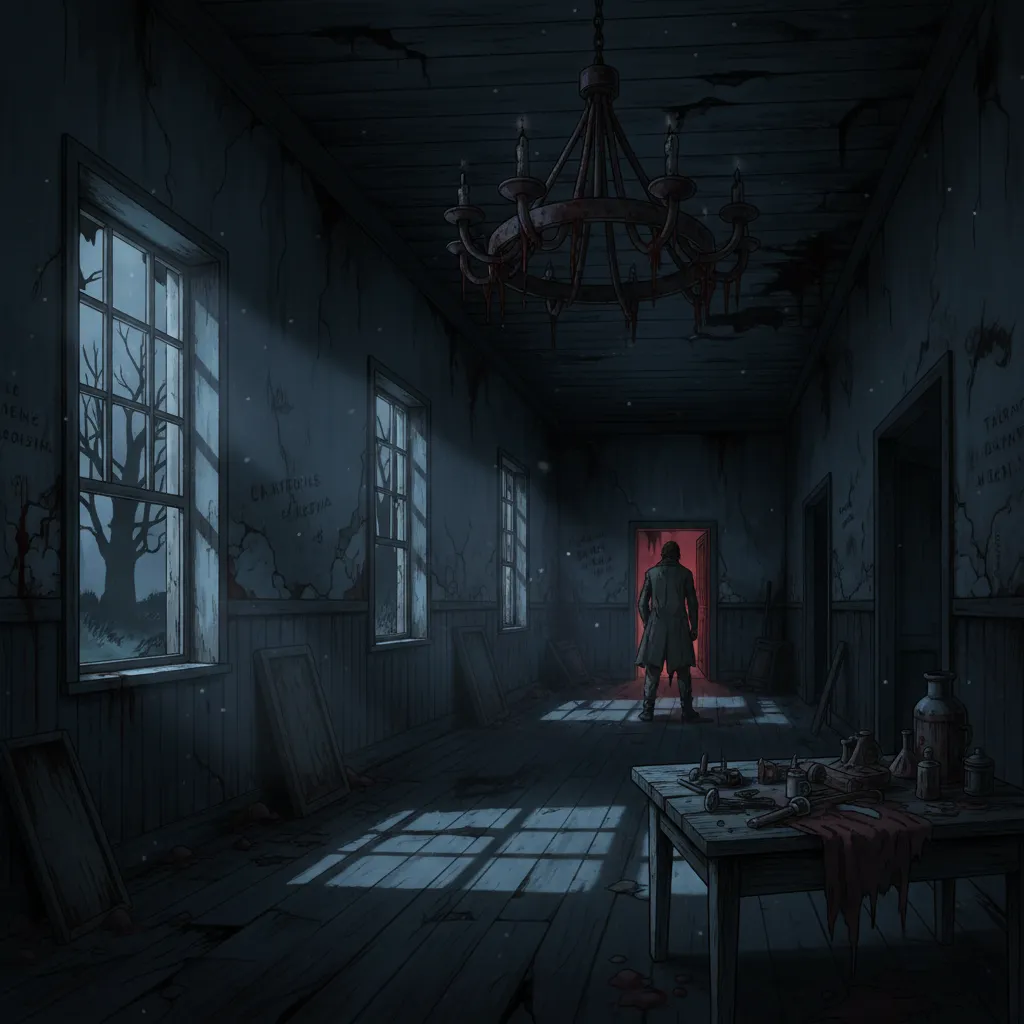
Yasmine’s journey rattles both nerves and social assumptions. But what if horror’s most graphic moments are precisely where meaning breaks free? Let’s wander—sometimes uncomfortably—into the nightmare logic of "Frontiers."
Pavement, Pregnancy, and Paris: Yasmine as a Molten Engine
Yasmine’s journey in Frontiers (2007) begins on the fractured streets of Paris, a city in revolt. From the opening scenes, she is already in flight, refusing to be captured by the city’s codes—legal, social, or familial. The riot-shattered pavement is not just a backdrop but a symbol of the striated, controlled space she seeks to escape. In Deleuzian terms, Yasmine is a micro-flow: a molecule of desire slipping through the cracks of the city’s rigid grid, always in motion, always seeking a line of flight.
Her pregnancy, far from being a sign of domestication or submission, becomes a moving contradiction. It is not a return to the safety of kinship or the promise of a future within society’s boundaries. Instead, it is a new kind of peril and possibility—a biological engine that propels her further from the codes that seek to define her. The gravid body, in this context, is not a vessel for social reproduction but a site of rupture and transformation.
Horror cinema often leans on stereotypes about motherhood: the self-sacrificing mother, the monstrous birth, or the redemptive power of maternal love. Frontiers refuses these tired tropes. Yasmine’s pregnancy is not a destination, a means of returning to the fold of society, but an evolutionary detour. Her journey is not about becoming a mother in the traditional sense; it is about becoming something else entirely—a molten engine of resistance and survival.
This is where Wilhelm Reich’s somatic theory becomes crucial. The film positions pregnancy as rupture: a break in the neurotic armor that holds the self together. Yasmine’s gravid body cracks open her criminal, self-focused identity, forcing her desire outward. The fetus is not a coded future subject, but a viscous potentiality—a quantum of life that resists being inscribed by the fascist family’s laws. Her desire is no longer about her own survival, but about protecting this un-coded flow from the machine that seeks to capture it.
The Nazi-Oedipal family, with its obsession for blood purity and incestuous lineage, represents the ultimate paranoiac machine. It is a closed system that demands absolute codification. Yasmine’s pregnancy, however, operates as a paradoxical weapon against this structure. Her body, carrying the un-coded potential of new life, becomes a threat the fascist machine cannot absorb or control. The attempt to force her into the role of reproductive organ only intensifies the contradiction, making her a living site of resistance.
In this way, Yasmine’s journey through pavement, pregnancy, and Paris is not a story of maternal sacrifice, but of deterritorialization. She is not returning to the codes of the city or the family; she is breaking them open, becoming a molten engine that burns through every attempt at capture.
The Paranoiac Machine: Nazi “Family” as Social Code Factory
In Frontiers, the neo-Nazi family is not simply a group of villains; they are the living embodiment of what Deleuze and Guattari call a Paranoiac Machine. This is a social structure obsessed with coding every stray molecule of desire, every unpredictable element, into a rigid, self-replicating order. Their home is not just a setting—it is a factory, churning out new codes, rules, and boundaries with relentless efficiency. This family’s obsession with blood purity and incest is not just a twisted tradition; it is their central mandate, a family tree so tightly wound it chokes itself at the roots.
To understand their function, imagine calling your childhood home a “machine.” For most, this would sound strange. But in Frontiers, the house is a literal appetite for violence and order, a place where every action is designed to reinforce the family’s perverse logic. The walls do not just contain people—they process them, demanding conformity or destruction. This is the Paranoiac Machine at work: it cannot tolerate difference, and so it must constantly seek out and eliminate anything that threatens its codes.
This dynamic is perfectly captured by Žižek’s Parallax View. On the surface, the Nazi family projects an image of strength, unity, and tradition. But beneath this myth lies chaos and decay. The family’s rituals—dinners, initiations, punishments—are not signs of health, but symptoms of a system that is always on the verge of collapse. They must perpetually consume—through violence, through forced reproduction, through cannibalistic acts—to sustain the illusion of order. Every act of violence is both a tool to enforce the code and a symptom of the code’s fundamental emptiness.
The household’s demand is clear: Yasmine, as the outsider and the pregnant woman, must become the vessel for their monstrous code. She is not seen as a person, but as a reproductive organ, a means to continue the family’s lineage and inscribe their law onto a new body. The family’s patriarch does not simply want a grandchild; he wants to ensure that the child is born into the code, that the cycle of purity and violence continues unbroken. In this way, the family becomes a social code factory, using every tool at its disposal—fear, ritual, even the promise of kinship—to force Yasmine into compliance.
Violence in this household is not random. It is systematic, a necessary part of keeping the machine running. The family must always be on guard against contamination, always ready to excise what does not fit. This is why Yasmine’s presence is so threatening: she carries within her the potential for something un-coded, something the machine cannot control. The family’s response is to double down, to try to absorb her and her unborn child into their system, to make her the mother of a new generation of coded subjects.
Event Cuts: Knives, Betrayal, and the Badiou Moment
In Frontiers, the pivotal moment when Yasmine refuses to kiss her captor is not simply an act of resistance. Instead, it is what philosopher Alain Badiou would call an Event: a rupture in the established order, a point where the rules of the system no longer apply. This refusal is not just personal defiance; it is a seismic philosophical break, a refusal to be re-inscribed into the fascist code that the Nazi family represents. The demand for a kiss is the Law’s final attempt to reassert itself, to fold Yasmine back into a system of control. Her refusal is the first cut, a betrayal of the Law’s expectations.
When Yasmine’s knife finds the patriarch’s throat, the violence is more than physical. It is a literal and symbolic incision—an act that tears open the Law itself. In Badiou’s terms, this is the Event Cut: a moment when the existing order is not just challenged, but fundamentally broken. The knife does not merely kill a man; it destroys the possibility of the child being coded by the fascist order. Yasmine’s act is not just murder—it is a refusal to allow her child to be born into a world shaped by the Law of the Father. She becomes a mother without a society, ensuring her child is spared the inscription of fascist ideology.
This moment raises a key question for the horror genre: When does violence in horror actually rupture meaning, rather than reinforce it? In many films, violence simply re-establishes the boundaries of the social order, punishing those who stray. In Frontiers, however, the violence is an Event in the Badiouan sense. It is not a return to order, but a break from it—a moment when something truly new becomes possible. The horror is not just in the blood, but in the possibility that the old codes can be destroyed.
Badiou’s concept of Fidelity is crucial here. After the Event, the subject must remain faithful to its truth, even when the world tries to force them back into old patterns. Yasmine’s every action after the cut is shaped by her commitment to this new reality. She does not seek to rebuild the old order or find safety within it. Instead, she embodies a rare, lived philosophy—one where the only way forward is through the void left by the destroyed Law. Her fidelity is not to the Law, but to the truth revealed in the Event: that the only way to protect her child is to annihilate the system that would claim it.
The fascist Law demands blood as a means of maintaining its power. Yasmine gives blood, but not in the way the Law expects. Her violence is not a sacrifice to the system, but a sacrifice of the system itself. In this sense, the knife is not just a weapon—it is the tool of philosophical incision, cutting away the old to make space for the new.
Body Horror as Philosophy: Schizoanalysis in Bloody Detail
In Frontiers, body horror is not just a tool for shock—it is a vehicle for philosophical exploration. The film takes the complex ideas of schizoanalysis, as developed by Deleuze and Guattari, and makes them tangible through the literal destruction and transformation of bodies. Here, theory is not left in the abstract; it is carved into flesh, making the invisible forces of social control and desire painfully visible.
Schizoanalysis—a term that might sound academic or distant—becomes visceral in Frontiers. The film’s violence is not random; it is a direct illustration of how society tries to code, brand, and script bodies. The Nazi family’s home is a microcosm of the fascist Body-without-Organs (BwO): a place where every body is forced to fit a role, every desire is policed, and every deviation is punished. The horror is not just in the gore, but in the realization that bodies matter so much because society is desperate to control them.
Bodily Disintegration and Reformation: The film literalizes Deleuze and Guattari’s theory by showing bodies torn apart and reassembled, echoing the process of deterritorialization and reterritorialization. The body is not a stable entity, but a site of constant struggle between the flows of desire and the codes of society.
The Pregnant Body as Schizo-Productive: Yasmine’s pregnancy is not a passive state. Instead, her gravid body becomes a field of uncontainable flows—a schizo-productive force that resists being coded by the fascist family. Her pregnancy is not simply about reproduction; it is about the possibility of new, uncoded life.
Making Philosophy Bleed: Horror’s highest function in Frontiers is to make abstract ideas bleed on screen. The violence is not gratuitous; it is a way of showing how deeply social codes are inscribed on the body, and how breaking those codes requires real, physical rupture.
The most disturbing moments in Frontiers are not always the scenes of gore, but the moments when viewers realize how much society wants to control bodies. The horror is in the branding, the forcing, the scripting—social coding that is always a violence of its own. The film asks a haunting question: Can a body ever truly escape inscription, or do we carry the codes not only in our minds but also in our nerves?
Yasmine’s journey is a schizoanalytic process in action. She is not just fighting for survival; she is fighting to keep her body—and the body of her unborn child—from being coded by the fascist machine. Every cut, every wound, is a battle over meaning and control. The film’s body horror is thus a philosophical statement: the body is a site of struggle, and true freedom may only be found at the edge, where coding breaks down and new flows can emerge.
Aftermath on the Threshold: Yasmine’s Nomadic Velocity
Yasmine’s final walk into the dawn, bloodied and alone, is not simply the end of her ordeal in Frontiers; it is the birth of a new kind of movement—a perpetual line of flight. In Deleuzian terms, she has become a nomadic war machine, a force that refuses capture by any social code or structure. The film’s closing moments do not offer the comfort of resolution. Instead, they highlight the absence of belonging: Yasmine survives, but she does not return home. Her victory is not a return to safety or normalcy, but the achievement of velocity—an ongoing escape from all systems that would seek to define or contain her.
This stands in stark contrast to the typical narrative arc of horror survivors. Usually, the final girl or protagonist finds her way back to a semblance of order, returning home or being welcomed by the authorities. Yasmine, however, has no home left. The world she knew has been incised and left behind. Her journey is not circular, bringing her back to where she started, but linear and open-ended—a true line of flight that never loops back to the origin. Her only companion is the molecular potentiality within her, the fetus that represents an un-coded future.
The image of Yasmine at dawn, drenched in blood, is not a symbol of rebirth in the traditional sense. There is no promise of renewal or reintegration. Instead, it marks a refusal of all forms of capture and coding. She has become-animal, in Deleuze and Guattari’s sense: a body in motion, unbound by the laws of the human socius. The blood is not a mark of shame or victimhood, but a sign of her passage through and beyond the fascist machine that sought to inscribe her. She is no longer a subject of the Law, but a vector of pure potentiality.
This raises a profound question: what kind of future can emerge from such a void? Yasmine has destroyed the only social structure left to her, ensuring that her child will not be immediately coded by the perverse laws of the Nazi-Oedipal family. But without any system to return to, she and her unborn child exist in a space of radical openness. The film refuses to answer whether this is a space of hope or despair. Instead, it leaves us with the image of nomadicity as horror’s ultimate gift—a push beyond any system or code, towards a life that is perennially uncapturable.
Yasmine’s walk is not an ending, but a perpetual line of flight—a nomadic war machine.
There is survival, but never belonging; her victory is velocity, not closure.
The bloodied dawn is a refusal of all capture, a becoming-animal of the body.
The future is a void—an open question of what can emerge when all codes are cut.
Nomadicity becomes the ultimate legacy of horror: a life that cannot be captured or defined.
Conclusion: When Cinema Flows Become Unstoppable
In Frontiers, the narrative refuses the comfort of closure or redemption. Instead, it offers a transformation by severance—a violent, irreversible break from the structures that seek to contain and define the body. Yasmine’s journey is not a story of healing or restoration; it is a raw demonstration of horror’s unique power to tear open the social body, exposing the coded machinery beneath and creating new, disruptive possibilities. The film does not provide answers or solutions. It leaves the viewer with wounds, not bandages, and with the unsettling sense that true freedom may only emerge when all codes—familial, legal, and even biological—are thrown into crisis.
The wildest idea at the heart of Frontiers is that the body itself, especially the gravid body, becomes cinema’s most disobedient device. Yasmine’s pregnancy is not a symbol of hope or continuity; it is a site of rupture, a biological event that cannot be fully captured by the Nazi-Oedipal machine. Her body, soaked in its own fluid revolution, refuses to be reduced to a vessel for reproduction or a tool for the preservation of bloodlines. Instead, it becomes a nomadic war machine, a force that cuts through the very codes meant to capture and control it. In this way, the film suggests that the body—when pushed to its limits—can become the ultimate source of deterritorialization, a living challenge to every attempt at social capture.
The real horror of Frontiers is not found in its violence or gore, but in its revelation that societies, like haunted houses, are always built for capture. The Nazi family’s home is a microcosm of every social structure that seeks to inscribe bodies with meaning, purpose, and limitation. The film’s relentless escalation of violence is not simply for shock; it is a necessary process of burning down the house, of setting aflame the very foundations that make capture possible. Yasmine’s final act is not a return to safety or normalcy, but a leap into the unknown—a refusal to be reterritorialized, even at the cost of total isolation.
What remains at the end of Frontiers is not hope in the conventional sense. There is no promise of a better future, no restoration of order. Instead, the film leaves behind potentiality—the raw, unformed promise that another kind of life might ooze from the wound. Yasmine’s blood-soaked escape into the dawn is not a victory, but a beginning. It is the image of cinema’s unstoppable flow: a body in motion, forever at the edge, carrying within it the possibility of new forms, new codes, and new ruptures. In this way, Frontiers stands as a testament to the power of horror to unsettle, to disrupt, and to remind us that sometimes, the only way forward is through the cut.
References
Badiou, A. (2007). Being and Event (O. Feltham, Trans.). Continuum.
Deleuze, G., & Guattari, F. (1983). Anti-Oedipus: Capitalism and Schizophrenia (R. Hurley, M. Seem, & H. R. Lane, Trans.). University of Minnesota Press.
Gens, X. (Director). (2007). Frontière(s) [Film]. EuropaCorp.
Reich, W. (1972). Character Analysis (V. R. Carfagno, Trans.). Farrar, Straus and Giroux.
Žižek, S. (2006). The Parallax View. The MIT Press.
TL;DR: "Frontiers" isn’t just blood and terror—it’s a philosophical anatomy lesson, dissecting the body, violence, and society’s deepest codes. Yasmine’s survival isn’t a return to safety; it’s the forging of something untameable, a relentless refusal to be defined by any system.
Comments
Post a Comment