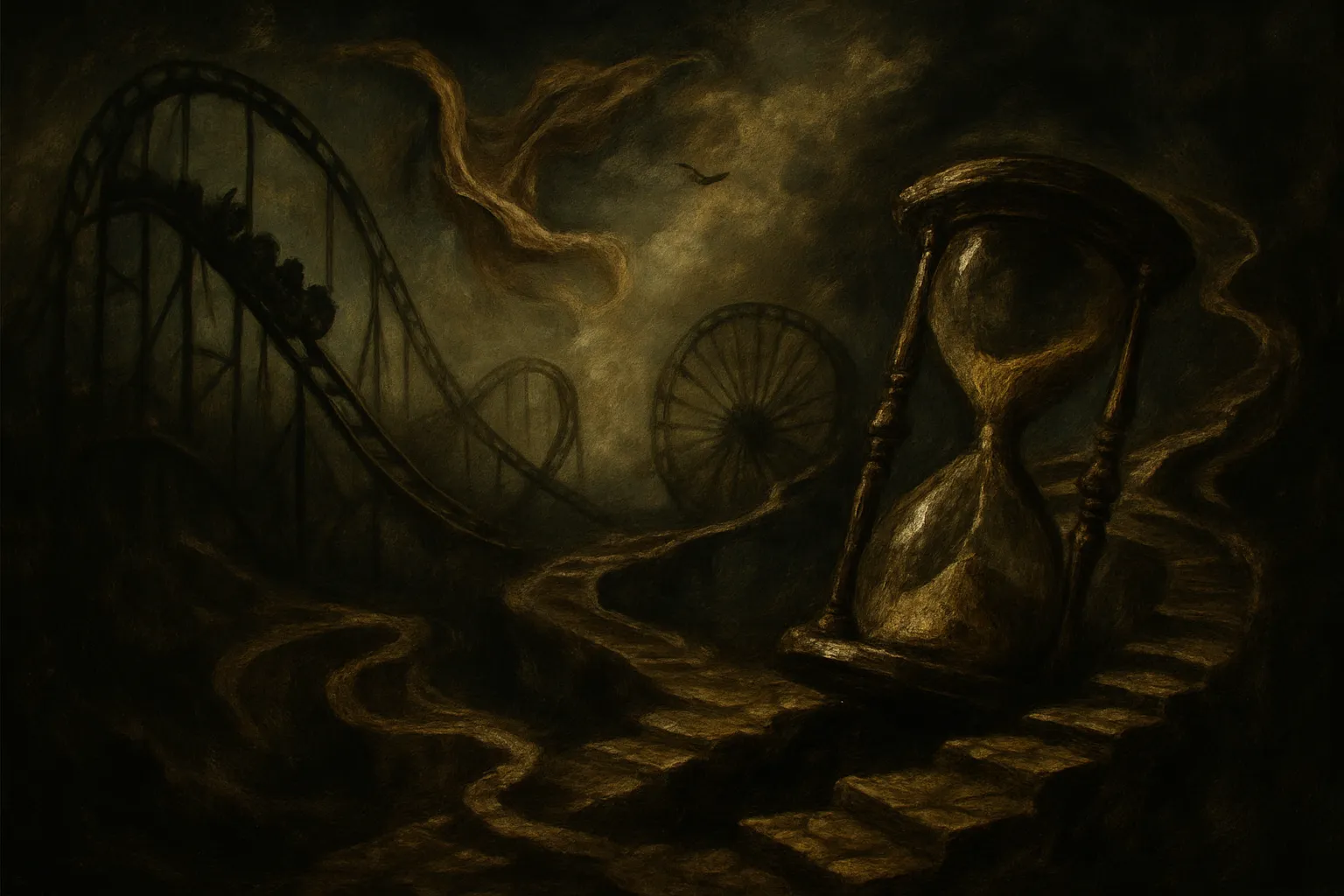
To live is to be a packet of intensive flows, momentarily stratified by the fragile axioms of the social machine, perpetually running the risk of being deterritorialized by the pure, indifferent chaos that hums beneath the surface of all structured reality.
The Transcendental Desiring-Machine: Death's Anti-Production
The core mechanism of the Final Destination series is the inversion of the capitalist desiring-machine. Where Capital functions as a socio-historical machine of production—continually generating and re-coding flows of desire into commodity and debt—the entity known only as Death functions as a Transcendental Desiring-Machine (TDM) (Deleuze & Guattari, 1983). Its output is not wealth or life, but the absolute deterritorialization of all flows that were momentarily saved from its immediate consumption. It is the machine of anti-production, dedicated to the rigorous re-capture of all subjects who attempted a line of flight from the Socius’s predetermined terminus.
The opening sequence, the roller coaster, is the TDM’s initial, magnificent stratification of human flow. The roller coaster itself is a molar apparatus—a disciplinary machine designed to generate controlled terror and pleasure within the strict safety parameters of the disciplinary society (Foucault, 1995). The riders submit their bodies to a calculated risk, exchanging their money for a codified, commodified thrill.
Wendy’s premonition is the Event—a sudden, uncodable rupture in the Symbolic Law (Lacan, 2007) that governs the ride. It is a line of flight that momentarily rips a handful of bodies from the ride’s striated trajectory. This vision is not merely a plot device; it is a schizo-process, the briefest connection to the pure, intensive chaos of the Body without Organs (BwO) (Deleuze & Guattari, 1987), where the distinction between what is real and what will be dissolves. The body, usually encased in character armor (Reich, 1949) and obedient to the social clock, is suddenly a site of prophecy, forced to confront the indifferent flow of pure chance.
The initial non-event—the averted crash—is a catastrophic success. These survivors are bodies ripped from the Big Other (Žižek, 1989), the invisible, ideological structure that validates their existence. They were supposed to die, and in failing to die at the pre-coded moment, they become anomalies, flows that must be violently re-absorbed to preserve the integrity of the TDM's operation. This is where the true horror begins: the survivors are now living signs of failure within the cosmic-economic ledger, and their continued existence is an ontological debt that Death must collect.
The Domestic War Machine
The TDM’s mechanism for re-capture involves transforming the stratified, everyday reality of the survivors into a Nomadic War Machine. The War Machine is defined by its exteriority to the State apparatus (the Socius) and its method of operating within smooth space—a space where lines, points, and surfaces are not organized by the State’s metric. Death accomplishes this by turning the most striated, codified aspects of the bourgeois American life—the gym, the tanning salon, the fast-food drive-thru—into a series of intensive, destructive points.
The core tension the user identified—the shift between randomness and deliberateness—is the crucial point of philosophical production. The individual malfunctions—the hydraulic leak, the misplaced nail, the loose cable—are, on their own, pure chaos, random variations in the life flow of objects. But the TDM orchestrates these random flows into a sequence, giving them a transcendental exhibitional sadism.
This orchestration transforms the everyday object from a commodity into a weapon of pure use-value (Marx, 1988). The tanning bed, a commodity designed for the aesthetic production of the docile, desiring body (Foucault, 1995), is re-coded into a sealed, incinerating coffin. The weight machine at the gym, designed to stratify muscle, is deterritorialized into a projectile that violently ruptures the body’s flows.
The viewer is caught in a transference—a Lacanian identification that overlaps their own everyday reality with the fictional universe. Every sound, every trip, every loose object becomes a potential Signifier of the death design. The TDM does not just kill; it weaponizes contingency.
"The delirium is the reality, but the reality is not the delirium. The delirium is the machine of the Real, but the Real is not the delirium, but the flow of reality that it deterritorializes and re-territorializes." (Deleuze & Guattari, Anti-Oedipus, 1983, p. 112, modified)
The logic of the TDM is that the chaos is real, but the design is the interpretive machine it forces upon the victims. Death is not merely killing; it is providing a fatalistic meaning to tragedy. It compels the survivors to believe that their deaths are not random accidents, but part of a deliberate plan, thus re-inscribing their shattered existence into a new, terrifying Symbolic structure—the law of Destiny.
The Trauma of the Uncodable
The film's narrative gives a fatalistic meaning to chaos, providing an immediate answer—Death's Plan—to the uncodable trauma of the non-event. This mirrors precisely how the larger Socius deals with real-world catastrophes like the Columbine Massacre.
When random, inexplicable violence rips through the striated fabric of society, the collective Big Other experiences a crisis of belief (Žižek, 2011). Randomness breaks the pattern of our everyday experience; it shatters the Kant's Categorical Imperative of a rational, moral universe. The mind, faced with the overwhelming flow of the Real—a reality that doesn't fit the puzzle—immediately seeks to re-stratify the chaos through a manageable narrative.
The real-life case of Columbine saw the media and public opinion grasp wildly at easily consumable Signifiers: "revenge for bullying," "gothic subculture," "The Trench Coat Mafia." These were simple, digestible simulacra (Baudrillard, 1983) generated to fill the terrifying void of meaningless destruction and pure nihilism (Nietzsche, 1968). The reality of Harris's psychopathy and Klebold's self-hate—the slow, methodical rationality of the slaughter—was harder to digest than the easy fiction of "kids who snapped."
This is the power of the likeable lie: the story of the girl who said "Yes" to God when confronted with the gun. This fabrication, instantly embraced and propagated by the religious community, is an ideological fetish.
"The function of the fetish is not to conceal the traumatic fact, but to conceal the fact that there is no traumatic fact in the Real, only a gap, an abyss, which is then filled by the fetish-signifier." (Žižek, 1989, p. 28)
The "She Said Yes" story is a fetish that seals the traumatic narrative holes. It allows the god-fearing machine (the local ideological apparatus) to re-fabricate its soul, trading the horror of senseless death for the comforting, transcendent meaning of martyrdom. The narrative is a commodity, bought and sold by believers because it reinforces the base emotional and ideological makeup of the community, ensuring their survival—not physical, but ideological survival.
The Fetish of Destiny
The protagonists of Final Destination 3 become trapped in a similar ideological loop, constantly trying to discern the order of Death's re-capture. Their frantic conversations and diagrams are attempts to map the schizo-process onto the familiar grid of formal logic. They are convinced that their wild, tangential understanding is the truth of their situation. This is the fetish of Destiny.
The film forces them to cling to this fabrication because the alternative—pure chaos—is existentially unbearable. The desire for continued existence (Nietzsche's Will to Power, perhaps, reduced to mere survival) depends on sanity, or at least a state of mind that allows agents to act on behalf of that desire. If their fate is random, then any action is futile. If their fate is deliberate, then they can still fight, seek patterns, and believe they possess context.
Context, in this flow, is not an objective truth but a creation, a perspective shaped by one's position in relation to the event. The elevator passengers, lacking the schizo-knowledge of the protagonists, cannot make sense of the "death order" because they lack the necessary context—the shared Signifier of the non-event. The protagonists, by contrast, cling to the context as a kind of truth, a schematic map of the narrative flow that provides temporary psychological security.
The token black man in Final Destination 2 (referenced in the notes) perfectly embodies this confrontation. He denies the possibility of the plan, clinging to the self-determination of his own ideological subjecthood, until gravity swings the canoe into his face. The forces of the TDM confront him with the undeniable Real, forcing him to submit to the idea of the plan. This confrontation is necessary for the character to trade the chaos of non-belief for the order of fatalistic belief.
This is the ultimate service the TDM performs for the larger Socius: it reinforces the deep human need to believe that everything happens for a reason, even if that reason is cosmic malice. It turns the raw, indigestible flow of tragedy into a manageable narrative, allowing the viewer to walk away disturbed, but ultimately reassured that the universe, even in its cruelty, is still comprehensible.
The Serpent Eating Its Own Tail
The structure of the TDM is an eternal recurrence (Nietzsche, 1968). The vision (line of flight) always leads back to the same destination (capture), creating a perpetual loop. The survivors, in their attempts to outwit Death, are simply running along the meticulously laid tracks of the War Machine.
Wendy's attempt to use the photographs—images as Signifiers of the future—is a desperate effort to re-code the TDM's flow through symbolic manipulation. However, the TDM, being transcendental, constantly deterritorializes the meaning of her images, forcing them to be interpreted in fragmented, horrifying ways. The picture itself is not the event; it is merely the sign of the event, forcing the subject to live in a state of hyperreality (Baudrillard, 1983), where the map (the photo) dictates the territory (their lives).
The finale, the inevitable subway crash, is the final, violent re-stratification. The brief, intensive period of the schizo-process is closed. The bodies, having momentarily escaped the death of the roller coaster, are finally re-inscribed into the TDM's master ledger. The subjects are forcibly returned to the Symbolic Law of their predetermined terminus.
The film's true violence is not the spectacular, elaborate kills, but the structural violence of its ideological closure. It teaches the viewer that resisting fate is futile, that all lines of flight are ultimately lines of re-capture. The terror is generated by the aesthetic of inevitability, the relentless demonstration that the world, even in its mundane objects, is simply a complex mechanism designed to enforce the original, unchangeable code of the TDM. The Final Destination series is therefore not about escaping death, but about making peace with the ideological necessity of fatalism in a world too chaotic to be believed.
References
Baudrillard, J. (1983). Simulacra and Simulation. (S. F. Glaser, Trans.). University of Michigan Press.
Deleuze, G., & Guattari, F. (1983). Anti-Oedipus: Capitalism and Schizophrenia. (R. Hurley, M. Seem, & H. R. Lane, Trans.). University of Minnesota Press.
Deleuze, G., & Guattari, F. (1987). A Thousand Plateaus: Capitalism and Schizophrenia. (B. Massumi, Trans.). University of Minnesota Press.
Foucault, M. (1995). Discipline and Punish: The Birth of the Prison. (A. Sheridan, Trans.). Vintage Books.
Lacan, J. (2007). Écrits: The First Complete Edition in English. (B. Fink, Trans.). W. W. Norton & Company.
Marx, K. (1988). Economic and Philosophic Manuscripts of 1844. In D. McLellan (Ed.), Marx: Selections. Oxford University Press.
Nietzsche, F. (1968). The Will to Power. (W. Kaufmann, Ed., & W. J. Hollingdale, Trans.). Vintage Books.
Reich, W. (1949). Character Analysis. (T. P. Wolfe, Trans.). Orgone Institute Press.
Žižek, S. (1989). The Sublime Object of Ideology. Verso.
Comments
Post a Comment