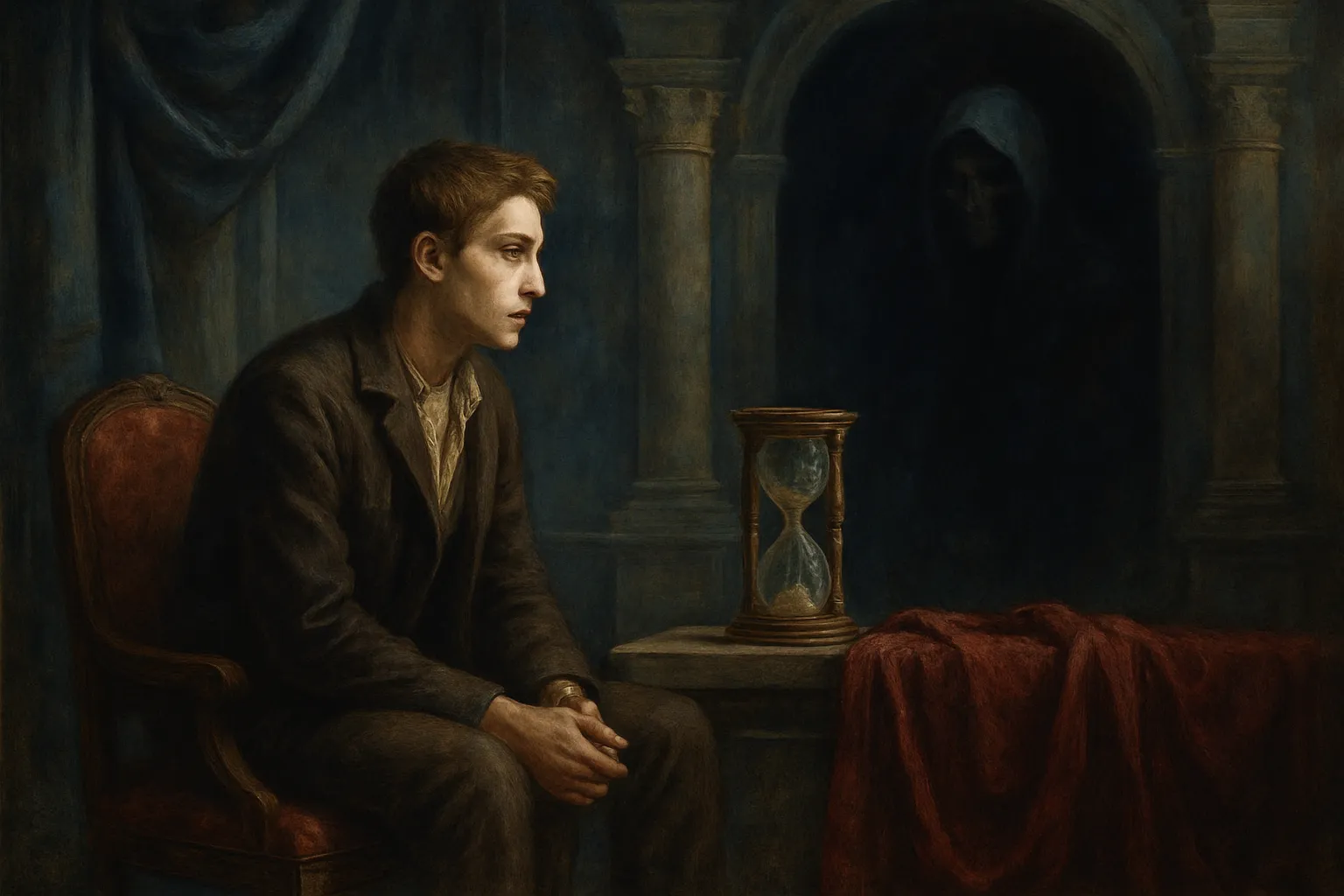
Forget the Grim Reaper. The true horror of Final Destination (2002) is not a cloaked figure, but a flawless machinic axiomatic: a cosmic, hyper-bureaucratic system correcting a fatal error. When Alex Browning and six others cheat death aboard Flight 180, they don't buy themselves time; they trigger a universal system failure, forcing a relentless re-territorialization of their lives back into the cold logic of the cosmic ledger. This analysis dives beyond simple horror tropes to examine the film as a terrifying expression of transcendental terrorism, where freedom is an illusion and Death is the ultimate accountant for capital-flow.
The Stratified Space
The architecture of Final Destination offers a brutal, explicit dramatization of the machinic axiomatic of the cosmos, where the principle of death is not a biological endpoint but a desiring-machine dedicated to the anti-production of life. This cinematic event is less a horror film and more a diagram of cosmic accounting, a terrifying visualization of a universe governed by a single, unyielding, non-negotiable balance sheet. Before the titular event, the subjectivities of Alex and his cohort exist in a state of naive molarity, simply youth flowing toward a predetermined destination (Paris, a vacation, a simple stratification of time and space). The casual remark from the nondescript jock, George—"That's a good sign. Younger, the better. It'd be a fucked up God to take down this plane"—followed by the sight of the mental patient—"A really fucked up God"—serves as the primal scream of the Problem of Evil. It erupts precisely against the backdrop of an impending 9/11-shadowed transcendence, a world where the absolute planar event (a plane explosion) is normalized and then immediately, traumatically, ruptured.
The premonition Alex experiences is not merely a dream; it is an involuntary, momentary line of flight ripped through the very Body Without Organs (BwO) of the cosmos itself. The BwO, that unstratified, intensity-laden ground, is always in process, yet here it is rendered concrete and stratified by the force of a fatalistic design—a divine spreadsheet. The plane crash is the initial, intended realization of this cosmic design, a profound re-territorialization of human flows back to the zero-point of matter. The students, in this context, are simply productive entities whose flows were scheduled to cease. The crash is the ultimate capture, the decoding and axiomatization of their desires into a final, catastrophic stillness (Deleuze & Guattari, 1983).
When Alex acts, the premonition—this fleeting awareness of the BwO’s underlying machinic diagram—becomes a schizophrenic rupture. He forces a break, not a meaningful political act, but a pure deterritorialization of the death flow. The flow of Destiny is not eliminated; it is merely diverted, creating a monstrous feedback loop. Death, therefore, is not a figure cloaked in black but the Leviathan-Bureaucrat—a supreme expression of the State-Apparatus applied to temporality itself, obsessed with ensuring the ledger balances and the stratification is restored. The teens become singularities that the cosmic machine must forcefully re-integrate. Their existence, post-premonition, is an unscripted event that pollutes the perfection of the Recording Surface.
The Evil God as Recording Surface
The film explicitly leans into the Calvinist claim that existence has been cosmically scribed by a deity. This God is not a paternal figure but a cold, efficient Recording Surface—a cosmic computer that pre-logs most existence, many actions, and nearly all deaths. This is the transcendental forgery of freedom. The moral framework that judges human action is fundamentally flawed when the action itself is pre-coded. This framework of morality serves as the apparatus through which ressentiment is mobilized, where the weak define the strong as evil to justify their own impotence (Nietzsche, 2002). The pre-coded fatalism turns the film’s weakness into a structural feature. The "Evil God" is precisely the oppressive structure that suffocates potential:
The Christian resolution to find the world ugly and bad, has made the world ugly and bad." (Nietzsche, 2002, p. 75).
This Evil God is a supreme hyperreal concept. Freedom, choice, and belief are merely simulacra staged by the transcendental axiomatic (Baudrillard, 1983). The students' struggles are not battles against fate, but against the sheer force of the simulacrum. Their preordained death is the Real that constantly attempts to break back into the Symbolic order of their brief, extended lives. The traumatic Real of the pre-scripted crash is what the survivors endlessly attempt to repress, yet it returns in the most elaborate, sadistic, and physical forms:
The dimension of the Real, of the traumatic kernel, is precisely what resists its symbolization." (Žižek, 1989, p. 119).
The cinematic mechanism of Death (the smoky figure orchestrating chaos) is a desiring-machine whose sole telos is to force conformity to the Symbolic order of the flight manifest. The elaborate Rube Goldberg murders—the leaking water, the falling sign, the runaway car—are the specific, molecular operations necessary to re-establish the failed stratification of the BwO. The teens' personalized disembowelment, where dying is itself a punishment, is the cosmic State-Apparatus insisting that the body must conform to the trauma of its missed moment, that the flow must be blocked precisely where it should have ceased. The death is not enough; it must be a suffering unto death, a spectacular, unique destruction that reaffirms the design's absolute authority over the body.
The Death Drive, Survivor’s Guilt, and the Blocked Flow
The lingering trauma and survivor’s guilt noted by the user are the psychological echo of the machinic flow reversal. The survivors are trapped in a repetition compulsion that is entirely externalized. They are compelled to relive, or at least witness the structural conditions of, their initial death. The fundamental force in the human organism seeks to return it to an inanimate, tensionless state (Freud, 1961). In Final Destination, this death drive (Todestrieb) is literalized and externalized as the Grim Reaper-Bureaucrat. Alex and his friends are not just afraid of death; they are living proof that the death drive failed to execute its primary mission. They exist in an artificial state of tension, an anti-tension sustained by the constant threat of the design correction. Their repeated attempts to thwart the design are the organism’s desperate struggle against a transcendentalized compulsion:
The aim of all life is death.” (Freud, 1961, p. 32).
This is where the film’s schizoanalysis hits its darkest point. The characters are not resisting the death drive; they are resisting the correct scheduling of the death drive. The attempt to live, the desiring-production flow, is the force that cuts across the BwO. But because the BwO here is pre-coded by the "Evil God," the desiring-production of the teenagers becomes immediately suspect. It is deemed an error, a glitch in the system. The ensuing murders are the system’s attempts to eliminate the molecular anomalies—the bodies that refuse to integrate into the death-flow. The flows of life and death, normally intertwined in biological process, are here separated into two warring, distinct entities: the linear flow of the teens’ extended life and the transversal, bureaucratic flow of the design attempting to re-cut it. The chaotic manner of the secondary deaths—the material associations—proves that Death is not arbitrary, but rather a hyper-specific engineer. Each death is a micro-cosmic reflection of the plane crash’s violence, only miniaturized and personalized, an almost aesthetic final gesture proving that the design is both totalizing and infinitely detailed.
The teenagers, finding their seats, their faces, and their fates in the order of the disaster, try to "understand the patterns." This attempt to create a map (a rhizome) from the trace (the vision) is the essential schizoanalytic gesture. But their efforts are doomed because they remain stuck in a molar interpretation. They seek to substitute one form of control (their hypothesis of action) for another (God’s design). This is the fatal error of Oedipal re-territorialization: they believe they can master the flow by engaging it on its own terms of cause-and-effect (the "saving gesture" to short-circuit the cycle). They treat the BwO as if it were a linear narrative, rather than a field of intensities.
The Failed Becoming
Alex’s final hypothesis—to repeat the original saving gesture by actively interrupting the next death—is a profoundly anti-schizoanalytic act. It is an attempt to solve a problem of flows and intensities using the rigid, striated space of moral action. It is a failure to achieve a true becoming-revolutionary. The line of flight must be total, a dissolution, not a tactical maneuver.
A true line of flight would require a complete disengagement from the axiomatic—an embrace of the BwO’s unstratified potential, perhaps a collective schizophrenic refusal to engage with the reality principle altogether. Instead, Alex attempts a "fix," which is nothing more than shoring up his own character armor, the frozen, muscular structure that defends the ego against the flow of natural impulse and desire (Reich, 1972). Alex is trying to patch the ego of the cosmos, not dissolve it:
Character armor is the sum total of typical, rigid attitudes… which the individual uses to protect himself against the dangers stemming from the external world and against his repressed instinctual stimuli.” (Reich, 1972, p. 24).
By attempting to "save" someone, Alex remains locked in the rigid, paternalistic role of the Oedipal savior—the hero figure, the one who knows. The Evil God’s axiomatic laughs at this gesture, because the attempt at heroism is simply another pre-coded vector of the ultimate fatalism. The design is not short-circuited; the characters simply move to the final, predetermined positions on the board. The film concludes with the symbolic death of the remaining survivors, confirming that the axiomatic of capital-death cannot typically be overcome by a simple intervention of the molar ego.
The true Evil God in Final Destination is not the figure of Death, but the transcendental principle of Order itself, which tends to insist that most events must be integrated into a totalizing, non-contingent design. The anxiety provoked by the film, particularly in its shadow of 9/11, is the cultural shock of realizing that the chaotic event (the airplane crash) was the design, and that the only true freedom lies in the impossible, terrifying leap off the plane—the deterritorialization from the strip of pre-coded destiny. But the film, being a product of the State-Apparatus of Hollywood, must ultimately re-territorialize the chaos, proving that the flow of order generally reasserts its dominion over the fleeting, chaotic lines of flight. The ledger must balance; the Capital-flow tends to capture the interest—the bodies.
APA References
Baudrillard, J. (1983). Simulacra and Simulation. University of Michigan Press.
Deleuze, G., & Guattari, F. (1983). Anti-Oedipus: Capitalism and Schizophrenia. University of Minnesota Press.
Freud, S. (1961). Beyond the Pleasure Principle. Liveright. (Original work published 1920).
Nietzsche, F. (2002). Beyond Good and Evil: Prelude to a Philosophy of the Future. Cambridge University Press. (Original work published 1886).
Reich, W. (1972). Character Analysis. Farrar, Straus and Giroux.
Žižek, S. (1989). The Sublime Object of Ideology. Verso.
Comments
Post a Comment