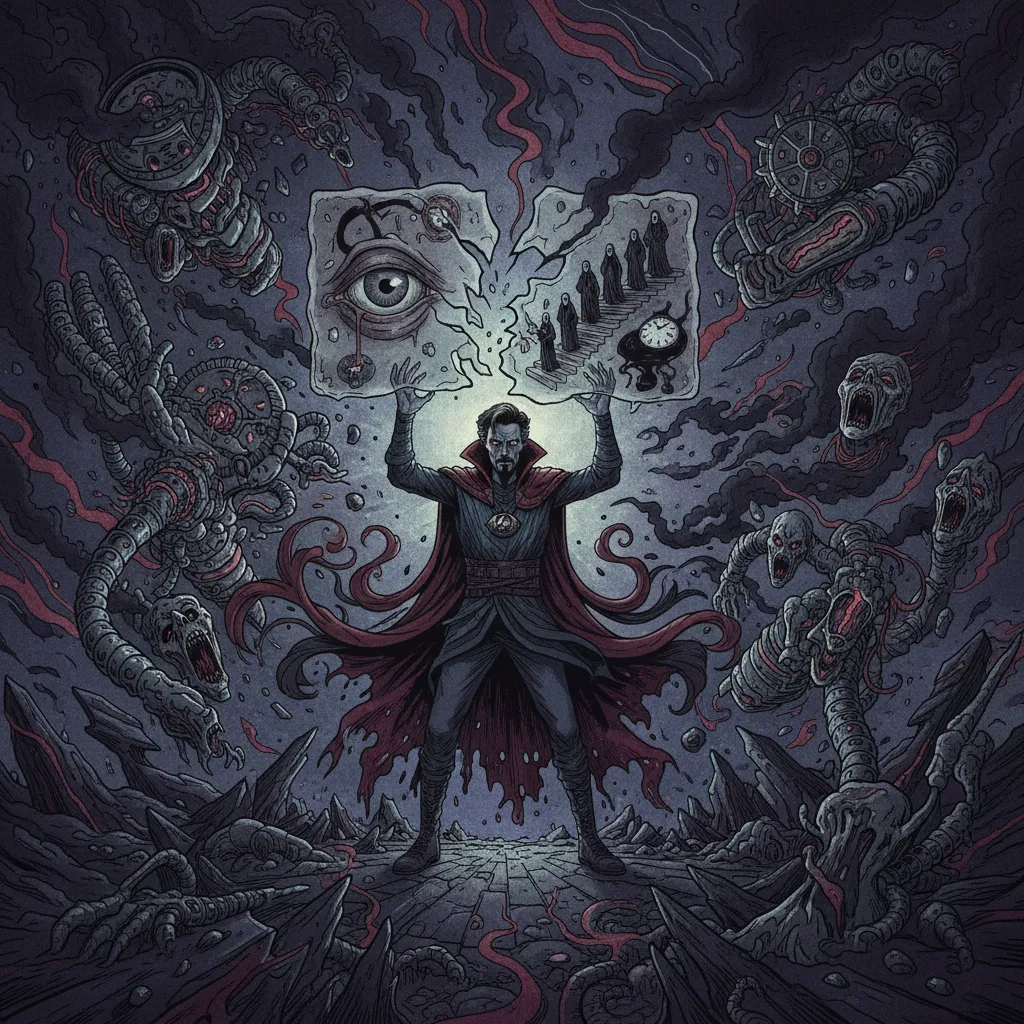
The clinical gaze of the neurosurgeon is the Abstract Machine of Western empiricism, its knife-edge tracing the final, violent boundary between the living flow of the Body-without-Organs (BwO) and the Molar organization of medical science (Deleuze & Guattari, 1983).
When we confront the cinema of dreams and desire, we must first abandon the armchair of the classical analyst. The dream is not a cryptic message from the repressed unconscious; it is a factory, a perpetual desiring-machine (Deleuze & Guattari, 1983) that produces reality, not representation. The idea that sex, or any energetic flow across a boundary, is "psychologically obscure" (Jung, as referenced in the source text) only holds true when the Oedipal Apparatus of the familial structure is used as the sole recording surface. To move beyond this, we must deconstruct the subject, the physician Stephen Strange, as a highly stratified commodity fetish, whose professional identity is merely a hardened Character Armor (Reich, 1949) waiting for the catastrophic moment of its own undoing.
I. The Surgical Axiom and the Stratification of the Ego
Stephen Strange’s pre-accident existence is the triumph of the Capitalist Axiom applied to the human body. He is a genius whose entire desiring-flow is channeled into the highly controlled, professionalized act of surgery. His hands are his technological inscription device, the very instruments of his social power and financial reproduction. This specialized skill is the ultimate commodity fetish (Marx, 1867/1976)—a physical talent valued not for its use (healing) but for its symbolic exchange value (wealth, fame, ego).
The Muscular Rigidity of the Molar Subject
The entire structure of Strange's ego—his narcissism, his isolation, his need for recognition—is a manifestation of Character Armor (Reich, 1949). This is not merely a psychological defense; it is a physical and psychic blockage, a muscular rigidity that prevents the turbulent, unmediated flows of the BwO from disrupting the Molar organization of his life. Reich described this as the "sum total of the chronic, specific ways in which an individual has restricted his original total mobility" (Reich, 1949, p. 144). Strange's restricted mobility is professional and ethical; he only operates when the profit (ego/financial) is high. His arrogance is the rigidity of the armor that shields him from the chaos of non-value.
The Deterritorialization of the Flow
The car crash is the schizo-fissure, the sudden, traumatic deterritorialization that rips his established flow away. The damage to his hands is not merely physical; it is a symbolic castration. The hands, the site of his economic and narcissistic power, are rendered functionally useless. They can no longer inscribe his will onto the world, forcing him out of the Symbolic Order of Western medicine. He is exiled from the Abstract Machine of the hospital, thrown into a state of acute ontological insecurity (Laing, 1960). His identity, which was externally defined by his work, fractures completely. He becomes a divided self, unable to reconcile the narcissistic surgeon he was with the crippled failure he has become. The film begins not with a mystical journey, but with a descent into the terror of the subject whose social coding has failed.
II. The Castration Complex and the Oedipal Apparatus
The source text correctly identifies the psychoanalytic core: the film’s confrontation with primordial horror is best interpreted through the lens of the Castration Complex. However, in a schizoanalytic context, the Castration Complex is not merely a psychic fear of lack, but the ultimate Oedipal Apparatus (Deleuze & Guattari, 1983) designed by society to organize and manage the terrifying flows of desire.
The Paternal Law and the Mother's Desire
Freud's insistence on linking sexuality and dreams to the parental unit—specifically the mother's role in giving birth and the symbolic removal of the father's penis—is the ultimate act of reterritorialization. The entire familial triangle is the recording surface onto which society inscribes its codes of acceptable desire and production. The mother figure, then, becomes the site where the male subject's infinite desiring-flow is forced into a finite, oedipalized channel.
The mother's role in the dream analysis proposed in the source text ("it was your mommy who gave birth to you and not some second mother or father") is the violent affirmation of this Oedipal lock: the singularity of the parental source enforces the singularity of the subject's desire, trapping him within the family's neurotic orbit. The desire for money and power, which the source suggests mirrors the mother-baby dynamic, is precisely the Capitalist Axiom operating through the Oedipal system. The subject, forbidden the mother, channels the intensity of that flow into the acceptable, commodity-driven production of wealth and status. The surgeon's ego is merely the adult realization of the baby's demand for absolute, unmediated attention and control.
The Oedipalization of the Dream-Flow
The act of dream interpretation itself is an Oedipal project. When Freud classifies dreams as wish fulfillment (Freud, 1923), he attempts to re-code the chaotic, productive flow of the dream-factory back into a comprehensible, lack-driven narrative: "The subject wants X but is denied X, therefore the dream substitutes Y." Schizoanalysis rejects this entirely: the dream is not a sign of lack but a sign of production. The dreams of Strange are not wishes to be a surgeon again, but the frantic, molecular production of new potential flows—flows that ultimately lead him to Kamar-Taj, the nexus of the schizo-flow itself.
III. The Sanctum Sanctorum and the Molecular Politics of the BwO
Strange's search for healing leads him to the masters of the mystic arts, who operate in a realm where physics—the Molar discipline of his former life—is meaningless. Kamar-Taj is the political laboratory where the nature of the BwO is finally revealed.
The Body-without-Organs of the Multiverse
The Multiverse is the ultimate realization of the BwO (Deleuze & Guattari, 1983)—an unstratified field of pure, intense energy flows where the organs (dimensions, time, space) are only temporarily and locally organized. The sorcerers, far from being "good" or "spiritual," are merely technicians who have mastered the art of local stratification. They use ritual and focus to channel the infinite energy of the BwO into defined, usable effects (spells, portals). The Ancient One, their leader, is the primary Stratification Agent, ensuring that the chaotic energy flows are never allowed to completely deterritorialized the Earth plane (the Oedipal recording surface).
The Sanctum Sanctorum, with its strict rules and defensive posture, is the Neurotic Assemblage of the magical community. It is a highly organized Molar structure whose sole purpose is to manage the overwhelming terror of the molecular flows that constantly threaten to burst through from other dimensions. The source text accurately captures the "Orwellian" nature of this, suggesting institutions like the Sanctum Sanctorum are the true agents of control. They represent the hegemony of controlled magic, preventing the majority of humanity from accessing the raw, revolutionary power of the BwO.
Kaecilius and the Line of Flight into Nihilism
Kaecilius and his zealots are the schizo-rupture that demands total dissolution. They seek the Dark Dimension and Dormammu not for power, but for total deterritorialization. They want the flow of time (the ultimate stratification) to cease, allowing them to merge fully with the eternal, structureless flow of the BwO. This is a nihilistic act (Nietzsche, 1967) because it rejects all existing value, all structure, and all production in favor of an absolute, static communion.
Their actions are a profound reaction against the Abstract Machine of the social socius. Having realized the utter hollowness of the Molar structures (faith, law, physics), their ultimate desire is to liquify the self entirely, achieving a form of non-existence that is also a terrible form of freedom. This self-willed destruction is the terrifying fulfillment of the will to power that seeks to overcome the self that was born under the sign of Oedipus.
IV. Dormammu: The Body-Without-Organs and the Obscene Fantasy
Dormammu, the entity possessing Strange in the source text (referring to the 2015 film's narrative), is not a creature in the traditional sense. He is the BwO made manifest—pure, untamed production without subject or limit. He is the ultimate schizo-entity whose nature is defined by the refusal of stratification and time.
The Obscene Fantasy of Eternal Consumption
Dormammu's desire to consume all dimensions, to absorb them into the Dark Dimension's timeless flow, is the ultimate realization of the State's obscene fantasy (Žižek, 2009). The State, like Capital, always seeks total, absolute absorption of all flows (labor, debt, desire) into its own system. Dormammu is merely the supernatural reflection of this terrestrial logic.
Žižek argues that ideology works not by hiding reality, but by manifesting an "obscene fantasy" that compels the subject to participate in their own subjugation. In the film, the threat of Dormammu forces the sorcerers, and Strange, to fight for the "illusion" of a stable reality that is itself deeply flawed. The ultimate threat is a perfect political metaphor:
Ideology is not simply a 'false consciousness,' a lie that hides the real state of things; it is a reality which is itself conceived to perpetuate the 'lie' in question. (Žižek, 2009, p. 43)
The "lie" is that the Molar world of Earth is free; the obscene fantasy is that only total submission to the dark flow or total subservience to the Ancient One's stratified code can save it.
The Molecular Flow of the Dream-Wish
The source text attempts to interpret the Doctor Strange narrative through Freud's lens of dreams and wishes. In the schizoanalytic context, Dormammu is the wish, but not a wish for gratification. He is the raw, molecular flow of desire that the entire Symbolic Order of Earth has attempted to wall off.
The dream flow that Strange enters when he begins training is a forced confrontation with this BwO. The kaleidoscopic cityscapes folding and twisting are a cinematic representation of molecular chaos, where the fixed, Molar coordinates of space and time are violently dissolved. This is the schizo-flow made aesthetic, forcing the arrogant surgeon to lose his grounding and accept that reality is defined by production (of energy, of spells, of new dimensions), not merely by representation (of anatomical truth, of scientific law).
V. The Becoming-Deontological: Strange's Line of Flight
Strange's final confrontation is not a battle of strength, but a brilliant conceptual rupture—a refusal to play the game of Molar conflict.
The Loop and the Re-inscription of Time
Strange uses the Eye of Agamotto not to reverse time (a simple reterritorialization), but to create a localized, self-sacrificing time loop. This is the ultimate, paradoxical move against the BwO: he uses a Molar mechanism (the absolute concept of infinite, repetitive time) to capture and paralyze the ultimate source of molecular deterritorialization (Dormammu).
By sacrificing his own ego and body to be killed infinite times, Strange achieves an ethical Event (Badiou, 2005). The Event occurs when a subject, confronted by an impossible situation, makes an ethical decision based on an absolute truth that transcends the existing codes of the situation. Strange's truth is that the Earth must continue its flow of stratification, even if that stratification is neurotic and flawed.
This self-sacrifice is his becoming-Deontological act. Unlike the Utilitarian, who performs a calculation for the "greatest good," Strange acts based on a pure duty to break the cycle of consumption, regardless of the personal cost. The loop is not a mere trick; it is the ultimate expression of the will to power (Nietzsche, 1967) that seeks to overcome the nihilism of the Dark Dimension by affirming the value of the finite and the stratified.
Critical Consciousness and the New Armor (Freire)
Strange's transformation—from the surgeon trapped in muscular armor to the sorcerer willing to die infinitely—is his achievement of critical consciousness (Freire, 2000). Freire’s liberation theory suggests that the oppressed must engage in dialogue and praxis to transform their world. Strange, having been "oppressed" by his own limitations and by the trauma of his injury, engages in praxis (training) and dialogue (with the Ancient One) to gain an awareness of the forces (dimensional, political, economic) that constrain him.
His new "armor" is not the rigid ego of the surgeon but the flexible, adaptable cloak of levitation and the conceptual power of the time stone. He has replaced his financial commodity (his hands) with a non-commodity flow (magical duty). He has accepted his divided self (the surgeon who must become a mystic) and used his ontological insecurity as the engine for his new, ethically guided desiring-machine.
The film concludes with Strange staring out the Sanctum window, now tasked with protecting a world he knows to be fundamentally fragile, neurotic, and constantly on the brink of deterritorialization. He has traded the neurotic safety of the operating room for the existential terror of the BwO. The true horror of the film is the final realization: the Abstract Machine of the social socius is just a thin, flickering light against the infinite, terrifying production of the Dark Dimension—and he is the only one left to guard the failing switch.
References
Badiou, A. (2005). Being and event (O. Feltham, Trans.). Continuum.
Deleuze, G., & Guattari, F. (1983). Anti-Oedipus: Capitalism and schizophrenia (R. Hurley, M. Seem, & H. R. Lane, Trans.). University of Minnesota Press.
Freire, P. (2000). Pedagogy of the oppressed (M. B. Ramos, Trans.). Continuum.
Freud, S. (1923). The ego and the id. Hogarth Press.
Laing, R. D. (1960). The divided self: A study of sanity and madness. Penguin Books.
Marx, K. (1867/1976). Capital: A critique of political economy, Vol. 1. Penguin Classics.
Nietzsche, F. (1967). On the genealogy of morals (W. Kaufmann & R. J. Hollingdale, Trans.). Vintage Books.
Reich, W. (1949). Character analysis (T. P. Wolfe, Trans.). Orgone Institute Press.
Žižek, S. (2009). The parallax view. MIT Press.
Comments
Post a Comment