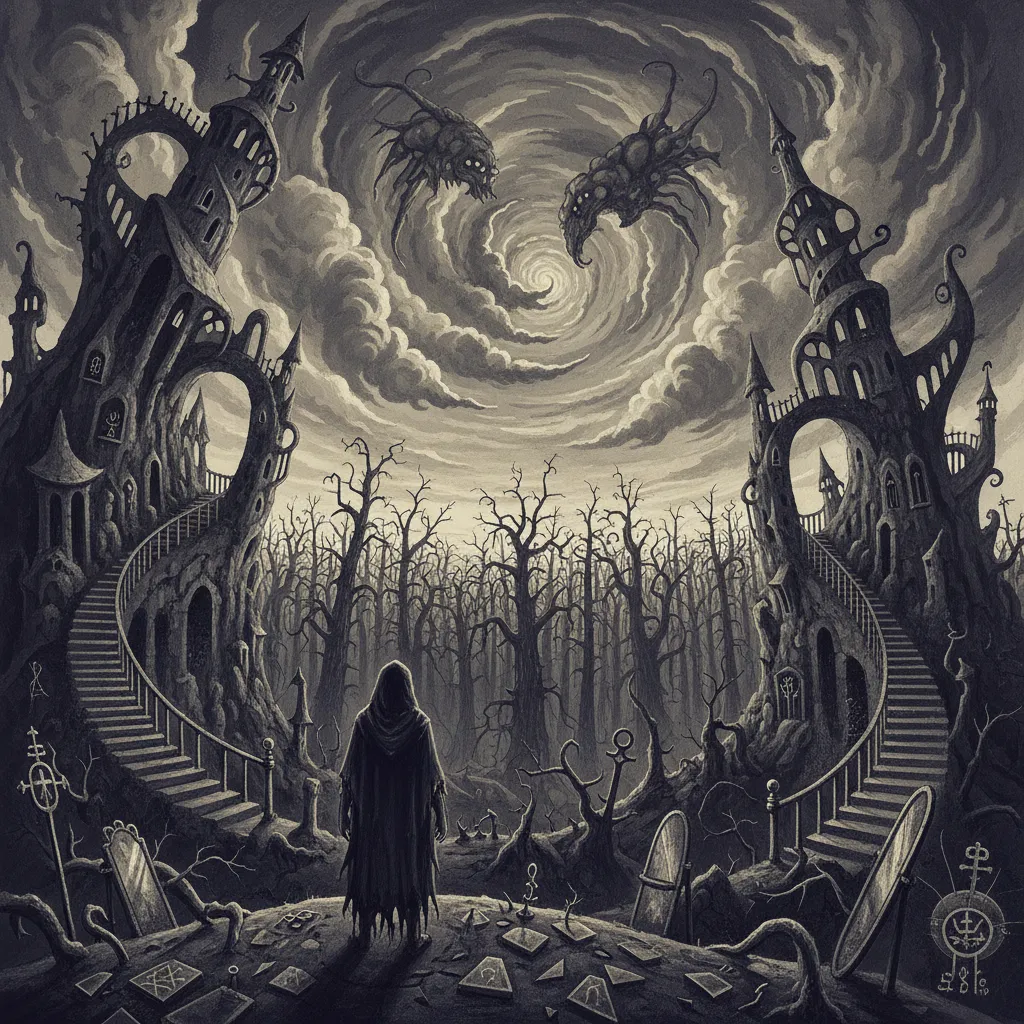
A few years ago, I caught III (2016) at a midnight screening purely by accident—and let me confess: I nearly left after the opening scene. Not because of gore or demons, but because I felt claustrophobically trapped inside layers of psychic guilt. The experience stuck: what if a film turned the actual plague into a metaphor for centuries of internalized guilt, all set to a surreal, feverish rhythm? III isn’t your garden-variety horror flick; it’s a psychoanalytic puzzle box, equally likely to spark a headache as an epiphany. Here’s a walk (or stumble) through its tangled corridors of trauma, theology, and resistance, cracking open uncanny symbols and sweaty-palmed sisterhood.
Hospitals, Plagues, and the Idea of Somatic-Theological Stratification
In III (2016), the hospital is far more than a setting for medical drama—it is a crucible where spiritual, psychological, and bodily forces collide. The film’s hospital is not simply a place of healing or containment; it is a battlefield for what the text calls “Somatic-Theological Stratification.” Here, the boundaries between disease, trauma, and ideology blur, making the hospital a charged space where the body becomes a canvas for both suffering and control.
The concept of the Somatic Plague in III is crucial. Unlike traditional plagues, which threaten life through infection, this plague is an ideological instrument. Trauma is recast as disease, and guilt becomes a fever that burns through the psyche and flesh. Mirra’s illness is not just a medical mystery—it is a symptom of a deeper, historical process where Christian and patriarchal codes use psychic trauma as a means of re-territorializing individuals, especially women, onto the stratified surfaces of theological guilt. The hospital, then, is not a neutral ground; it is a site where bodies are conscripted into moral crusades or, just as often, left to suffer alone, wrapped in their bedsheets and their shame.
Early in the film, dream sequences involving a priest make this dynamic explicit. The priest, acting as a molar dignitary, recodes Mirra’s suffering—not as a response to social violence or indifference, but as a personal failure, a spiritual shortcoming. This is a sinister twist on the traditional bedside manner. Instead of offering comfort or understanding, the priest’s presence reframes illness as a mark of sin or fear, dissolving the reality of external oppression and redirecting its weight onto the patient’s Body-without-Organs (BwO). The hospital becomes a place where the chaos of trauma is not resolved, but instead recoded and internalized as guilt.
This process is not unique to the world of III. Hospitals, in both fiction and reality, often serve as liminal spaces—zones where flesh and spirit, discipline and chaos, are tangled up in flickering fluorescent light. The boundaries between patient and diagnosis, between care and control, are always shifting. In the film, the hospital’s corridors echo with the logic of the Christo-Axiom: the idea that suffering is a sign of spiritual failure, and that guilt is a hereditary disease passed down through generations, much like the doctrine of original sin.
“The plague is Christianity,” the film suggests, with the Christo-Axiomatic functioning as an abstract machine that perpetuates guilt as a generational, transhistorical flow.
This logic is not confined to the screen. In real hospitals, patients sometimes interpret their pain through the lens of inherited guilt or cosmic debt. One night in the ER, a patient once told the attending nurse that his pain was “bad karma”—a belief that his suffering was the result of past misdeeds, echoing Mirra’s plight in III. This anecdote highlights how easily the boundaries between medical and moral explanations for suffering can blur, especially in spaces where vulnerability is at its peak.
The hospital in III is thus a microcosm of the broader mechanisms of Somatic-Theological Stratification. It is a place where trauma is not only treated, but also judged and recoded. The priest’s authority, the institutional routines, and the flickering lights all contribute to a system where bodies are disciplined and spirits are weighed down by inherited guilt. Mirra’s illness is a spotlight on how easily bodies can be drafted into moral crusades, or left to languish in isolation, their suffering reframed as evidence of personal or spiritual failure.
Christo-Axiomatic Machines: How Guilt Outlives the Plague
In III (2016), the true contagion is not the plague that ravages bodies, but the guilt that seeps through generations—transmitted not by microbes, but by the machinery of theology. The film’s schizoanalytic lens exposes how Christian and patriarchal systems encode guilt as a kind of invisible inheritance, one that outlives any physical epidemic. This “Christo-Axiomatic” process, as the film terms it, operates like a historical machine, transforming trauma into a tool for social control.
The Real Contagion: Guilt as Transgenerational Code
The narrative opens with Mirra’s mysterious illness, quickly reframed as a “Somatic-Theological Stratification.” Here, the body becomes a battleground for wounds inflicted by dominant moral codes. The priest’s early appearances are crucial: he does not treat Mirra’s suffering as a medical issue, but as a spiritual failing. This is the first sign of the Christo-Axiomatic machine at work—illness is recoded as sin, and trauma as personal fault.
This dynamic is not unique to the film’s world. It echoes the way original sin is presented in Christian doctrine: an unchosen, inherited stain that marks every individual. As the film provocatively suggests, “the plague is Christianity.” In this view, guilt is the real epidemic, passed down like a family heirloom. No one escapes; everyone gets a slice, whether they want it or not.
Original Sin: The Ultimate Family Heirloom
The Christo-Axiomatic machine does not discriminate. Its logic is universalizing, flattening all difference into a single fabric of guilt. The film references the idea that even figures as different as Hitler and Gandhi are “sewn into the same quilt” of original sin. This is the theological axiom of causality at work: saints and monsters alike are caught in the same net, unable to escape the machinery of inherited blame.
“All personalities, from Hitler to Gandhi, are sewn into the same quilt of original sin under the oppressive logic of the theological axiom of causality.”
This quote from the film’s analysis highlights the uncomfortable reach of the Christo-Axiom. It is not just about individual actions, but about a system that makes guilt inescapable and collective.
Guilt-Flow: The Invisible Inheritance
The concept of “guilt-flow” emerges as a central theme. Unlike the visible symptoms of plague, guilt is an invisible current—an inheritance that shapes bodies and minds without anyone remembering when it started. In modern terms, it’s the same feeling that keeps people awake at 2am, scrolling through social media, wishing the blame for their anxieties could be outsourced. The Christo-Axiomatic machine ensures that guilt is always internalized, always personal, even when its origins are social or historical.
Guilt as a generational flow: Passed down through doctrine, not DNA.
Original sin as universal: No one is exempt, not even the most virtuous or the most villainous.
Modern parallels: Shame cycles in digital life echo the old theological patterns.
Schizoanalysis and the Machinery of Guilt
The film’s schizoanalytic approach, drawing on thinkers like Reich and R.D. Laing, maps trauma as a “Schizo-Cartography.” Here, the body becomes a “Body-without-Organs (BwO),” a surface where guilt and trauma are inscribed. The “Character Armor” described by Reich is visualized in Mirra’s defensive postures and self-blame, showing how external violence becomes internalized as physical and psychic fragmentation.
The Christo-Axiomatic machine is relentless. It re-territorializes every line of flight, every attempt to escape guilt, by reframing it as further evidence of sin or failure. The only resistance comes through minoritarian knowledge and collective support, as seen in the bond between the sisters—a fragile line of flight against the overwhelming machinery of inherited guilt.
In III, the plague may kill bodies, but the Christo-Axiomatic machine ensures that guilt survives, mutates, and continues to govern the living. The film’s unsettling message: the machinery of guilt is harder to cure than any physical disease.
#Schizoanalysis #ChristoAxiom #GuiltFlow #RDLang #CharacterArmor #NomadicHealer
Schizo-Cartography, Divided Selves, and Internal Aggressors
In III (2016), the act of healing is radically reimagined. Rather than a traditional exorcism, Ayia’s journey into her sister Mirra’s subconscious is presented as a form of schizo-cartography—a mapping of psychic landmines left by trauma, guilt, and patriarchal violence. Ayia is not simply a healer or priest; she is a cartographer, tracing the hidden routes of pain and repression that structure Mirra’s suffering. This approach aligns with schizoanalytic theory, which focuses on the flows and blockages within the psyche, rather than reducing illness to either biological or supernatural causes.
The film’s most visually striking sequences occur within these dream-dives. Here, the concept of the Divided-Self—a direct nod to R.D. Laing—takes center stage. Mirra’s inner world is populated by countless versions of herself, each one echoing the same refrain: “I wanted it.” These replicated selves are not simply hallucinations; they are the psychic fragments produced when patriarchal culture forces victims to internalize blame for their own trauma. The effect is chilling: imagine if every voice in your head blamed you for someone else’s crime. That is the horror Mirra endures, and it is the very mechanism by which the Christo-Axiom and patriarchal logic maintain their grip.
The film’s imagery—fields of Mirras, a bloody-faced man with a noose—serves as a visual manifesto for the psychic horror of patriarchy. The noose, in particular, stands as a symbol of the internal aggressor: the part of the self that has absorbed the voice of the abuser, now turned inward as self-punishment and guilt. These images are not just symbols; they are the lived reality of trauma as it is encoded in the body and mind.
This process is further illuminated by Wilhelm Reich’s concept of Character Armor. Reich argued that the body carries the history of its wounds as chronic tension, posture, and pain. In III, Mirra’s physical symptoms—the spasms, the cowering, the inability to speak—are not simply signs of disease, but the visible traces of social and psychic violence. The Somatic Plague is not just a metaphor; it is the way trauma becomes flesh, how the body-without-organs (BwO) is marked by the ideological and physical assaults of the outside world.
The film’s exploration of rape-guilt is especially pointed. The repeated line, “I wanted it,” exposes how culture forges complicity in trauma. Victims are pressured to accept responsibility for the violence done to them, a dynamic that mirrors the theological logic of original sin. Just as the Christo-Axiom burdens all of humanity with the guilt of Adam and Eve, so too does patriarchal culture demand that victims carry the blame for their own suffering. This is not just a psychological process, but a political one: it ensures that the structures of power remain unchallenged, as guilt is internalized and resistance is stifled.
Ayia’s dream-diving: She is less an exorcist, more a cartographer of psychic landmines, navigating the dangerous terrain of her sister’s trauma.
The Divided-Self: Multiple Mirras, each blaming herself, illustrate the fracturing of identity under patriarchal narratives—a direct reference to R.D. Laing’s work.
Character Armor: Mirra’s body carries the history of violence as tension and pain, echoing Reich’s theories.
Rape-guilt and complicity: The phrase “I wanted it” shows how culture manufactures victim-blaming, embedding it deep within the psyche.
Iconic images: The noose and the mirrored field of Mirras visually represent the psychic horror of internalized aggression and patriarchal control.
Hypothetical: Imagine if every inner voice blamed you for someone else’s crime—this is the lived reality of Mirra’s divided self.
Through these schizoanalytic lenses, III reveals how trauma is not just experienced, but mapped, internalized, and multiplied within the self. The film’s psychic landscapes are not only sites of suffering, but battlegrounds where the forces of guilt, resistance, and healing are in constant conflict. The schizo-cartography Ayia undertakes is thus both a diagnosis and a subtle act of rebellion against the Christo-Axiomatic order.
Sisterhood, Resistance, and the Nomadic-Healer Archetype
In III (2016), the motif of sisterhood is not simply a narrative device but a radical force of resistance against the oppressive structures of the Christo-Axiomatic order. The film’s visual language, especially the image of Mirra and Ayia’s shaved heads, signals a deliberate break from the codes of femininity imposed by both religious and patriarchal systems. This act is not just a matter of personal style; it is a molecular gesture—a small but powerful act of defiance against the “Somatic-Theological Stratification” that seeks to inscribe guilt and submission onto women’s bodies.
The Shaved Heads: A Symbol of Molecular Resistance
The sisters’ decision to shave their heads functions as a visible rejection of the roles and expectations mapped onto them by the dominant order. In the context of the film’s haunted hospital, this act becomes a flicker of autonomy, a refusal to be coded as passive recipients of trauma or as vessels for inherited guilt. The shaved heads mark a shared commitment to resist the re-territorialization of their identities, disrupting the smooth surface upon which the Christo-Axiom attempts to write its narrative of original sin and blame.
Shaved heads = refusal of coded femininity
Visible solidarity = molecular rupture with patriarchal inscription
Shared gesture = foundation for collective resistance
Ayia’s Healing: Minor Literature Over Major Doctrine
Ayia’s approach to healing stands in stark contrast to the sanctioned rituals of the Church. Rather than relying on orthodox prayers or the authority of the priest—the “molar dignitary” who recodes trauma as sin—Ayia turns to a forbidden book, a source of “minor literature.” This esoteric knowledge, positioned outside the boundaries of accepted doctrine, allows her to engage with Mirra’s suffering on its own terms. In doing so, Ayia embodies the Nomadic-Healer archetype: a figure who moves across boundaries, refusing to be fixed by the molar apparatus of institutional power.
This path resonates with Paulo Freire’s ideas of liberation pedagogy, where true healing and transformation come from dialogical engagement and the co-creation of meaning, not from top-down imposition. Ayia’s rituals are collaborative, experimental, and rooted in the lived experience of her sister, rather than in abstract theological axioms. She seeks to unearth the political roots of Mirra’s suffering, tracing the flows of guilt and trauma back to their social and historical sources.
The Sisters’ Bond: A Lifeline Through Bleakness
Throughout III, the relationship between Ayia and Mirra forms a lifeline that threads through the film’s bleakest moments. Their bond is not just emotional support; it is a practical strategy for survival in a world where guilt and trauma are weaponized for control. The sisters’ shared rebellion—symbolized by their appearance and their mutual care—creates a space where guilt becomes less isolating, and where resistance can be imagined as a collective project.
During a family crisis, it is often the small acts of shared rebellion—breaking a rule together, refusing a demand—that make guilt less lonely. In III, the sisters’ alliance echoes this truth, offering a glimpse of hope even in the shadow of the Somatic Plague.
Nomadic-Healer vs. the Molar Apparatus
Ayia’s journey as the Nomadic-Healer stands in direct opposition to the molar apparatus represented by the priest and the Church. Where the molar apparatus seeks to fix, categorize, and control through the logic of guilt and original sin, the Nomadic-Healer moves fluidly, seeking lines of flight and new possibilities for healing. This dynamic is central to the film’s schizoanalytic reading, as it highlights the potential for minoritarian strategies—small, collective acts of resistance—to disrupt the flows of trauma and guilt that sustain oppressive systems.
Nomadic-Healer: moves outside sanctioned rituals, creates new healing practices
Molar Apparatus: enforces guilt, maintains order through theological axioms
Freirean pedagogy: healing as dialogical, collective, and liberatory
In III, sisterhood and the Nomadic-Healer archetype together offer a schizoanalytic line of flight—a path toward survival and transformation that resists the re-inscription of trauma as guilt, and opens the possibility for new forms of collective life.
Unreliable Priests and the Horror of Ideological Archives
One of the most haunting images in III is that of the priest, once a figure of authority and guidance, now kneeling helplessly among the dead. His rituals—meant to cleanse, heal, and absolve—have failed. Instead of relief, his actions have only deepened the suffering, leaving a trail of corpses as evidence. This image captures the film’s core critique: when institutions like the Church attempt to manage trauma and catastrophe through guilt, they often intensify the very horrors they claim to remedy.
The priest in III is not simply a character; he is a living symbol of what the film terms the Christo-Axiom—the logic by which Christian and patriarchal systems transform psychic trauma into a “Somatic Plague.” Through his presence, the film explores how authority figures recode suffering as a spiritual failing, shifting the blame from external violence or neglect onto the individual’s soul and body. The priest’s rituals do not address the material roots of pain; instead, they reinforce the idea that the afflicted are responsible for their own misery.
‘Not the crime, but how institutions reinterpret it, is the real monster under the bed.’
This quote encapsulates the film’s schizoanalytic insight: the true horror is not the initial act of violence or disease, but the way ideological systems rewrite these events into narratives of guilt and destiny. The priest’s role as a “molar dignitary” is to archive trauma—not as a record of injustice, but as a ledger of sin. In this way, the ideological archive becomes a haunted space, filled not with the truth of suffering, but with the stories institutions tell to maintain their power.
The ambiguous ending of III raises a disturbing question: is the entire film the priest’s dream—a desperate attempt to recode catastrophe as a spiritual mystery? By suggesting that the events may be the product of the priest’s own psyche, the film points to the dangers of the Molar Apparatus: the large-scale systems that explain away horror instead of confronting its real, material causes. This apparatus turns every outbreak of pain into a lesson about faith, every act of violence into a test of character, and every victim into a sinner.
This process is not unique to the world of III. It echoes in everyday life, as shown in a simple anecdote: Once, after losing a case at work, someone told me, ‘It just wasn’t meant to be.’ Funny how systems can rewrite disaster as destiny. In both the film and real life, institutions often prefer to frame suffering as fate or personal failure, rather than as the result of structural injustice or neglect. This reframing protects the system, not the individual.
The priest’s rituals—meant to heal—produce only more suffering, highlighting the failure of ideological solutions to address real trauma.
Ambiguous reality: The possibility that the film is the priest’s dream blurs the line between actual events and institutional rationalization, suggesting that the greatest horror may be the stories we are told to make sense of catastrophe.
Molar Apparatus: The film critiques how large systems, like the Church, archive trauma by recoding it as spiritual or personal failure, rather than confronting its material and social origins.
Guilt as control: The Christo-Axiom’s flow of guilt is shown to be a tool for re-territorializing individuals, especially women, on the surfaces of theological and patriarchal power.
By focusing on the unreliable priest and the haunted archives of ideology, III exposes the mechanisms by which institutions transform trauma into guilt, and catastrophe into a lesson about faith or destiny. The film’s schizoanalytic lens reveals that the real monster is not the plague itself, but the way systems of power reinterpret and archive suffering to maintain control.
Why III Refuses Easy Answers: On Watching, Enduring, and Remembering
The 2016 film III stands apart from typical narratives of possession or plague. It is not a puzzle to be solved, but a fever dream that lingers, unsettling and unresolved. This refusal to offer easy answers is not a flaw, but a deliberate strategy—one that mirrors the schizoanalytic critique at the heart of the film. Rather than guiding viewers toward a neat resolution, III insists on the discomfort of ambiguity, inviting us to sit with the psychic bruise it leaves behind.
From its opening moments, III makes clear that the real affliction is not the Somatic Plague itself, but the deeper, more insidious process of Somatic-Theological Stratification. Here, trauma is not simply a personal wound, but a site where historical, religious, and patriarchal forces inscribe guilt onto the body. The film’s dreamlike sequences—especially those involving the priest—remind us that suffering is often recoded as a spiritual or moral failing. This is the work of the Christo-Axiom: transforming external violence into internalized shame, and in doing so, re-territorializing the subject on the surfaces of theological guilt.
Watching III is less like following a story and more like carrying a psychic bruise. The film’s imagery—fields of self-blaming Mirras, the ever-present priest, the shaved heads of the sisters—stays with the viewer, impossible to ignore but demanding to be examined. In this sense, the film enacts a kind of Schizo-Cartography, mapping the flows of trauma, guilt, and resistance across the psychic landscape. It is not content to let us remain passive; instead, it asks us to endure, to witness, and to remember.
It is tempting, when faced with such a narrative, to search for closure. We want to believe that wounds can heal, that trauma can be resolved, that guilt can be lifted. But III resists this impulse at every turn. The repeated journeys Ayia makes into her sister’s subconscious are not quests for a final cure, but acts of ongoing resistance. The film suggests that some wounds never fully seal—and that it is precisely in this space of unhealed trauma that the possibility for resistance and transformation emerges. The Nomadic-Healer does not erase guilt, but works to unearth its roots, to disrupt the flows that keep it in place.
If this blog post were a prescription, it might read: “Take with equal parts skepticism and empathy. Do not operate heavy moral machinery while under its influence.” III asks us to question not only the stories we are told about trauma and guilt, but also the systems—religious, social, and psychological—that benefit from keeping those wounds open. The film’s refusal to provide easy answers is itself a form of resistance against the Molar Apparatus—the machinery of authority that seeks to rationalize, categorize, and ultimately neutralize the unruly flows of psychic suffering.
In the end, III is a film that sticks with you, much like certain conversations or memories that echo for years. It reminds us that not all trauma is personal, and not all healing is official. The image of the priest kneeling before the dead is not a resolution, but a question: whose dream are we living in, and who benefits from the stories we tell about suffering? The true horror, the film suggests, is not the plague itself, but the Guilt-Flow that allows catastrophe to be manipulated for political and ideological ends.
To watch III is to endure, to remember, and—perhaps most importantly—to resist. It is an invitation to examine the psychic bruises we carry, and to recognize the systems that keep them from healing. In refusing easy answers, III opens a space for new forms of watching, enduring, and remembering—ones that do not close the wound, but keep it open as a site of possibility.
TL;DR: III (2016) swaps typical demonic tropes for a dense mesh of trauma, guilt, and ideological critique—making it essential viewing for anyone seeking film that wrestles deeply with psychic and social illness.
Comments
Post a Comment