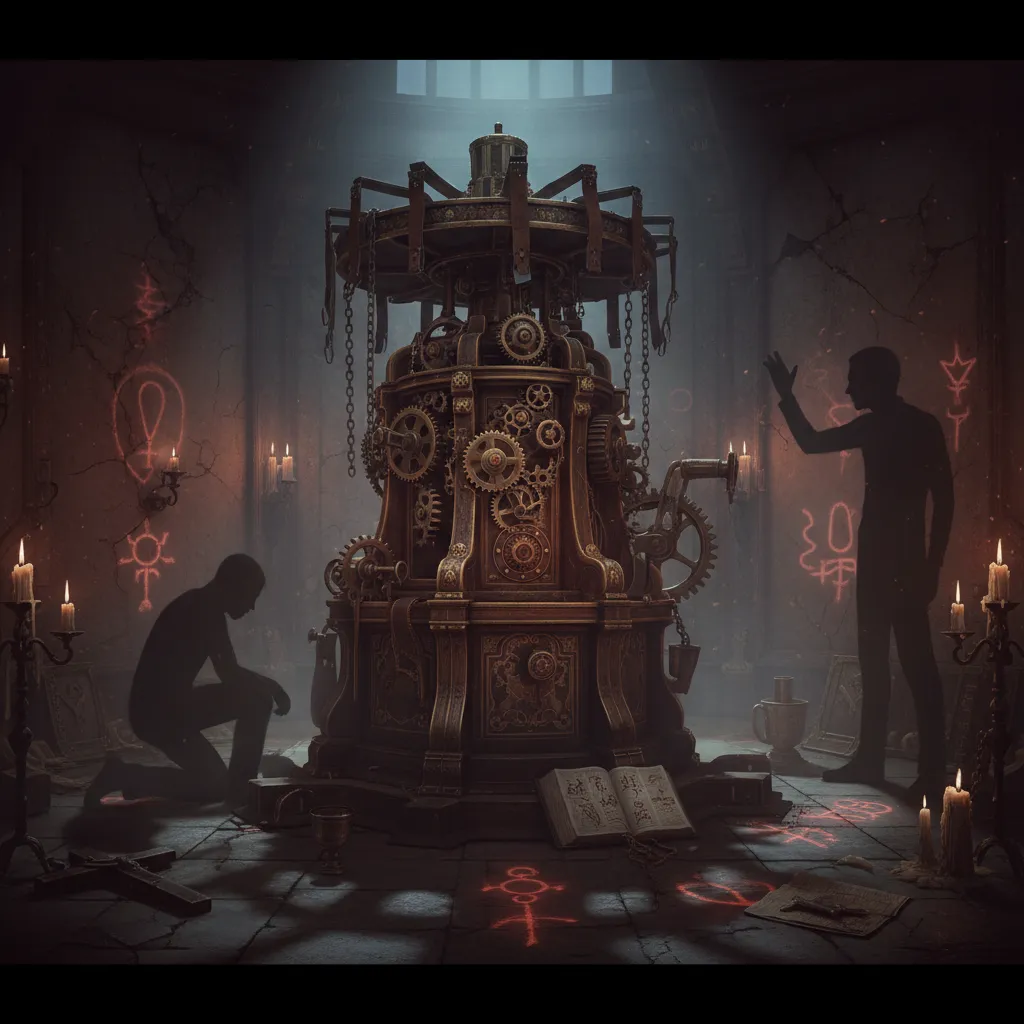
The moment the knee bends and the polished diamond catches the light, the Capitalist Axiom achieves its perfect, miniaturized instantiation: the creation of the domestic debt-machine. This is the schizo-fissure that occurs when the desiring-machine of the body is forcibly stratified by the Oedipal apparatus of marriage. The wedding band is not a symbol of eternity, but a technological inscription forcing the raw flow of desire back into the paranoiac production of the nuclear family—the bedrock unit for reproducing labor and debt. As Deleuze and Guattari argue, the "Abstract Machine of the social socius" operates through the "organization of the production of desire on the earth" (Deleuze & Guattari, 1983, p. 10). Marriage is that organization made rigid.
I. The Capture of the Flow and the Neurotic Assemblage
The initial euphoria—the kicked up feet in front of the TV—is the last, beautiful moment of Body-without-Organs (BwO) (Deleuze & Guattari, 1983) freedom, a brief, ungoverned flow of time and libido. When the thought of popping the question arrives, it is not love but the Abstract Machine sending an immediate, violent signal: capture the flow. The woman is not a beloved partner; she is, in the logic of the economy, the "cow or bull" whose purchase immediately terminates the libidinal nomadism of the male subject.
The man's choice to wed is the ultimate act of self-imposed Character Armor (Reich, 1949). The pre-marital life allowed for video game flows and flexible weekends. Marriage, however, demands the hardening of the subject into the Molar organization of the Husband, the designated provider whose defense mechanisms become structurally necessary to manage the debt and domestic labor—the very definition of the neurotic assemblage (Freud, 1923). This psychic and physical blockage is Reich’s character armor made manifest. As Reich defined the defense mechanism, "Character armor is the sum total of the chronic, specific ways in which an individual has restricted his original total mobility" (Reich, 1949, p. 144). The wedding contract is that restriction. This shift is not emotional; it is political. It is the full reterritorialization of the subject onto the Oedipal recording surface.
II. The Anti-Christ as the Failure of the Oedipal Reactor
Devil’s Due does not feature a monster from the abyss; it documents the Event (Badiou, 2005) that occurs when the schizo-flow violently rejects its Oedipal capture. The horror is not the pregnancy itself, but the fact that the desiring-machine has managed to produce something that is un-codable by the social system. The Anti-Christ fetus is the unrecuperable political rupture generated by the sheer pressure of trying to force infinite desire into the finite, debt-ridden, two-person unit.
The couple, now ontologically bound, experiences a profound ontological insecurity (Laing, 1960). Their previously "divided selves" attempted to merge through the brittle fiction of romance, only to find the institution of marriage produces a terror far greater than separation: forced co-existence. As Laing notes of the precarious subject, "The individual whose being is in question, who is ontologically insecure, may be quite unable to experience himself as a person in his own right" (Laing, 1960, p. 43). This insecurity forces the husband’s obsession with found footage: his desire to control the narrative—to film everything—is the final, desperate attempt by his Character Armor to force the terrifying molecular flows back into a Molar narrative that the Law can understand (Žižek, 2009). But the fetus, in its terrifying production, is already operating on a line of flight that is purely molecular.
It is a becoming-revolutionary act (Freire, 2000) that dissolves the family unit from the inside out, proving that the foundation of the bourgeois home is built on a lie. This is the obscene fantasy of the State made visible, whereby the institution compels its victims to participate in their own terror.
Ideology is not simply a 'false consciousness,' a lie that hides the real state of things; it is a reality which is itself conceived to perpetuate the 'lie' in question. (Žižek, 2009, p. 43)
The film’s entire narrative structure is itself ideological, attempting to pin the trauma on a supernatural entity rather than the foundational violence of the family unit itself.
III. The Final Deterritorialization
The true horror of the film is the moment the husband realizes that the machine he helped build—the family—is designed to consume him. His panic, his violent attempts to escape, are the final, futile movements of a subject whose will to power (Nietzsche, 1967) has been completely liquidated by the Abstract Machine of the marriage contract. The final tragedy is not the birth, but the realization that his freedom was not taken by a demon, but willingly exchanged for the neurotic safety of the bourgeois domestic life. Nietzsche understood this domestication as the termination of the living flow, arguing that the will often becomes a reaction: "The will to power is essentially the will to overcome" (Nietzsche, 1967). The husband’s will is overcome by the contract. The resulting chaos is the only possible outcome when two individuals sacrifice their entire BwO to the Capitalist Axiom.
The ultimate escape from this horror is not divorce, which is simply a second-order bureaucratic reterritorialization of debt, but the embrace of the molecular, nomadic existence that refuses all such political inscriptions.
Comments
Post a Comment