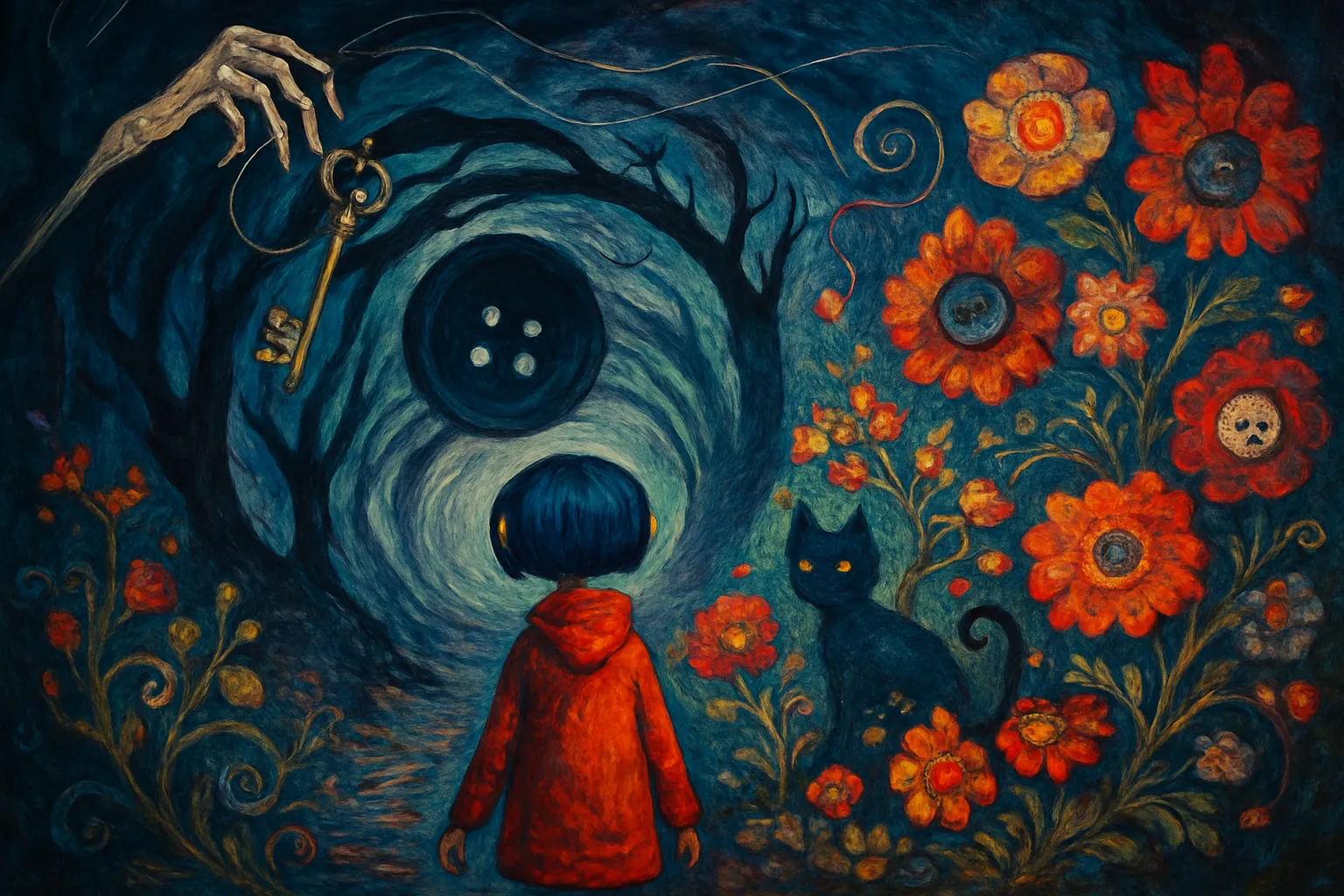
The childhood wish for absolute attention is the first signifier of capture, a narcissistic flow demanding a world machine that bends entirely to the needs of the lonely subject.
The House as the Oedipal Machine: Stratification and the Abject Flow
Coraline's initial reality, the Pink Palace Apartments, is not merely a setting of inconvenience but a perfectly realized model of the capitalist Socius in decay (Deleuze & Guattari, 1983). The parents, perpetually bent over their screens, are not neglecting Coraline out of malice, but because they have been perfectly integrated into the desiring-machine of alienated labor. Their creative labor (writing the garden book) is a desperate attempt to plug their own lack, a flow directed towards the distant, abstract Axiomatic of Capital, leaving zero energetic output for the child's affective needs.
The house itself is a physical manifestation of this stratification. It is drab, muddy, and plagued by poor upkeep—the architectural evidence of poverty's aesthetic, a place where the vibrant flows of childhood (imagination, play) are immediately met with the Real of the leaky roof and the swarm of bugs Coraline squishes with her hands. The house is an anti-BwO, a thoroughly striated space where desire is met with rejection, and the very ground is sticky with the residue of deferred maintenance.
The eccentric neighbors—Miss Spink, Miss Forcible, and Mr. Bobinsky—are not just quirky distractions; they are the molecular fragments of previous, failed lines of flight, now re-territorialized into harmless, repeatable performances. They perform past desire (Russian gymnastics, music hall theatrics) for an audience of one (Coraline) or none, their desire-machines now running on the lowest, most harmless current of memory. They represent the only "play" available in the stratified world: the simulacrum of art as domesticated hobby.
The Door, The Wall, and the Passage: The Colonoscopy of the Lacanian Lack
The small, locked door is the central rupture in the stratified field. Coraline’s initial encounter with the door and the brick wall is the perfect structural metaphor for the Lacanian Symbolic Order. The door is the signifier that promises access to the Other (the full, realized desire), but the brick wall is the immovable presence of the Law of the Father (Castration), the boundary that prohibits the realization of primal desire (Lacan, 2007). It says: You cannot have everything, you cannot be the center.
The parents’ rationalization—that the wall separates vertically-stacked apartments—is the ideological fantasy that attempts to suture this illogic with the Symbolic law of property and architecture. Coraline, the sharp-eyed schizo-subject, immediately rejects this cover story: "Why is the door small then?"
The mouse-flow, urging her to follow, is the momentary deterritorialization of the Symbolic Law, a brief, chaotic flow that opens the door again. What awaits is not the wall, but a "glowing rectal passageway" (Deleuze & Guattari, 1983). This passage is the Body without Organs (BwO)—the immediate, pre-Oedipal, unstratified field of pure intensity and flow. It is the schizo-flow that bypasses the Oedipal triangle entirely and leads not to cosmic liberation, but to the BwO of the Mother Machine.
The Other Mother and the BwO of Absolute Affirmation
The Other Mother (The Beldam) is the Ultimate Desiring-Machine—a being whose entire architecture is dedicated to the consumption and capture of the child's narcissistic desire. Her world is the pure Simulacrum (Baudrillard, 1994): a hyperreality that perfectly reflects Coraline’s wish. It is the perfect model of a caring, playful, and attentive family that has no referent in the Real.
The Other Mother is the synthesizer of the conjunctive flow (I want attention, I want play) and the disjunctive flow (This attention must be perfect, constant, and unconditional). She offers Coraline a temporary, perverse jouissance—the absolute pleasure of being the center of the universe, a brief, overwhelming return to the maternal womb of attention.
This perfection, however, is a trap:
"The essential trick of the ideology is to make us feel that we are free when we are slaves, to make us feel that we are the masters when we are subjects." (Žižek, 2008, p. 55, paraphrase).
The Other Mother is not the real parent; she is the Super-Ego's ultimate demand for pleasure made manifest, but at the cost of the subject’s autonomy. The moment Coraline notices the Other Mother’s fingers tapping impatiently, the Real pierces the fantasy. The flow of attention is not unconditional; it is productive. The Other Mother requires a return on investment—Coraline’s life force, her identity, and her eyes. The maternal desiring-machine is revealed to be running on the death drive (Freud, 1961), perpetually consuming and replacing its object (the children's souls).
The Button Eyes: The Gaze as the Apparatus of Capture
The Button Eyes are the most terrifying signifier of the film, operating on two distinct philosophical planes of capture.
Lacanian Capture: They eliminate the Gaze of the Lack. In the Symbolic Order, the subject is always incomplete, and desire is always fueled by a fundamental lack ($A \rightarrow S'$). Coraline's desire for attention is a desire to fill this lack. The button eyes eliminate the subject's capacity to see the lack in the Other (the flaw in the Mother) or the lack in the Self (her own incomplete state). By seeing only through the blind, shiny surface of the button, the subject is granted the illusion of total vision and full jouissance. It is a trade: subjective death for total perceptual presence (Lacan, 2007).
Schizoanalytic Capture: The buttons are the final re-territorialization of the child's subjectivity back onto the Other Mother's BwO. They turn the child into a passive component in the Mother’s consumption-machine.
"The eye is precisely a piece of the body without organs that has become an organ, a capture apparatus for the flow of light, but also a capturing apparatus for the flows of desire." (Deleuze & Guattari, 1983, p. 15, slightly modified).
The button eyes are the ultimate capture apparatus, making Coraline an anti-eye—a component that only reflects the Mother's light, incapable of deterritorialization or generating a line of flight of its own.
The Reluctant Revolutionary and the Ideological Recuperation
Coraline's final confrontation with the Other Mother is not the birth of a revolutionary subject, but the hysterical defense of the ego against its own dissolution. She is forced into action not by a political consciousness of collective oppression (like Gale in The Hunger Games), but by the extreme personal threat of losing her property (her parents) and her eyes (her identity).
The Other Mother's threat—holding the real parents hostage—is the perfect Oedipal trap. Coraline must regress from the search for the ideal mother and defend the real, flawed parents. This is the ideological function of the narrative: it forces the child to accept the poverty of her reality as a superior alternative to the excessive danger of the fantasy.
The film's ultimate lesson is the recuperation of the line of flight: be careful what you wish for. This instruction is a profound act of discipline (Foucault, 1995), teaching Coraline to self-regulate her own demanding, narcissistic flow of desire. She learns to discipline her wants to match the minimal capacity of her parents' attention.
The ending, where the real parents finally join Coraline to garden, is a moment of false synthesis—a fleeting, negotiated adjustment that leaves the Axiomatic of Capital perfectly intact. The parents are still wage-slaves; the house is still dreary. The minimal attention given is the negotiated settlement of the Oedipal machine, a small concession designed to prevent the next schizophrenic break. Coraline’s flow of desire has been successfully re-territorialized back onto the Family Unit, albeit a slightly modified, less aggressively neglectful one. She has internalized the lesson: desire for perfection leads to destruction; settle for the mediocre.
The film, in its totality, executes a profound piece of societal dream-work. The wish presented—the perfect, attentive family—is revealed to be a deadly threat, thus confirming the viewer’s existing, miserable reality as the lesser evil. The film doesn't critique the conditions of parental alienation (capitalism); it critiques the child's desire (narcissism), ensuring that the audience leaves with a renewed commitment to their sublime ideological object: the flawed, overworked family unit is still the best defense against the terrifying Other of the world. Coraline's journey is the failed becoming-revolutionary—a molecular escape that was violently captured and re-inserted, stronger than before, into the flow of the capitalist Socius.
APA References
Baudrillard, J. (1994). Simulacra and Simulation. (S. F. Glaser, Trans.). University of Michigan Press.
Deleuze, G., & Guattari, F. (1983). Anti-Oedipus: Capitalism and Schizophrenia. (R. Hurley, M. Seem, & H. R. Lane, Trans.). University of Minnesota Press.
Foucault, M. (1995). Discipline and Punish: The Birth of the Prison. (A. Sheridan, Trans.). Vintage Books.
Freud, S. (1961). Civilization and Its Discontents. (J. Strachey, Ed. and Trans.). W. W. Norton & Company.
Lacan, J. (2007). Écrits: The First Complete Edition in English. (B. Fink, Trans.). W. W. Norton & Company.
Žižek, S. (2008). Violence: Six Sideways Reflections. Picador.
Comments
Post a Comment