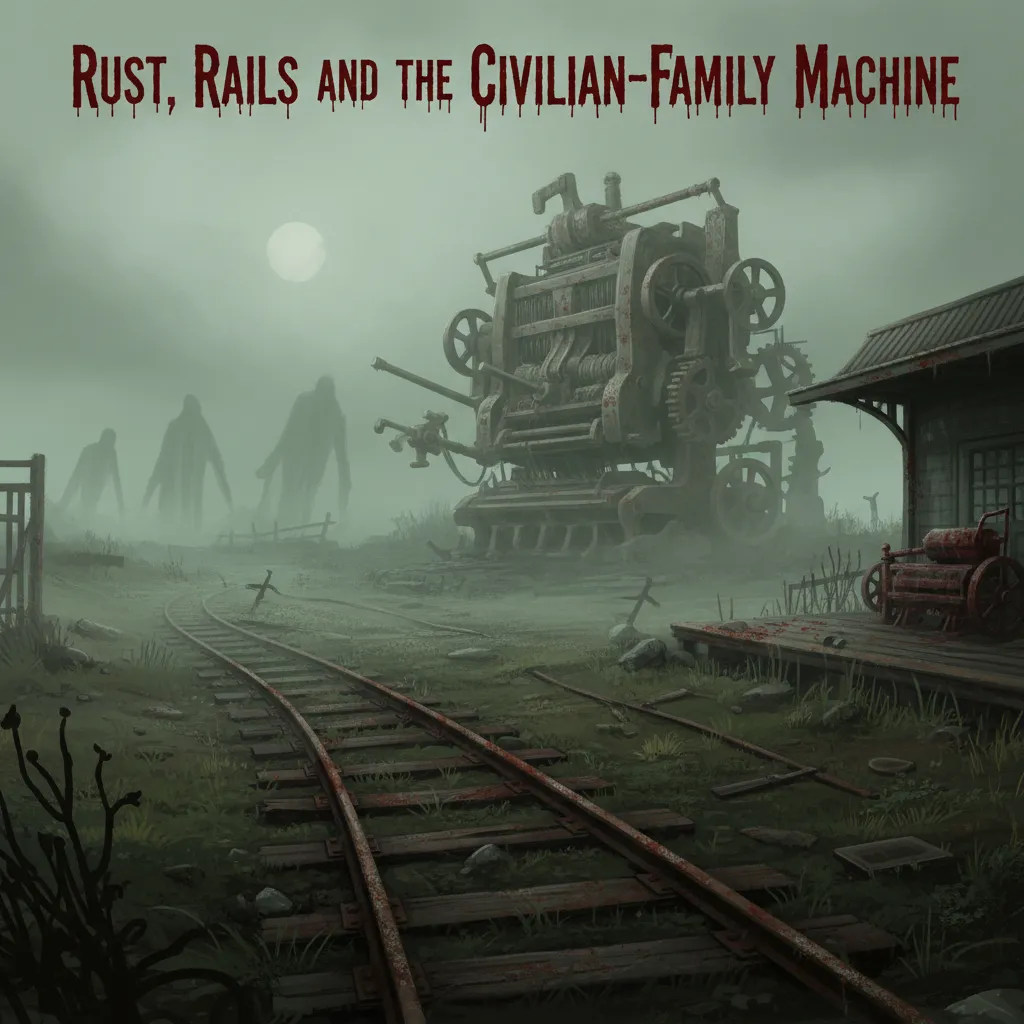
I’ll never forget the sound of my boots echoing down the hallway of my childhood home after Great Mistakes—each step a sharp reminder that war doesn’t end at the border. The real struggle began the day I was told, 'Go back to the loony bin!.' That phrase, is where my journey began: a quest to map the old machinery grinding beneath the cheery surface of domestic life.
The Civilian-Family Machine=
Returning to Belding
When I first came home to Belding, Michigan, the quiet was deafening. It wasn’t the absence of gunfire or the lack of orders barked across a base. It was the unspoken rules, the routines, the way everyone seemed to know their place at the dinner table and in the community. The expectation was clear: I was to step back into the role of son, husband, neighbor—no questions asked. The chaos of my war-self was to be filed away, hidden behind a smile. “In the eyes of my family, every scar needed to disappear behind a smile. I felt rusted shut.”
Defining the Civilian-Family Machine (C.F.M.)
The Civilian-Family Machine (C.F.M.) is not just a metaphor. It is an abstract machine—a system of routines, expectations, and silent agreements that shape daily life in rural Michigan. The C.F.M. demands simplicity and wholeness. It wants the returning veteran to fit back into the script of partner, father, or neighbor, as if nothing happened. This is not just about being polite or “moving on.” It is a subtle, but powerful, form of oppression in domestic settings. The C.F.M. does not tolerate fracture or difference. It wants the chaos of war to be contained, boxed up, and left at the edge of town.
In schizoanalytic terms, this is a process of reterritorialization. The war-self, with its unpredictable flows and breaks, is forced back into the old territory of family and routine. The Body without Organs—the part of us that resists being organized or defined—is pressed into a mold. The rusted rails of the old Silk Mill in Belding are a perfect image: rigid, worn, and unyielding, yet still holding everything in place.
Desiring-Machines and Social Libidinal Investments
Deleuze and Guattari’s concept of desiring-machines helps us see how these invisible forces work. Every family member, every neighbor, is part of a network of desires and investments. We want things to be smooth, predictable, safe. The C.F.M. is powered by these social libidinal investments—the energy we put into keeping things “normal.” But for the veteran, this demand for normalcy is not comforting. It is suffocating.
My own experience was shaped by these forces. I remember sitting at a family dinner, the conversation circling around the weather, the crops, the high school football team. No one asked about the war. No one wanted to hear about nightmares or the feeling of being split in two. The C.F.M. had drawn a boundary: “That’s just how we do things in Belding, Michigan.” The flow of my experience hit a wall. The machine contained my chaos, but at the cost of my authenticity.
Mapping the Invisible Boundaries
Routine as Control: The daily rituals—coffee at sunrise, church on Sunday, mowing the lawn—are not just habits. They are mechanisms of containment, keeping the unpredictable at bay.
Uniformity Over Difference: Any sign of fracture or trauma is quietly discouraged. The expectation is to “come back whole,” even when wholeness is impossible.
Silent Agreements: Family and community members invest in the idea that everything is fine. This collective denial is a form of social oppression, more binding than any military order.
Teaching the Core Concept
Schizoanalysis teaches us to look beneath the surface of domestic life. The Civilian-Family Machine is not just about love or support. It is a machine of control, powered by desiring-machines and libidinal investments. It demands that veterans suppress their war-selves and resume their old roles, no matter the cost. The rust on the old rails is not just decay—it is a sign of how long these boundaries have held, and how hard it is to break free.
To understand oppression in domestic settings, we must map these invisible forces. The C.F.M. is a machine that runs on routine, but it is also a site of struggle—a place where the flows of desire and the need for authenticity collide.
Rusty Rails, Rusted Selves
Walking past the old Silk Mill in Belding, Michigan, I always pause at the corroded iron gate. The rust eats away at the metal, leaving it pitted and brittle, but the structure still stands—rigid, unmoving, and strangely proud. For me, this gate is more than just a piece of industrial infrastructure; it’s a living metaphor for the boundaries that shape, confine, and sometimes corrode the self, especially for veterans returning to rural Michigan. The symbolism of industrial infrastructure is everywhere here, echoing the invisible social boundaries that define our daily lives.
When the Map No Longer Fits
In schizoanalysis, deterritorialization describes the process of losing place or stability. For veterans, this begins the moment we step off the plane from Afghanistan or Iraq. The familiar markers of military life—routine, camaraderie, purpose—are stripped away. Suddenly, the map we used to navigate our days no longer fits. Our identities, once welded to the machinery of war, begin to rust and flake, much like the Silk Mill’s gate. Trauma and memory become loose bolts and missing rails, making it hard to move forward smoothly.
Back in Belding, the Civilian-Family Machine (C.F.M.) kicks in. This is the local script, the set of cultural expectations Belding Michigan hands to every returning veteran: “Come back whole. Be a partner, a father, a neighbor. File away the chaos of war and resume your place.” But the war-self doesn’t fit neatly into these roles. The demand for uniformity is subtle but binding, a form of oppression more persistent than combat. The C.F.M. insists on coherence, on the impossible expectation that we can simply reassemble ourselves into the old mold.
This phrase—“That’s just how we do things in Belding, Michigan”—became a refrain. It was a domestic boundary, a rusted gate swung shut to contain my flow. My stories, my pain, my attempts to process trauma and memory, were quietly redirected. The message was clear: Don’t disrupt the local order. Don’t bring the war home.
Patchwork Selves and Local Scripts
But the process doesn’t end with deterritorialization. Reterritorialization is the patchwork work of assembling a new, socially acceptable self. In Belding, this means learning to speak in coded ways, hiding the jagged edges of experience, and performing the roles the community expects. The rusted rails of the Silk Mill become a symbol for this: old forms, still standing, still shaping movement, even as they decay.
Veteran experiences in rural Michigan are marked by this constant negotiation. We are asked to reterritorialize—to build a new self that fits the C.F.M. But the fit is never perfect. There are always gaps, places where the rust shows through. The pressure to conform to cultural expectations in Belding Michigan is intense, but the process is never complete. The war-self leaks out in dreams, in silences, in the way we flinch at sudden noises or avoid crowded rooms.
Friction, Isolation, and Lines of Flight
Sometimes, resisting these scripts leads to friction. Friends drift away. Family members grow silent. The community’s boundaries, like the Silk Mill’s gate, can be both protective and confining. Isolation sets in, and the veteran becomes a ghost in their own hometown. But there are also moments of creative escape—what schizoanalysis calls lines of flight. These are the moments when we refuse to be fully contained, when we find new ways to express ourselves, to connect, to move beyond the rusted rails.
Writing poetry about trauma and memory
Forming support groups outside the usual community structures
Redefining what it means to be “whole” in rural Michigan
The rusted infrastructure of Belding is not just a backdrop; it is an active force in shaping how we live and remember. Deterritorialization and reterritorialization are not just abstract concepts—they are the daily reality of trying to rebuild a self in a place that demands coherence but is itself marked by decay and change.
Teaching Moment: Schizoanalysis in Everyday Life
Understanding these processes helps us see how trauma and memory are not just personal struggles, but are shaped by the machines of control around us. The Civilian-Family Machine in Belding, Michigan, is a powerful force, but it is not absolute. By recognizing the rusted rails in our own lives, we can begin to find new paths—lines of flight—toward a more honest and open way of being.
Unmasking the Machines of Control (M.I.M. & P.T.M.)
To understand the hidden forces shaping life in rural Michigan, especially for veterans like me, we must learn to see the world through the lens of schizoanalysis concepts. This approach is not just theory—it’s a toolkit for survival and transformation. In Belding, Michigan, the landscape is dotted with rusted rails and the bones of old industry, but the real machinery of control runs deeper. I call these the Machines of Control: the Michigan Identity Machine (M.I.M.) and the Post-Trauma Machine (P.T.M.).
Defining the Machines: M.I.M. & P.T.M.
The M.I.M. is the silent engine that tells us what it means to be “from here.” It’s the voice behind, “That’s just how we do things in Belding, Michigan.” It insists on sameness, on fitting in, on never letting the chaos of war or difference leak into the neat rows of domestic life. The P.T.M. is its twin, the mechanism that tries to file away trauma, insisting the veteran must “come back whole”—to resume the script of partner, father, neighbor, as if nothing ever broke. Together, these machines create a containment grid, a network of expectations that can feel more binding than the battlefield itself.
Schizoanalysis teaches us to spot these machines not as literal engines, but as assemblages—networks of habits, routines, and silent agreements that keep us in line. The molar flows (big, obvious pressures) are easy to see: the town’s pride, the family’s hope for normalcy. But the molecular flows (tiny, everyday gestures) are subtler: the way a neighbor glances away from your limp, or the silence at the dinner table when nightmares surface. These flows and breakdowns map the invisible rails of the Civilian-Family Machine (C.F.M.), which demands that the “war-self” be tucked away, never disrupting the domestic script.
Breaking Cycles
Here’s where schizoanalysis becomes a tool, not just a theory. By tracing the flows—where desire, memory, and trauma move or get blocked—we can begin to see how the Machines of Control operate. The Body without Organs (BwO) is a key concept here: it’s the potential to break free from the prescribed roles, to let new forms of life and connection emerge. In my own life, I felt the C.F.M. clamp down every time I heard, “That’s just how we do things here.” It was a boundary, a line drawn to contain my flow, to keep the chaos of memory from leaking into the family home.
But schizoanalysis also shows us how to deterritorialize—to push back against these boundaries. Sometimes, it’s as simple as refusing to hide my limp, or as complex as making art from the fragments of memory. Art as schizoanalysis is not just expression; it’s a way to undo the hidden trauma woven into community life. When I paint, write, or even photograph the rusted rails of the old Silk Mill, I am both symptom and undoing—I am mapping the breakdowns and building new flows.
Wild Card
What if Belding’s Silk Mill had welcomed every “ruined” veteran to paint a mural on its gates? Imagine the gates covered not in rust, but in stories—each brushstroke a refusal of silence, each color a break in the containment grid. Trauma and memory would become public, shared, and transformed. Art as schizoanalysis would turn the site of constraint into a site of possibility, a living Body without Organs, always in motion.
A schizoanalytic eye can unearth the marvelous within the mundane, whether in rust or routine.
Schizoanalysis Project
This is the heart of the Schizoanalysis Project: to teach ourselves and our communities to see the machines, to trace the flows, and to break the cycles of domestic oppression. By naming the M.I.M. and P.T.M., by making art, by refusing the demand for wholeness, we reclaim our right to be unfinished, to be in process. In the end, schizoanalysis is not just about analysis—it’s about transformation. It’s about turning the rusted rails of routine into the wild, unpredictable lines of a life lived on our own terms.
TL;DR: Schizoanalysis helps unpack the unseen control mechanisms in rural family life, highlighting how returning veterans face unique, subtle, and deeply binding forms of oppression at home. By understanding the Civilian-Family Machine, we can finally start to break rusty chains and reimagine wholeness beyond conformity.
Comments
Post a Comment