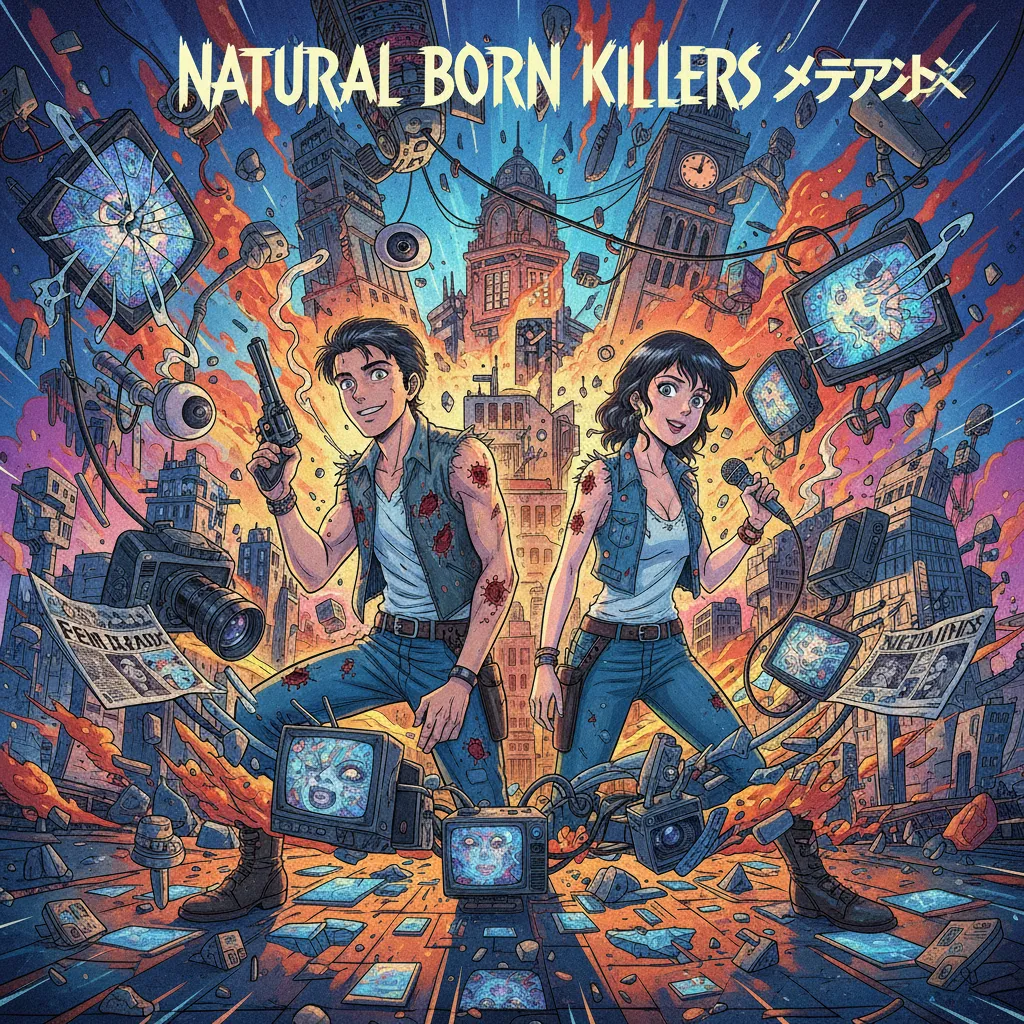
The first time I watched Natural Born Killers, I expected a Tarantino-esque romp—guns blazing, love on the run. But what I got was something far weirder. It felt like my own living room had grown teeth. The film didn’t just break the fourth wall; it chewed it up and spat it out. Most reviews talk about violence, but what got me was the way the movie sabotaged the ordinary, turning sitcom moments into existential dread. As someone who grew up with I Love Lucy reruns humming in the background, seeing that nostalgia weaponized gave me chills. Let’s dig into how this film sets out to scramble our wiring—and why, even decades later, it still feels dangerously alive.
Violent Detournement in Cinema
When I watched Natural Born Killers, the most unsettling moments weren’t the bursts of violence, but the jarring sitcom flashbacks—especially the I Love Lucy parody. Here, sitcom laughter becomes a weapon, not a comfort. This is a prime example of violent detournement in cinema: the rerouting of familiar cultural signs to expose and disrupt their hidden power. In this film, the sitcom format is hijacked and weaponized, turning the impact of sitcoms on social norms upside down.
The I Love Lucy sequence is not just a clever reference; it’s a direct Oedipal machine critique. The nuclear family, usually presented as the bedrock of order and safety, is revealed as a “despot-machine”—a system that can be rewired with any set of values, even those of abuse and violence. The sitcom’s laugh track, applause signs, and canned joy are exposed as tools that engineer our emotions, smoothing over horror with manufactured comfort. As director Oliver Stone put it:
“When television lies to you, it’s with a laugh track.”
By blending 1950s TV nostalgia with scenes of trauma and brutality, the film critiques the nuclear family in film and society. The sitcom cues—like laugh tracks and applause—are not neutral. They are part of a media apparatus that codes our responses, teaching us when to laugh, when to feel safe, and when to ignore suffering. In Natural Born Killers, these cues become sinister. The laughter that once signaled comfort now signals complicity, making us question our own emotional programming.
This is the essence of violent detournement in cinema: sitcom tropes are reprogrammed as tools for horror. The familiar living room set becomes a stage for abuse, and the father figure—a staple of the Oedipal machine—is exposed as a source of both physical and psychic violence. The boundaries between comfort and terror blur, showing how easily the codes of the sitcom can be rerouted to serve darker purposes.
Jarring flashbacks: The I Love Lucy parody uses sitcom laughter as a weapon, not a balm.
Destabilizing formats: By hijacking television’s familiar rhythms, the film destabilizes our expectations and exposes the artificiality of media-driven norms.
Nuclear family as despot-machine: Applause signs are replaced by screams, revealing the family as a switchboard for arbitrary, often violent, values.
Through these techniques, Natural Born Killers offers a powerful critique of the nuclear family in film and the broader machinery of media. The sitcom, once a symbol of stability, is revealed as a flexible code—one that can be easily twisted to justify or conceal violence. This is not just film theory and ideology in action; it’s a direct challenge to the myths that shape our sense of order and reality.
Desiring-Fragments and Despot-Machines
When I look at Mickey and Mallory in Natural Born Killers, I don’t see a modern Bonnie and Clyde. Instead, I see what Deleuze and Guattari might call desiring-fragments: unstable, partial objects shaped by the broken flows of a society that codes and recodes every aspect of life. Their actions are not simply the outbursts of individual pathology. Rather, they perform a living critique of the systems that produce and perpetuate violence. This is the heart of the Mickey and Mallory character study: they are not rebels against order, but symptoms of a deeper, foundational cruelty.
The desiring-fragment concept helps me understand Mickey and Mallory as more than just characters. They are not whole, coherent selves. Instead, they are assemblages of pain, media images, and repressed drives. Their spree is less about crime and more about a cleansing-ritual—an attempt to purge themselves, and maybe the world, of inherited psychic pain. The violence is not random; it is a desperate response to the despot-machine—the social and familial systems that perpetuate abuse through coded routines and rituals. The infamous “I Love Lucy” flashback is a perfect example: the sitcom’s laugh track and bright colors are violently detourned, exposing the family not as a safe haven, but as a primary site of trauma and control.
Mickey, in particular, is not a savior. As the film puts it,
“Mickey is not a savior, but a noble anti-heroic partial object.”
He embodies a repressed drive for what I call sympathy-flow. His awareness of Mallory’s suffering is not ordinary empathy. Instead, it is a kind of schizo-awareness—a mirror ball reflecting not just her pain, but his own implication in it. This is what I mean by Kantian-flux: Mickey recognizes that to do nothing is to become a passive cog in the abuse-machine. His actions are not heroic, but they are clear-eyed. He sees the oppressors not as individuals, but as flows of evil that must be stopped, even if the means are monstrous.
The despot-machine theory is crucial here. The film suggests that the real villain is not Mickey or Mallory, but the social body—the socius—that allows suffering to continue. The couple’s rampage is a kind of existential question posed to the audience: Is existence just absurd, or is it intentionally cruel? Their answer is not to advocate violence, but to expose the world’s complicity. In this way, their spree becomes a molecular purge, a rejection of the “blight” of passive compliance.
Through schizo-awareness in film, Natural Born Killers shows us that our basic humanness is a product of images and flows manipulated by mass media. Mickey and Mallory’s journey is not about rebellion, but about revealing the machinery that codes our feelings, our pity, and even our sense of reality. Their violence is a symptom, not a solution—a desperate attempt to break the circuits of the despot-machine that keeps us all in line.
Media Influence and Vicarious-Injection
When I watch Natural Born Killers, I’m struck by how the film doesn’t just show violence—it throws it back at us, the viewers. The spectacle isn’t contained on the screen; it leaps out, forcing us to question our own role in the cycle of media influence on society. The film’s wild, chaotic style is not just a creative choice. It’s a direct challenge to how we consume media, and how media, in turn, consumes us.
In Natural Born Killers, the media is more than a background force. It’s a machine that codes our feelings, dictating what we should fear, pity, or desire. The news anchor, the sitcom laugh track, and the sensational headlines all work together to engineer our emotional responses. This is not accidental. As the film shows, pain and pity are staged for profit. We keep buying into it, tuning in for the next emotional fix. The film’s critique is clear: the media doesn’t just represent violence—it structures how we participate in and respond to it.
The Emotional Fix
One of the most disturbing ideas in my Natural Born Killers review is the concept of vicarious-injection. This is the process by which we, as viewers, are pulled into cycles of emotion and spectacle. We feel the thrill, the fear, and the pity—not because we are directly involved, but because the media injects these feelings into us. The film suggests that our humanness is not a pure, untouched core. Instead, it’s shaped, commodified, and sustained by the media machine.
Pity and suffering become the synaptic-triggers that make us feel alive, and we stay tuned for the emotional-fix that keeps the media-machine running.
This quote from the film’s analysis captures the heart of vicarious-injection media consumption. We don’t just watch violence—we become emotionally invested in it. Our reactions are not entirely our own; they are engineered by the codes and cues of the media apparatus. The laughter in a sitcom, the horror in a news report, or the empathy in a tragic story are all carefully staged. Our bodies respond on cue, reinforcing the spectacle and ensuring its continuance.
Are We Co-Conspirators?
This raises a troubling question: are we the real audience, or the next targets? Natural Born Killers blurs the boundary. By thrilling in the spectacle, we become part of the machine. Our engagement fuels the spectacle, making us co-conspirators in the cycle of violence and profit. The film’s media influence on society is not passive. We are implicated, our feelings and attention harvested as resources.
The spectacle is not just in the film—it implicates our own viewing habits.
Media codes dictate feeling: pain and pity are staged for profit, and we keep buying.
Vicarious-injection means our thrill comes from watching, not doing—making us part of the cycle.
In the end, Natural Born Killers forces us to confront the uncomfortable truth that our humanness is a product of the media machine—shaped, commodified, and endlessly recycled for the next emotional fix.
The Existential Crash
Imagining Mickey and Mallory as therapists rather than killers is more than a playful exercise—it’s a way to test the boundaries of Natural Born Killers and its existential themes. The film’s power lies in how it forces us to confront our complicity, agency, and the meaning we assign to violence and healing. If the couple’s infamous cleansing-ritual symbolism was inverted—if their acts of destruction became acts of creative intervention—would they disrupt society’s wounds, or simply reinforce them in a new guise?
In the film, Mickey and Mallory’s violence is a response to a world structured by cruelty and absurdity. Their rampage is not just a spree, but a schizoanalytic rejection of the despot-machine: the social systems and media flows that perpetuate abuse and suffering. As killers, they deterritorialize the world, exposing the arbitrary codes that keep the machinery of order running. But what if, instead of murder, their ritual was one of healing? What if their war machine was a therapy machine?
As therapists, Mickey and Mallory would still be agents of disruption. Their methods—unorthodox, perhaps even shocking—could expose the same existential questions that the film raises. Would they help people break free from the Oedipalized flows of family trauma and media conditioning? Or would their “therapy” become another apparatus of control, another sitcom-machine that promises healing but only perpetuates the wound? The existential themes in Natural Born Killers—questions of cruelty, absurdity, and the nature of choice—would remain. The cleansing-ritual would shift from bloodshed to the psychic violence of confronting one’s own complicity and the constructed nature of reality.
This hypothetical flips the lens on the film’s critique, showing its ongoing relevance in our current media landscape. Today, therapy and self-help are often commodified, packaged as solutions to suffering while leaving the underlying despot-machine untouched. If Mickey and Mallory were therapists, would they offer true liberation—or simply a new form of vicarious-injection, a way to feel alive through the spectacle of healing? The existential crash is not avoided; it is merely rerouted. Detachment in the face of totalizing media remains as elusive as ever. The couple’s actions, whether violent or therapeutic, still pose the same existential-schizo question: is it possible to escape a world structured to rob us of substance, or are we forever sutured to its flows?
In the end, Natural Born Killers shreds the myth of order by revealing how easily the codes of violence and healing can be swapped. The desiring-fragment at the heart of the film is not inherently destructive or redemptive—it is a force that can be turned toward any ritual, any flow. Whether as killers or therapists, Mickey and Mallory force us to confront the boundaries between destruction and creation, complicity and agency, and the existential themes that define our place in the spectacle. The choice, as always, is ours—but the crash is inevitable.
TL;DR: Natural Born Killers isn’t just a film about violence—it’s a wild, prophetic mash-up showing how media codes, distorts, and reprograms our sense of reality and self. If you think you’re safe on your sofa, think again.
Comments
Post a Comment