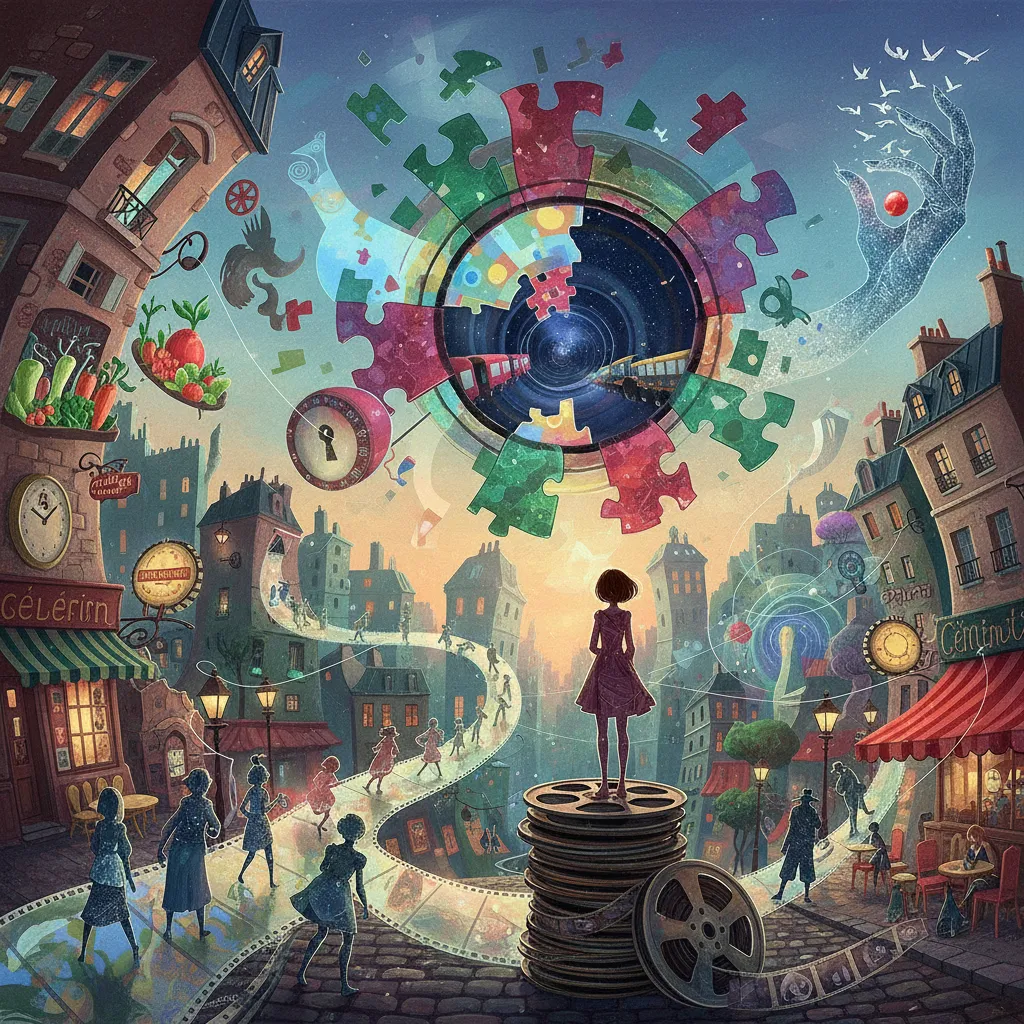
I first saw Amélie in a cramped indie theater, squashed between two people I'd never met—each of whom, weirdly, would play minor roles in my life later on. I'd come for the picturesque Paris, but what struck me instead was the sense of feverish invention: every shot scrambled my expectations, every gesture felt like a coded transmission straight from the subconscious. This wasn’t a movie about quirky romance. It was something stranger—a story of desire breaking its own rules, sneaking sideways through a labyrinth of schematics I hadn’t learned to read. What happens when love isn’t a feeling, but an entire system?
Why Amélie?
Schizoanalytic film theory is less about interpreting what a film “means” and more about experiencing what it does—how it moves, pulses, and erupts across the body and mind. If traditional psychoanalysis is the Freudian couch, schizoanalysis is the fever dream: a method that tracks the flows, blockages, and eruptions of desire as they unfold onscreen. For Deleuzian film theorists, cinema is not a mirror but a machine, a site of production. As Patricia MacCormack puts it,
“Cinema is not a window, it’s a factory: it produces worlds, not just reflections.”
This is why Amélie (2001) is so vital for schizoanalysis as method. The film is not a simple romance but a living map of desiring-production—a cartography of how desire forms, fragments, and recombines. From the opening montage, we are thrown into a world of micro-events: a bluebottle fly’s erratic flight, the clink of glasses, the erasure of a name from a notebook. These are not just quirky details; they are detonations, each one a tiny schizoanalytic explosion that sets the desiring-machine into motion. The film’s fragmented, non-linear style is itself a schizoanalytic gesture, refusing the comfort of narrative unity in favor of a nomadic-assemblage of sensations and affects.
Amélie Poulain is not a character in the conventional sense; she is a machinic subject, a desiring-machine built from partial objects and affective flows. Her quirks are not answers but productions—outputs of a system always in flux. The schizoanalytic approach asks: how does Amélie feel her own story? Where, in her “Body-without-Organs,” does the eruption of desire register? Raised in a home of anti-production—her father’s emotional distance, her mother’s anxiety—Amélie internalizes a fragile, neurotic circuit. Her attempts at connection are always indirect, machinic orchestrations rather than direct encounters. She creates elaborate games and puzzles, constructing a desiring-territory where intimacy is possible only through mediation.
This focus on micro-events resonates with my own experiments. I once tried to keep a diary using only lists and diagrams, avoiding narrative or explanation. It failed as a record of my life, but it revealed how the tiniest details—an image, a gesture, a fleeting sensation—can become the real engines of memory and desire. In Amélie, the small stuff is the big stuff: the montage of objects and actions is not background, but the very substance of the desiring-machine.
Schizoanalytic film theory foregrounds this bodily, affective response. It is not about decoding symbols, but about tracing how the film’s assemblages—its rhythms, its interruptions, its sudden surges—move us, sometimes before we even know why. Amélie’s montage is a diagram of schizogenesis, the process by which new forms of subjectivity and connection emerge from the interplay of fragments. The film’s love story is not a solution but a question: how can two desiring-machines, each fractured and incomplete, construct a shared territory without collapsing into sameness or stasis?
In this way, Amélie becomes the perfect case for schizoanalysis as method: a film that does not just tell a story, but produces a world—a world built from the unpredictable, the partial, and the eruptive flows of desire itself.
Machinic-Orchestration, Anti-Production, and the Eruption of Desire
When I first encountered Amélie, I was struck by how desire in the film never travels in a straight line. Instead, it is orchestrated through a series of playful detours, indirect gestures, and elaborate games. This is what Deleuze and Guattari call machinic-orchestration: the process by which desire in cinema is not simply expressed, but constructed through a network of signs, objects, and actions. In Amélie, the orchestration is everywhere—hidden notes, scavenger hunts, and coded messages. Each gesture is a part of a larger machine, a system that produces desire not by direct pursuit, but by creative, circuitous routes.
So, what exactly is machinic-orchestration? It is the way desire is mapped onto a series of interconnected actions and objects, rather than being a straightforward, linear drive toward satisfaction. In the film, Amélie’s affection for Nino is never confessed outright. Instead, it is filtered through a dazzling array of indirect circuits: torn photographs, riddles, and mysterious clues. These are not just quirky plot devices; they are the very mechanisms by which desire is produced and sustained. As Deleuze famously said,
‘Desire always makes a detour—it never travels in a straight line.’
This brings us to the concept of anti-production. In schizoanalysis, anti-production refers to the self-imposed blocks or interruptions that prevent desire from reaching its object directly. Amélie is a master of anti-production. Her avoidance of direct contact with Nino—her refusal to simply say what she feels—freezes the desiring-circuit. Instead of a direct confession, we get a series of creative, indirect acts of seduction. The result is a quirky, catch-and-release dynamic: desire is detonated only when filtered through elaborate signs and playful detours. This is not a failure of connection, but a deliberate strategy—a way of keeping desire alive by refusing its simple satisfaction.
This dynamic echoes the concept of deterritorialisation in cinema. Amélie and Nino break away from fixed codes of romantic pursuit, inventing new patterns of desire that are unique to their world. Their relationship is a nomadic assemblage, always on the move, never settling into a predictable routine. The soundtrack itself—Yann Tiersen’s whimsical melodies—becomes a kind of desiring-circuit, revealing the inner workings of each character’s emotional machine. I often wonder: if everyone’s desire could be heard as a soundtrack, would it sound like a delicate waltz or a tangled synth jam gone haywire?
On a personal note, I once tried to confess my feelings to someone through an absurd scavenger hunt. I left clues in books, slipped notes into coat pockets, and even recruited friends as accomplices. In the end, all I had to show for it was a checkout receipt and two allies-for-life. The direct circuit was blocked, but the detour created its own kind of magic—a small eruption of desire, refracted through the machinery of play.
In Amélie, machinic-orchestration and anti-production are not obstacles to love; they are the very engines of its creation. Desire in cinema, as in life, is always a matter of detours, of finding new ways to connect across the unpredictable terrain of the Real.
Desiring-Territories and the Shared Fantasy Machine
When I watch Amélie, I see more than a quirky romance—I see a living map of desire, a fragmented narrative where love is not a destination but a machinic-orchestration. Amélie and Nino do not simply “fall in love”; they construct what schizoanalysis calls a desiring-territory: an emergent, aesthetic space built through signs, riddles, and shared secrets. Their connection is not a settled unity but a continually renegotiated territory, a shared fantasy-machine assembled from torn photographs, cryptic messages, and the playful exchange of clues.
This territory is not about merging into one, but about creating a protective zone against the chaos of the world. The fantasy they build together is less about “becoming a couple” and more about inventing a collaborative shelter—a kind of psychic architecture. Each message left in a photo booth, every orchestrated encounter, is a brick in this construction. The machinic-orchestration of their romance is what keeps them moving forward, not toward fusion, but toward the ongoing invention of new ways to connect.
‘A couple is not a fusion of two subjects, but a construction in the face of the void.’ – Alain Badiou
Badiou’s idea of love as an “event” is recoded through schizoanalysis here. The “event” is not a single moment, but a process: the encounter, the creation, the negotiation. Amélie and Nino’s shared world is not a fixed thing—it is a living, breathing assemblage, always at risk of collapse, always being rebuilt. The traditional romance collapses, but this is not failure. Instead, it becomes the raw material for new assemblies of love. The couple survives not by becoming one, but by inventing and adapting together, day after day.
How the Shared Fantasy Machine Works
Torn Photographs: Each piece is a fragment of desire, a signifier that must be decoded and reassembled by the other.
Riddles and Clues: The playful exchange of puzzles is a way to test and reinforce the boundaries of their shared territory.
Shared Secrets: The intimacy of hidden knowledge creates a membrane of fidelity, a protective layer against the void.
In this way, the exploration of desire in Amélie is not about the final union, but about the process of building and maintaining a desiring-territory. The couple’s survival depends on their ability to adapt their creation to the unpredictable interventions of the Real—moments of misunderstanding, fear, or loss. The shared fantasy-machine is always provisional, always in flux.
What if cinema itself offered us toolkits for building our own desiring-territories? Amélie becomes more than a story—it is a construction guide, a set of blueprints for assembling new forms of connection. The film’s fragmented narrative is not a flaw, but a feature: it mirrors the way we must continually invent and re-invent the machines of our own desire.
Victory Through Invention
In Amélie, romance is not a stable structure but a restless process of invention. Through the lens of schizoanalytic film theory, the film’s love story is not about finding the perfect match or resolving difference. Instead, it’s about the ongoing, everyday work of creating connection—what Deleuze might call a “machine of invention.” This is the heart of deterritorialisation in cinema: the refusal to let desire settle into cliché or certainty. Amélie and Nino do not follow a pre-written script; they sidestep the usual cinematic tropes by constantly reinventing the terms of their relationship. Their romance is a nomadic-assemblage, always moving, always adapting, never quite landing on a final meaning.
This exploration of desire is what makes Amélie so enduring. The film’s micro-events—the torn photos, the mysterious clues, the glances exchanged in passing—are not just quirky details. They are the very substance of a desiring-territory, a shared psychic space built not on grand gestures but on the accumulation of small, inventive acts. Schizoanalysis helps us see that these moments are not detours from the main story; they are the story. The “victory” of Amélie and Nino is not in achieving a tidy resolution, but in their ability to survive the randomness of encounter by inventing new ways to connect, day after day. As Deleuze writes,
‘To love is to become a machine of invention—daily, awkwardly, uniquely.’
Since watching Amélie, I find myself thinking about the odd, unfinished moments that link people together: an accidental brush of hands, a cryptic smile, an unfinished sentence. These are not just cinematic flourishes; they are reminders that meaning in both cinema and life is always on the move. The more we try to pin it down, the more it wriggles away. Schizoanalytic film theory teaches us to embrace this instability, to see every love story—no matter how familiar—as a fresh experiment in invention and adaptation. This approach is not just for “weird” films; it can make even the most conventional romances feel new, alive with the possibility of rupture and sensation.
Ultimately, Amélie shows us that love, like cinema, is less about closure and more about the power of adaptation. The couple’s fidelity is not a static achievement, but a daily act of creative resistance against the forces that would reduce their connection to a formula. Their extended victory is the random encounter, defeated and reinvented through the construction of a shared world. In this way, deterritorialisation in cinema becomes a celebration of sensation, rupture, and the aesthetic experience of desire—a reminder that invention, not certainty, is the true engine of both cinematic and romantic connection.
TL;DR: Amélie, through the lens of schizoanalysis, isn’t a standard love story but an experiment in desire, connection, and non-linear cinematic experience—offering film lovers a chance to question how cinema produces not just meaning, but sensation itself.
Comments
Post a Comment